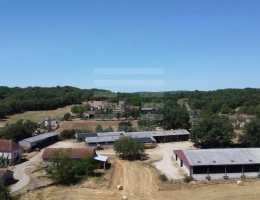
In the Quercy, poultry has long belonged to the farming landscape, and a poultry farm for sale in Lot often takes the shape of a farm-based fattened-duck unit: free-range poultry reared on grass ranges, a force-feeding room, a processing workshop and a canning room. Next come the broiler farm buildings — chickens, guinea fowl, sometimes turkeys — and a handful of units of laying hens selling table eggs at market. These holdings reach us from farmers arranging their handover, from rural property professionals and from notaries, with the buildings, the flock and the sales channels described. They round out the record of poultry farms for sale across France.
This page goes past the listings: what land is worth in the department, where handovers cluster, how to read buildings that are sometimes old, and the health and administrative duties falling on a buyer. If your plan involves setting up, our white paper « Créer une exploitation agricole » (in French) takes the stages one by one, from the agricultural qualification to the funding plan.
Land remains the largest item when buying a poultry farm. According to sales recorded by the French tax administration (DVF, vineyards excluded), the median price of agricultural land in Lot (46) stood at €5,500/ha in 2025, with an average of €6,345/ha across 43 sales; 80% of transactions fall between €3,399 and €9,880/ha, against a national median of €5,307/ha.
The SAFER benchmark of land values (2025 figures) puts vacant land and pasture at €5,590/ha (-1.1% year on year, -0.4% over ten years), against a national average of €6,460/ha; land already let sells around 17% lower.
On a holding here, value shows mainly in the tool and in the outlet. What counts is the condition of the houses and range shelters, the ventilation and silos, but also the force-feeding room, the cold stores and the approved workshop, along with the flock at the time of sale. Add the goodwill — market custom, shops, mail orders — and, for a contracted unit, the strength of the producer group collecting the batches. To place all of this, open our land price observatory and our financial calculators.
A duck holding is visited in three stages: the rearing houses and range shelters, the force-feeding room with its ventilation and washable floor, then the workshop where birds are drawn, cooked and packed. Each link has its own requirements: health approval or a direct-supply exemption, autoclaves, chilled and frozen stores, water treatment and disposal of animal by-products. On a chicken farm building meant for table birds, the inspection turns instead to the frame, the insulation, the ventilation, the feed line, the floor and the entry room, and to whether a full clean-out period can be kept between batches.
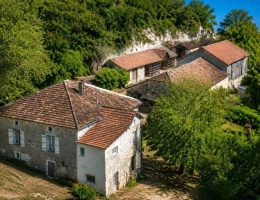
Upgrading work already done, or still to come, explains much of the gap between two otherwise comparable holdings. Ask for the date of the last works, the inspection reports and, where one exists, the registration file under the classified installations regime. Many sales cover a complete Quercy farmstead with a stone house, barns and land: have the dwelling, the farm buildings, the machinery and the parcels valued separately, because a single overall figure often hides a house priced high at the expense of the working tool.
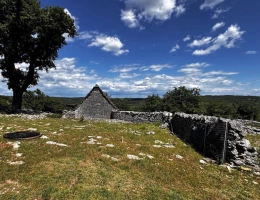
Duck units are found mostly in the north and east of the department: the Bouriane around Gourdon, the Limargue and the Ségala towards Lacapelle-Marival and Figeac, and the edges of the Dordogne valley near Souillac and Saint-Céré, where farms readily combine poultry, cattle and forage crops. On the causses of the Quercy, between Gramat and Labastide-Murat, units are more scattered and often backed by a sheep flock; land stays more affordable there, but water supply and access deserve attention. The Quercy Blanc and the slopes near Cahors mix vines, arable land and small units.
Demand comes from two very different profiles: new entrants looking for a complete, workable production tool, and buyers drawn by the setting, who are really after the house and the land. That competition lifts prices in the tourist areas near the Dordogne, while the most affordable handovers appear inland, away from the busiest valleys.
Duck units have been placed at the forefront of avian influenza prevention: possible indoor housing, stocking densities, fenced ranges, separation of batches and an up-to-date flock register. A buyer asks for the biosecurity plan, the latest veterinary visits and the health history of the site. Depending on flock size and husbandry, the unit falls under declaration, registration or authorisation as a classified installation, and a change of operator must be notified to the prefecture. An old prefectural order may carry requirements that have become restrictive for any extension.
The processing side brings its own checks: validity of the approval, the food safety management plan, compliance of the premises and disposal of animal by-products. On land, part of the parcels is usually rented; the lease follows the holding provided the landlord accepts the incoming farmer, and the sale then passes the structures control, the French authorisation regime for farmland, and SAFER. Finally, where the output carries a protected geographical indication, check that the incoming farmer can be approved in turn.
What you will find here is put on the market by private sellers, by rural estate agencies and by notarial offices. Narrow the selection by area, by budget or by type of production, from a farm unit with its own processing workshop to a small egg farm, then switch on an alert to follow new entries. You can also stretch the search to the poultry farms for sale in Occitanie.