Buying an arable farm for sale in Seine-Maritime usually means settling on the Caux plateau, where deep wind-blown loess carries wheat, barley, oilseed rape, sugar beet and textile flax within a short haul of the grain terminals at Rouen. What comes online is put forward by farmers arranging their exit, by rural property firms and by notarial offices in Yvetot, Dieppe or Neufchâtel-en-Bray; the particulars set out the rotation practised, the split between owned and rented ground, the storage fitted and the machinery included. Read them against the arable farms for sale listed across every French region.
Beyond the listings, this page gathers the land values recorded in the department, the districts where handovers cluster, pointers for judging a Caux farmstead, its grain bins and its turning area, and the checks specific to a Norman cereal farm. Once the plan reaches its costed stage, our white paper « Créer une exploitation agricole » (in French) walks through the setting-up route.
Pricing the land comes first in any plan to buy an arable farm. On the basis of 2025 DVF sales (vineyards excluded), the median in Seine-Maritime (76) works out at €11,543/ha and the average at €12,013/ha, across 209 transactions. The central range covering 80% of sales runs from €7,594 to €17,090/ha; nationally the median is €5,307/ha.
The SAFER benchmark, the market's second yardstick, gives €11,600/ha in 2025 for vacant land and pasture (-0.3% over twelve months, +23.3% over ten years), beside a national €6,460/ha; tenanted land is worth about 17% less.
For a comparable acreage, the gap between two files lies elsewhere: depth and agronomic potential of the loess, how tightly the blocks sit around the yard, the state of the drains on the wetter Bray ground, storage volume and bin ventilation, the age of the combine and the cultivation kit, transferable basic payment entitlements, beet or flax contracts, the commitment given to a cooperative or a grain merchant. To frame your own offer, turn to our land price observatory and our financial calculators.
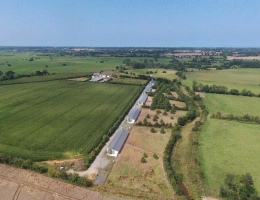
The blanket of loess covering the plateau gives deep, easily worked land with a generous water reserve, which is why rotations run longer here than elsewhere: soft wheat, barley and oilseed rape sit alongside sugar beet, textile flax, potatoes and sometimes protein crops. That same loess caps over and runs off readily, so ask for soil analyses, harvest results block by block, and the record of cover crops, earth banks and buffer ponds. In the Bray depression, clays and waterlogged ground change the picture entirely and make the condition of the drainage decisive.
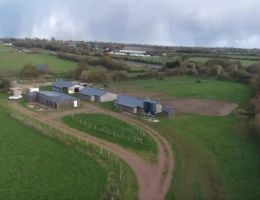
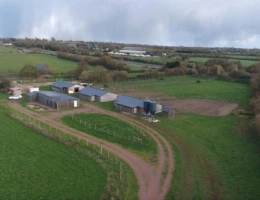
Caux farmsteads are recognisable by their planted courtyard, a belt of beech and earth banks sheltering barns of flint, brick or timber frame, usually with steel sheds added. Look at the roof structure and covering, the load-bearing slab, articulated-lorry access, the number of bins and, where fitted, the drier. A grain farm able to hold its own harvest picks its selling windows instead of taking what the intake queue offers. The dwelling, often a fine one, is valued apart from the productive tool.
The cropping heartland covers the wide plateau running from Yvetot to Doudeville, Saint-Valery-en-Caux, Cany-Barville and Totès: reorganised field blocks, large holdings, neighbours watching for any chance to expand, and keen competition whenever a unit is released. Towards Eu, Blangy-sur-Bresle and the Petit-Caux, arable land stays plentiful but sits further from the main collection points. The pays de Bray, around Forges-les-Eaux, Neufchâtel-en-Bray and Gournay, remains grass and dairy country where cropping supports the herd. South, between Caudebec and the Seine meanders, pressure from Rouen weighs on the market.
Those contrasts show up in budgets: a few dozen kilometres separate hotly contested plains from districts where an incoming buyer keeps genuine room to bargain. Gauge too the run to the silo, the flax scutching mill or the sugar factory taking your deliveries: with bulky crops, harvest logistics count for as much as a point of yield, and scattered blocks are paid for every year in fuel and tractor hours.
A takeover requires authorisation under the structures control, the prefectural regime governing new entrants and farm expansion, and SAFER, the rural land agency, may pre-empt as soon as the notary notifies it of the sale. Go through each rural lease on its own: remaining term, rent level, environmental undertakings signed up to, the pre-emption right the sitting tenant enjoys. In a department with many farming companies, establish whether the handover transfers assets or shares, since the tax treatment and the warranties sought differ completely. Beet and flax contracts follow transfer rules of their own.
Then check the transfer of basic payment entitlements and the CAP declarations under way, followed by the water constraints: the chalk beneath the Caux is riddled with swallow holes that take surface water straight to the aquifer, which explains the catchment protection perimeters, the designated supply areas and the erosion control programmes. Grass strips, hedges and soft hydraulic works may be imposed. Finish with the fuel tanks, the crop-protection store and the electrical installation.
Retiring owners, rural property agencies and Norman notaries feed this page as their mandates arrive. Whether you are after a complete unit or a crop farm without a dwelling, narrow by area, budget or district, create an alert so you hear as soon as a matching property goes online, and take the search on to the arable farms for sale in Normandy.