

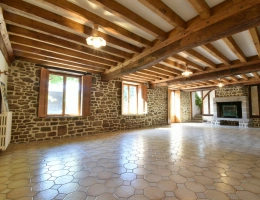
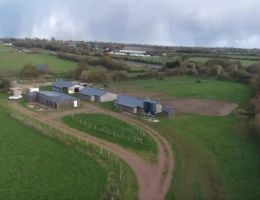
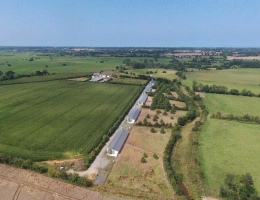
The farms for sale in Seine-Maritime nearly always belong to one of the two farming worlds that share the department: the loams of the pays de Caux, where high-value rotations feed industrial supply chains, and the grassland of the pays de Bray, where milk and cheese rule. Between them the Seine valley and the coast add constraints of their own. The market is tight: few complete units, a great deal of enlargement between neighbours, and land that only comes out on a retirement or a succession. Instructions reach us from farmers handing over, from notaries, rural agencies and succession firms. They set out the worked area, the nature of the loam, the crop contracts attached, the state of the walled farmstead and of the sheds. This double market shows up in our national survey of farms for sale in France, drawn up department by department.
Deciding takes more than a list: the sections below show where land values stand in Caux and in Bray, which productions make the income, which districts release property, and which checks condition a purchase. A plan not yet finalised will find in our white paper « Créer une exploitation agricole » (in French) the legal framework, the funding and the sequence of formalities.
Land forms the base of a farm's value. DVF, the property sales database published by the French tax administration (vineyards excluded), records a 2025 median of €11,543 per hectare in Seine-Maritime (76), an average of €12,013 and 209 sales; four transactions in five fall between €7,594 and €17,090, against a national median of €5,307.
The SAFER land value benchmark sets €11,600 per hectare for vacant land and pasture offered for sale in the same year, -0.3% over one year and +23.3% over ten, against €6,460 nationally. Land sold with a tenancy in place is valued at €10,610, a discount of about 9%.
Against the Normandie region, whose median is €8,305 per hectare, this department sits 39% higher. For commune-level detail and comparisons with neighbouring areas, see our land price observatory, then cost your purchase with our financial calculators.
On the Caux plateau, arable holdings run rotations where textile flax, sugar beet and potatoes sit between wheat and oilseed rape: crops demanding in labour, in specific machinery and in contracts, which explains the level of local land values. The pays de Bray answers to another logic entirely, that of grass-based dairy holdings and a long-standing appellation cheese. In between, mixed farming survives on the margins, and poultry units supplement the income of some holdings.
Buying in Caux therefore means buying a place in contracted supply chains as much as a block of land: ask what follows the property — delivery commitments, co-operative shares, specialised machinery, lifting and storage equipment — because those items can be worth more than the price gap between two units. In Bray the examination turns instead on the livestock buildings, the drainage of the pasture and how far the blocks lie from the cubicle house. An agricultural property can only be compared within its own system.
The pays de Caux covers most of the department, from Yvetot to Fécamp and from Doudeville to the coast: even soils, extensive holdings, farmsteads set inside beech-planted enclosures. Land here is among the most contested in Normandy and is often agreed before it is ever published. The pays de Bray, east towards Forges-les-Eaux and Neufchâtel, is the grassland exception in this clay buttonhole, with smaller structures and markedly lower entry prices.
To the south, the Norman Vexin and the Roumare plateau extend the arable model while absorbing pressure from the Rouen conurbation and from infrastructure projects. The pays de Bray and the Bresle valley, in the north-east, remain the districts where a new entrant has the best chance of finding a complete unit at a bearable price.
Caux loam is fighting erosion: run-off control programmes have produced grass strips, buffer ponds, fascines and hedges whose upkeep falls to the occupier, sometimes together with easements registered for the benefit of the local authority. Many parcels also lie in a drinking-water catchment area under an action programme, and the whole department is a nitrate vulnerable zone. These points change what can be grown: check them block by block before the offer, never after.
With a market this tight, SAFER Normandie acts as a more visible arbiter than elsewhere: notified of every sale, it may pre-empt and reallocate, favouring new entrants over enlargement. The authorisation to farm is read against the regional structures plan, whose thresholds are quickly reached at this scale. And a working farm that is let stays occupied by its tenant, whose right to buy outranks that of the intended purchaser.
Two filters save time in this department: the soil you are after — plateau loam or buttonhole clay — and whether livestock buildings come with the property, since the two systems have nothing in common. Then refine by area and by budget, and let the e-mail alert do the work: property moves quickly here. Sellers, list with us. At regional scale, see farms for sale in Normandy.


