

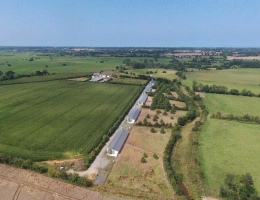
Looking at farms for sale in Eure means looking at loam plateaux where the rotation runs from wheat and oilseed rape to sugar beet, flax and potatoes, and where a free parcel usually finds a buyer before it is ever advertised. Proximity to the Paris region and to the Seine ports shapes both the outlets and the price of land. What changes hands is not always a whole holding: retiring farmers, local notaries, succession advisers and rural agencies entrust us with complete units as readily as with blocks of land and their storage buildings. Each listing gives the usable area, the soil potential, whether the land is owned or let, and the machinery included. This Eure catalogue sits inside our national census of farms for sale in France, next to the other cereal basins of the Paris region.
Reading the listings is not enough to decide. What follows sets out what Eure ground is worth, which districts release holdings at a workable price, which productions carry the department, and which verifications make or break a purchase. If your file is still being built, our white paper « Créer une exploitation agricole » (in French) covers legal form, funding and the order of the formalities.
Land forms the base of a farm's value. DVF, the property sales database published by the French tax administration (vineyards excluded), records a 2025 median of €9,723 per hectare in Eure (27), an average of €10,355 and 214 sales; four transactions in five fall between €7,000 and €15,212, against a national median of €5,307.
The SAFER land value benchmark sets €10,270 per hectare for vacant land and pasture offered for sale in the same year, +3.1% over one year and +14.7% over ten, against €6,460 nationally. Land sold with a tenancy in place is valued at €8,990, a discount of about 12%.
Against the Normandie region, whose median is €8,305 per hectare, this department sits 17% higher. For commune-level detail and comparisons with neighbouring areas, see our land price observatory, then cost your purchase with our financial calculators.
Arable holdings lead on the deep loams of the Neubourg, Saint-André and Norman Vexin plateaux, with long rotations where flax, sugar beet and potatoes supply the margin that cereals alone no longer give. Such systems demand heavy machinery, supply contracts and real working capital: a buyer acquires entry into industrial supply chains as much as a block of land. Away from the plateaux, mixed farming holds on in the Lieuvin, the Roumois and the pays d'Ouche, where dairy holdings rely on valley-bottom grassland and on buildings that often need modernising.
A few poultry units and beef enterprises complete the picture, generally backed by a forage area rather than run as pure specialists. An agricultural property in Eure is therefore judged on two scales: soil quality, which sets the yield, and the layout of the parcels, which sets the cost of every field operation. Ask for the block map before you look at the price per hectare; a holding scattered over several communes is not worked like a single ring-fenced unit.
The Neubourg plateau and the Saint-André plain form the arable heart of the department: large structures, even soils, and competition between neighbours that leaves little within reach of a newcomer. Eastwards, the Norman Vexin and the Madrie around Les Andelys and Vernon extend the same model while absorbing the land pressure of the Seine valley. The north-west is another country: the Roumois, the Lieuvin and the Risle valley mix grassland, remnant orchards and fragmented parcels, on holdings of more modest size.
The pays d'Ouche, to the south-west towards Breteuil and Rugles, is the easiest place to start: colder soils, less regular yields, but entry costs far below those of the Neubourg. It is also where medium-sized units, buildings included, come free most often. To enlarge an existing structure, blocks of bare farmland released through successions remain the usual route here.
Loam runs off and the groundwater here is exposed: a significant share of parcels lies within a drinking-water catchment area carrying an action programme that imposes cover crops, grass strips and sometimes permanent grassland. Erosion-zone status and the soft hydraulic works already built deserve the same scrutiny. The whole department also falls within the vulnerable zone defined under the nitrates directive, a status from which spreading and storage obligations follow for any livestock enterprise. Have the list of environmental easements on each block drawn up before you make an offer, because they pass with the property.
Then come the three points of rural law. SAFER Normandie is notified of every sale of rural property and may pre-empt. The authorisation to farm depends on the regional structures plan, whose thresholds are assessed against the area the applicant already works. Finally, a working farm that is let stays with the sitting tenant, whose right of purchase comes ahead of yours: that single point, more than any other, decides how much ground your project can actually use.
Sales here follow the cropping calendar: most instructions arrive after harvest and before autumn drilling. Rather than checking the page at random, set your criteria — district, cropping, area, budget — and let the e-mail alert keep watch. Owners preparing a handover can list with us directly. To think at regional scale, open farms for sale in Normandy.


