

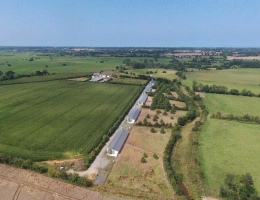
Few places in France make farms for sale in Manche mean quite so plainly a dairy herd: the department ranks among the country's leading milk producers, and grass grows here almost all year. The bocage, the Cotentin marshes, the grassland of the Avranchin and the sandy western shore nonetheless amount to four distinct markets under one label. Properties reach us from stock farmers stopping without a family successor, from notaries in the Cotentin and the Avranchin, from succession advisers and from rural property agencies. The description states whether the land lies in one block, how much grass can be grazed from the buildings, the condition of the parlour and what livestock the seller leaves behind. They sit too in our wider picture of farms for sale in France, beside the other dairy regions of the west.
Choosing then calls for bearings a listing cannot give: what a hectare of grass is really worth by district, which sectors hold the territory, where retirements release complete units and what to check before making an offer. A project still at file stage will gain from our white paper « Créer une exploitation agricole » (in French), on legal form, funding and the order of the steps.
Land forms the base of a farm's value. DVF, the property sales database published by the French tax administration (vineyards excluded), records a 2025 median of €7,735 per hectare in Manche (50), an average of €7,788 and 411 sales; four transactions in five fall between €4,957 and €10,831, against a national median of €5,307.
The SAFER land value benchmark sets €8,150 per hectare for vacant land and pasture offered for sale in the same year, +1.0% over one year and +16.4% over ten, against €6,460 nationally. Land sold with a tenancy in place is valued at €7,010, a discount of about 14%.
Against the Normandie region, whose median is €8,305 per hectare, this department sits 7% lower. For commune-level detail and comparisons with neighbouring areas, see our land price observatory, then cost your purchase with our financial calculators.
Dairy holdings run through the department from end to end, built on the Norman breed, on permanent pasture and on the butter and cheese appellations of the west. Around them live beef enterprises that use the wetter ground, sheep flocks on the salt meadows of the bay, and mixed holdings combining a herd, forage maize and a little cash cereal. The west coast between Créances and Lessay is the exception, with field vegetable growers working light sandy soils.
On this market a working farm is judged on forage self-sufficiency far more than on area: grass reachable from the buildings, how the ground carries stock in winter, slurry storage, the age of the milking installation. A grazing system and a maize-based system do not want the same block of land, and two holdings of identical size can show very different costs of production. How the milk is sold matters just as much.
The northern Cotentin, around the Val de Saire and the Hague, combines a mild microclimate, early vegetables and livestock on small tight structures. In the centre, the Cotentin and Bessin marshes set the rhythm: abundant summer grass, flooded parcels in winter, holdings organised around that alternation. The Coutançais and the Saint-Lois form the dense dairy core, with the largest number of handovers each year. To the south, the Mortainais and the Avranchin, more rolling, belong to granite bocage and carry grassland of good potential.
The western shore, from the havres of Lessay to the bay of Mont-Saint-Michel, carries the highest values, between vegetable competition and residential pressure. The steadiest supply lies inland, in the triangle between Saint-Lô, Percy and Villedieu, where complete dairy units still change hands on terms a well-advised entrant can meet.
Two local constraints weigh more here than elsewhere. Marsh parcels carry drainage easements, agri-environmental commitments and seasonal access conditions that limit their use; their working value has nothing in common with that of free-draining pasture. Along the coast, planning rules specific to the shoreline restrict extensions to livestock buildings, even for a simple upgrade. Add the department's classification as a nitrate vulnerable zone, which fixes spreading calendars and required storage volumes.
The legal framework completes the list. Every sale of rural property is notified to SAFER Normandie, which may pre-empt and reallocate, giving priority to new entrants. Taking on land above a certain threshold requires an authorisation to farm, granted or refused according to the priorities the regional structures plan sets out. And when an agricultural property is let, the sitting tenant keeps the upper hand: a first-rank right to buy, a protected lease, and tightly framed grounds for recovering the land.
One point of method: in Manche, fix a travelling radius around the district you want first, then filter by system and by area rather than the other way round — distance to the parcels decides the daily workload. The e-mail alert then flags each new instruction that fits. Selling your holding? Send us the details. The wider view sits with farms for sale in Normandy.


