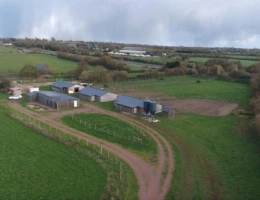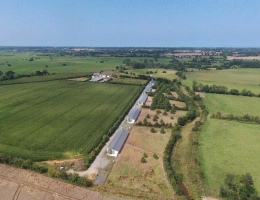
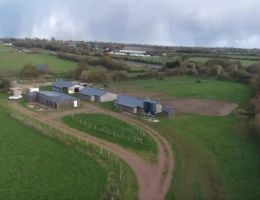
Hunting for farms for sale in Calvados means choosing between three farming worlds that share the department without mixing. Grass and milk hold the Pays d'Auge and the Bessin, backed by cheese and cider appellations that shape prices. Cereals and sugar beet hold the Caen-Falaise plain, one of the most productive stretches of western France. The Virois bocage, further west, is suckler-beef country with tight field patterns. The properties gathered here come from livestock farmers arranging their retirement, Normandy notaries, rural property agencies and succession advisers, and they sit within our wider view of farms for sale in France.
Beyond the particulars of each property, this page pulls together what actually weighs on a decision: what grassland and loess are worth district by district, where supply renews itself, how far quality schemes drive income, and which checks to run before signing. For a project still being shaped, our white paper « Créer une exploitation agricole » (in French) works through the stages.
Land forms the base of a farm's value. DVF, the property sales database published by the French tax administration (vineyards excluded), records a 2025 median of €8,917 per hectare in Calvados (14), an average of €9,368 and 301 sales; four transactions in five fall between €5,785 and €13,759, against a national median of €5,307.
The SAFER land value benchmark sets €10,390 per hectare for vacant land and pasture offered for sale in the same year, +2.8% over one year and +30.0% over ten, against €6,460 nationally. Land sold with a tenancy in place is valued at €8,290, a discount of about 20%.
Against the Normandie region, whose median is €8,305 per hectare, this department sits 7% higher. For commune-level detail and comparisons with neighbouring areas, see our land price observatory, then cost your purchase with our financial calculators.
Calvados remains one of Normandy's dairy strongholds. Dairy holdings sell into a dense cluster of protected designations — Camembert de Normandie, Pont-l'Évêque, Livarot, Isigny butter and cream — whose specifications require grazing, a minimum share of grass in the ration and a proportion of Normande cows in the herd. A buyer therefore acquires a regulated entitlement as much as a herd. Arable holdings hold the central plain with wheat, oilseed rape, sugar beet, fibre flax and vegetables for processing, on deep soils and at substantial scale.
Around those two pillars turn suckler beef units in the bocage, standard cider orchards that go with Auge fruit growing, and a dense equine sector of studs, training yards and liveries that explains much of the other livestock enterprises coming to market. The consequence is practical: two holdings of equal area here will not share the same buildings, the same working capital needs or the same takeover value.
The Pays d'Auge, from Lisieux to Orbec and Livarot, lines up grassy valleys, timber-framed buildings and orchards; land there is contested by strong residential and lifestyle demand that pushes prices well beyond agronomic value. The Caen-Falaise plain, between Caen, Falaise and Saint-Pierre-en-Auge, is arable country and the best-documented market of the four. The Bessin, around Bayeux and Isigny, keeps a powerful dairy tradition and coastal marshes given over to grazing. The Virois bocage, further west, offers the most moderate entry prices.
Two areas call for care. The coast, from the Côte de Nacre to the Côte Fleurie, competes with tourist accommodation and second homes. The Dives and Bessin marshes, by contrast, trade on forage value but under heavy drainage and environmental constraints, which thins the field of serious buyers.
On a livestock holding the inspection starts with the buildings: housing capacity, the age of the parlour or robot, compliance of slurry and manure stores, and the regulatory status of the unit under the classified-installations regime. Because the whole department is a nitrate vulnerable zone, required storage capacity, winter soil cover and the manure spreading plan govern how the herd can be run just as firmly as the available area does.
Then come the rules of transfer. The Normandy land agency SAFER learns of the sale through the notary and can substitute itself for the buyer; the right to work the ground is granted under structural control, measured against Normandy's own thresholds; and rented land carries its tenant with it, with first refusal if he wants it. Finally, check that the parcels lie inside the designated areas for the schemes concerned: an agricultural property partly outside them loses some of its earning potential, and taking back let farmland is rarely settled on completion day.
Properties come up here on the rhythm of retirements and cluster into a few periods of the year, so an e-mail alert is the surest way not to miss a listing. Frame the search by district first, then by production, milk reference volume and the state of the buildings. Retiring livestock farmers, notaries and Normandy rural agencies publish their instructions within minutes. To widen the net, browse farms for sale in Normandy.