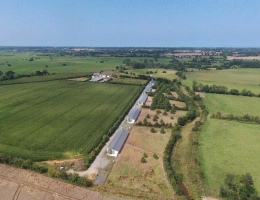
An arable farm for sale in Calvados is first of all a farm on the broad plain running from Caen to Falaise: deep loams, open field blocks and a solid rotation of wheat, barley, oilseed rape, textile flax, field beans and beet. The rest of the department, the pays d'Auge and the Virois bocage above all, stays turned towards grass and milk. What is gathered on this page reaches us from farmers preparing to step back, from rural property advisers and from notaries in Caen, Bayeux or Lisieux; the files state soil type, how the land is held, the storage available and the machinery line-up. They also sit within our nationwide view of arable farms for sale.
This page rounds out the particulars: land values recorded locally, the communes where holdings change hands most often, a method for judging a Caen-stone farmstead and its bins, and the duties that come with taking over a cereal farm in Normandy. Our white paper « Créer une exploitation agricole » (in French) sets out the setting-up route alongside.
Pricing the land comes first in any plan to buy an arable farm. On the basis of 2025 DVF sales (vineyards excluded), the median in Calvados (14) works out at €8,917/ha and the average at €9,368/ha, across 301 transactions. The central range covering 80% of sales runs from €5,785 to €13,759/ha; nationally the median is €5,307/ha.
The SAFER benchmark, the market's second yardstick, gives €10,390/ha in 2025 for vacant land and pasture (+2.8% over twelve months, +30.0% over ten years), beside a national €6,460/ha; tenanted land is worth about 17% less.
Hectares account for only part of an asking price. An asking price is built on loam depth, drainage, the shape of the blocks and their distance from the yard, bin capacity, ventilation, a drier, a yard able to hold baled flax, the state of the combine and the sprayer, the basic payment entitlements and the contractual tie to a cooperative, a grain merchant or a flax scutching mill. Arable land within reach of the port silos on the Orne estuary also gains commercial flexibility. Open our land price observatory and our financial calculators to frame your offer.
On the Caen plain and the Falaise countryside, loams over limestone give high agronomic potential and a comfortable water reserve, so yields hold steady without irrigation. The rotation turns on milling wheat, winter barley and oilseed rape, with textile flax, protein crops and sometimes beet; flax means a contract with a scutching mill and harvesting kit of its own. Elsewhere, soils that cap or hold water call for drainage that has been maintained. Ask for soil analyses, the drainage plan and recent season yields before settling on a price, rather than reasoning from a departmental average.
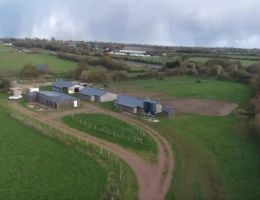
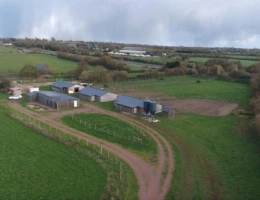
Buildings pair long stone barns, sometimes disused cattle housing, and newer steel-framed sheds. Check the roof covering, bin ventilation, the concrete apron, the intake pit and access for articulated lorries. A grain farm able to store its own harvest escapes delivering at the height of harvest and markets its parcels better. Where a manor house forms part of the sale, ask for a separate valuation: the residential market around Caen and along the coast answers to quite different forces than farmland.
The Caen plain, from Bretteville-sur-Laize to Argences and Troarn, holds most of the department's arable farming, with substantial holdings and long-settled field reorganisation. The Falaise countryside and the Saint-Pierre-en-Auge district carry that block southwards. The Bessin, around Bayeux and Isigny, mixes cropping with dairy grassland, producing combined units where grain often feeds the herd. The pays d'Auge and the Virois bocage, towards Vire Normandie, remain livestock country: cropping appears there mainly inside mixed farms.
Proximity to Caen bears on values: urban growth, road links and neighbours wanting to expand tighten the market along the northern edge of the plain. Towards the south of the department and the bocage margins, a crop farm buyer finds more affordable prices but less convenient field layouts and buildings often designed for livestock.
A takeover goes through the structures control, the administrative authorisation governing entries into farming and expansion, and SAFER may pre-empt once the notary notifies the sale. Read the rural leases field by field: expiry, rent, environmental clauses, the tenant's right of pre-emption. Calvados lies in a nitrate vulnerable zone, with regulated spreading periods and an obligation to keep soils covered between crops. Near the coast and around water catchments, specific easements can limit certain practices, so have the applicable designations listed before you build your budget.
Make sure the basic payment entitlements transfer and that the CAP declaration is filed on time, compare the graphical field register with the advertised areas, and have current contracts spelled out, the flax ones in particular, since they carry part of the turnover. A survey of fuel tanks, the crop-protection store and the electrical installation avoids discovering costly compliance work after the first harvest.
Owners stepping back, agencies specialising in rural property and Normandy notaries feed this selection. Set the area, budget and district filters, create an alert to follow each new listing, and carry the search on through the arable farms for sale in Normandy.