

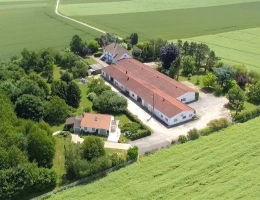
Finding a goat farm for sale in Yvelines takes patience: the department holds very few caprine units, yet those that change hands enjoy a dense catchment and customers genuinely attached to farmhouse produce. The properties shown come from breeders passing on their business, from agencies specialising in farmland around the capital and from notaries; they give the number of goats milked, the nature of the livestock building, the milking equipment, whether a cheese room and a shop exist, and the pasture and rough grazing attached. They add to our national inventory of goat farms for sale.
Beyond the listings, this page assembles what is missing at decision time: local land values, the districts where a caprine project remains feasible, the usual condition of buildings taken over from other enterprises, and the checks imposed by nearby housing. The white paper « Créer une exploitation agricole » (in French) then supports the shaping of the project and its funding plan.
Land weighs heavily on the budget for a goat farm. Transfers published by the French tax authorities (DVF, excluding vineyards) put the median for farmland in Yvelines (78) at €7,398/ha in 2025, with an average of €7,365/ha over 36 sales. Eight transactions in ten settle between €5,518 and €9,274/ha, where the national median is €5,307/ha.
A second reference, the SAFER land value benchmark, sets vacant land and pasture at €8,410/ha for 2025, +17.6% in a year and +5.3% over a decade; the French average is €6,460/ha, and a sitting tenant costs a plot roughly 17% of its value.
Price here is built less on area than on the ability to produce and to sell: a building fitted out for the herd, parlour and bulk tank, make room, drying room and cold store, farm shop, then the animals, their genetics and their health record. The goodwill built up, local customers, vegetable-box rounds, markets and restaurants, counts equally, as does securing forage ground. Check land values with our land price observatory and test your assumptions with our financial calculators.
Purpose-built goat houses are rare: most units occupy former barns, buildings from arable farms or converted cattle housing. Inspect the frame, the roof, the height under the ridge, ventilation, daylight and the partitioning of batches, the bedded area, the kidding pen, then the volume available for hay and straw. The milking side is judged on the number of units, pulsation, washing, cooling, tank size and the cleanliness of the milk room. Effluent storage structures and electrical compliance are the two items that most often need bringing back up to standard before the herd can be run properly.
Turning the milk into a goat cheese farm operation makes all the difference here. Make room, drying room, cellar, cold store and shop form a tool whose worth follows the health approval, the volumes produced and the local standing of the farm. The herd is valued separately, Alpine or Saanen, with the age of the animals, the bucks, replacement kids and the health history. If the sale includes a dwelling, outbuildings and land, a price breakdown is essential: the residential share quickly takes over close to the roads leading into the capital.
The south of the department, around the upper Chevreuse valley and towards Rambouillet, keeps pasture, woodland edges and a livestock tradition that makes a caprine project credible. The Houdanais and the borders with Eure-et-Loir, more open country, offer reasonably sized farmsteads at less strained values. The Mantois and the Seine meander mix crops, slopes and continuous building. To the north, the Yvelines communes of the Vexin français keep a preserved farming landscape. The plain of Versailles, closely watched where land is concerned, combines immediate proximity to the consumer with almost no ground coming free.
Selling is never the problem: weekly markets, producers' shops, box rounds, restaurants and school canteens take a smallholding's volumes easily, and the crowds walking the forests favour farmgate sales. The difficulty lies in land, contested between arable farmers, horses and development schemes; assembling forage ground next to the buildings, and securing it over time through a written lease, is the hardest part of any takeover and usually decides how large a herd you can realistically run.
Taking over a caprine holding on the edge of a city region means looking first at the regulatory framework. Depending on numbers, the unit falls under the departmental health regulation or under the French classified installations regime, by declaration or registration, with the change of operator notified to the prefecture; distances to dwellings, effluent storage and the spreading plan warrant all the more care where neighbours are numerous. Read the local planning document, the protection perimeters that shield farmland from development and, where relevant, the charter of the regional nature park governing new building.
Then ask for the herd's CAEV and paratuberculosis history and the replacement protocol, and, for the cheese room, the food safety plan, the approval or the exemption covering direct supply, and the self-checks. A shop open to the public brings accessibility and parking rules to verify. Finally, rural leases continue with the buyer and the deal passes through the structures control, the French authorisation regime for taking over farmland, then through SAFER, very active across this territory.
This page brings together offers entrusted by private owners, by rural estate agencies and by notaries in the department. Select by area, by budget or by route to market, then set up an e-mail alert: a dairy goat holding never stays available for long around the capital. Passing your own business on? Post your listing. Widen the search to goat farms for sale in Île-de-France.