

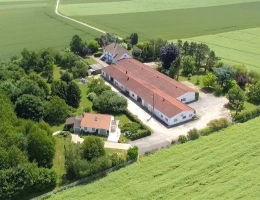
Looking for a goat farm for sale in Essonne points you to the southern half of the department, where the Hurepoix, the Gâtinais français and the valleys of the Juine, the École and the Renarde still hold pasture, rough grazing and farmsteads that remain in production. The strength of the area lies less in herd size than in its customers: a vast conurbation within a short van run, busy weekly markets, producers' shops and cheesemongers that take up farmhouse output. The properties we circulate come from breeders preparing to step back, from firms specialising in rural estates and from notaries in Étampes, Dourdan or Milly-la-Forêt, with herd, buildings and acreage set out. Each joins our goat farms for sale.
Beyond the listing itself, this page gathers what local land is worth, the districts that still release grassland farms, how to judge a livestock building and a processing workshop, and the permits to check before signing. Enough to rule out quickly a property that does not suit the plan. Our white paper « Créer une exploitation agricole » (in French) then takes over on setting up and financing.
Land weighs heavily on the budget for a goat farm. Transfers published by the French tax authorities (DVF, excluding vineyards) put the median for farmland in Essonne (91) at €8,000/ha in 2025, with an average of €8,011/ha over 32 sales. Eight transactions in ten settle between €5,903 and €10,380/ha, where the national median is €5,307/ha.
A second reference, the SAFER land value benchmark, sets vacant land and pasture at €8,260/ha for 2025, -9.1% in a year and -22.4% over a decade; the French average is €6,460/ha, and a sitting tenant costs a plot roughly 17% of its value.
Acreage tells only part of the story. The goat house and its ventilation count too, along with the parlour and bulk tank, the cheese room with its drying room, cellar and cold store, haymaking machinery, the worth of the herd and its replacement kids, and finally the goodwill: market pitches, box subscribers, restaurants and retailers already served. In a department this populous, an established clientele can weigh as much as the buildings. Weigh that against the figures in our land price observatory, then test the numbers in our financial calculators.
Caprine units in this department are often housed in buildings never meant for them: a barn from an arable farm, a storage shed, a converted stable. Look at the air volume per animal, ridge ventilation and low inlets, the state of the bedded area, effluent drainage, how batches are kept apart and where kidding happens, then covered space for hay. The parlour deserves its own technical inspection: units relative to herd size, pulsation, automatic washing, cooling, tank volume, and whether the milk room and its hot water supply meet requirements.
Where the farm processes, the cheese room is judged on its health approval or exemption, on the forward flow between make room, drying room and cellar, and on a delivery access that does not cross the animal area. The herd reads separately: milking does, average age, bucks, kids retained, cell counts, CAEV status, that is caprine arthritis-encephalitis virus, and any organic management. If the dwelling is in the sale, insist on a written split between house, land and working plant: in the Paris region the residential share can carry most of the price.
The south and west of the department hold almost every opportunity. Around Étampes, Méréville and along the Juine, the Beauce side is given over to arable cropping and shows hotly contested land, though its valley floors keep meadows. The Gâtinais français, around Milly-la-Forêt, La Ferté-Alais and Maisse, mixes woodland, sandy soils and fragmented parcels, with the regional nature park supporting short supply chains. Westwards, the Hurepoix of Dourdan, Saint-Chéron and the Renarde valley touches the Haute Vallée de Chevreuse regional nature park. The urbanised north, from Évry-Courcouronnes to Massy and Orsay, no longer releases farmland.
There is no structured dairy goat basin here: collection by a dairy stays marginal and almost every herd processes its own milk. A dairy goat holding is therefore judged first on its outlets, on road access towards the southern suburbs, and on whether a farm shop can open without friction with neighbours.
Below a certain herd size the unit falls under departmental health rules; above it, it moves into the classified installations regime, the French environmental permitting system, by declaration and then registration, with any change of operator reported to the prefecture. The order in force fixes distances to dwellings, effluent storage capacity and the spreading plan, and therefore any scope to expand. On the edge of the city that point is decisive: read the local planning document, the rules on putting up farm buildings and whether retail activity suits the local road.
Where the grazing is rented, the rural lease governs it and carries over to the buyer once the landlord has agreed; the deal passes through the structures control, the French authorisation regime for taking over farmland, then where relevant through SAFER, heavily called upon around Paris. Protected peri-urban farmland perimeters, like drinking water catchment zones, can restrict use: ask for the easements before making an offer.
The offers shown here are entrusted to us by private owners, rural estate agencies and notaries based in the department. Refine by area, by budget or by the presence of a processing workshop, then set an e-mail alert: a caprine unit in the Paris region is often agreed before it circulates widely. Handing yours on? Post your listing. You can widen the search to goat farms for sale in Île-de-France.