
A goat farm for sale in Val-d'Oise is nearly always sought in the west, on the Vexin français plateau, the one district where farming still has room, droveways and limestone farmsteads. Arable cropping leads the way there, yet a few caprine units run on direct selling have found their place, carried by the regional nature park and by a town-dwelling clientele close at hand. Properties reach us from farmers arranging their succession, from rural estate agencies and from notaries in Pontoise, Magny-en-Vexin or Luzarches. Every one of them also features in our nationwide round-up of goat farms for sale.
This page rounds out the listing on four fronts: what local land and pasture are worth, the districts still putting farms on the market, how to inspect livestock buildings and the cheese room, and the permits a takeover depends on. Our white paper « Créer une exploitation agricole » (in French) supports the building of the start-up project itself.
Land weighs heavily on the budget for a goat farm. Transfers published by the French tax authorities (DVF, excluding vineyards) put the median for farmland in Val-d'Oise (95) at €8,872/ha in 2025, with an average of €9,484/ha over 20 sales. Eight transactions in ten settle between €6,991 and €12,121/ha, where the national median is €5,307/ha. * Fewer than 30 recorded sales: indicative value.
A second reference, the SAFER land value benchmark, sets vacant land and pasture at €8,810/ha for 2025, +3.6% in a year and -20.1% over a decade; the French average is €6,460/ha, and a sitting tenant costs a plot roughly 17% of its value.
The fields explain only part of the asking figure. The goat house, its air volume and ventilation weigh too, along with the parlour and bulk tank, the cheese room with drying room and cellar, haymaking and feeding machinery, the herd, its genetics and its kids, and finally the goodwill: open-air markets, a farm shop, boxes and resellers. On a plateau where appetite for farm produce is not fading, that goodwill has a price. Compare with our land price observatory and project your financing with our financial calculators.
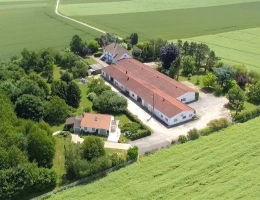
Building stock in the Vexin is known for its closed courtyard farms, long stone barns and high walls. Handsome to look at, these structures ventilate badly: check the volume per goat, the high openings, low air inlets, humidity, the state of the bedded area and effluent drainage, then the covered space available for hay. Newer sheds usually suit livestock better but call for a look at frame and roof. On the milking side, check the number of units against herd size, pulsation, washing, cooling, tank capacity and whether the milk room complies.
The cheese room, where there is one, must show a clear forward flow between make room, drying room, ripening cellar and cold store, with deliveries that do not cross the livestock area. The herd is valued separately: milking does, age, bucks, replacement kids, cell counts, CAEV status, that is caprine arthritis-encephalitis virus, any organic certification, most often Alpine and Saanen animals. If a dwelling comes with the whole, ask for a written split of the price between house, land and working plant: residential pressure from the Paris region otherwise distorts the reading.
The Vexin français, around Magny-en-Vexin, Marines and Vigny, holds most of the holdings: a loamy plateau given to cereals, the grassier Epte and Sausseron valleys, and a regional nature park that actively supports on-farm processing. The Oise valley, from Pontoise to Persan, mixes urban growth with riverside meadows. To the north-east, the Pays de France, towards Luzarches and Viarmes, borders hotly contested arable land, while the Montmorency valley remains marked by fruit growing. The densely built south of the department no longer releases farmland.
Goat milk collection here is marginal: most herds process on site and sell direct. A dairy goat holding is therefore judged on its shop, its markets and its reseller network as much as on its hectares, and road access towards Cergy-Pontoise and the northern suburbs becomes a criterion in its own right.
Goat keeping falls under departmental health rules up to a certain herd size, then under the classified installations regime, the French environmental permitting system, by declaration or registration, with the prefecture informed when the operator changes. The order in force imposes distances to dwellings, effluent storage capacity and a spreading plan, sensitive matters in Vexin villages where new housing has crept closer to farmsteads. Consult the regional nature park charter and the local planning document too: they govern the look of buildings, extensions and the opening of a sales point.
Rented land stays under the rural lease, passing to the buyer with the landlord's agreement, and permission to farm goes through the structures control, the French authorisation regime for taking over farmland; SAFER intervenes often where arable farmers seek to expand. Check nitrate vulnerable zones, water catchment perimeters and easements tied to the damp valleys. For processing, require the health approval or the direct supply exemption, the food safety plan and the self-checks.
The properties carried on this page are entrusted to us by private owners, rural estate agencies and notaries based in the department. Filter by acreage, by budget or by the presence of a cheese room, then put an e-mail alert in place: in a market this narrow, a caprine unit finds a buyer within weeks. Selling your own? Publish your listing. Carry on with goat farms for sale in Île-de-France.