
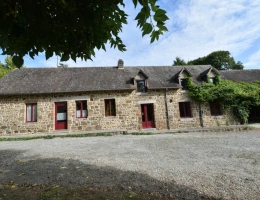
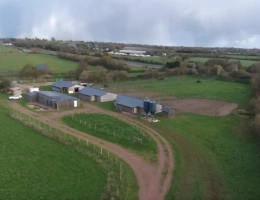
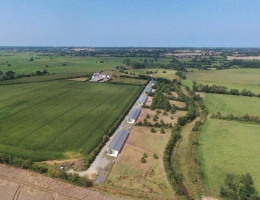
Coming across a goat farm for sale in Seine-Maritime means catching an opening when it appears: the department lives on cereals, sugar beet, flax and cow's milk, and caprine herds form an active minority, nearly always tied to processing and to customers nearby. The properties shown come from farmers arranging their succession, from agencies specialising in rural land and from notarial offices in the Caux and the Bray; the descriptions give herd size, the layout of the shed, whether a cheese room exists and how much grassland goes with it. They take their place in our national overview of goat farms for sale.
The page carries the listings further with what counts when a decision nears: what land on the Caux plateau and in the Bray is worth, the districts where a holding surfaces, the state of buildings and milking block, and the checks specific to farmhouse cheesemaking. To shape your project, our white paper « Créer une exploitation agricole » (in French) covers procedures, legal structures and funding.
Land weighs heavily on the budget for a goat farm. Transfers published by the French tax authorities (DVF, excluding vineyards) put the median for farmland in Seine-Maritime (76) at €11,543/ha in 2025, with an average of €12,013/ha over 209 sales. Eight transactions in ten settle between €7,594 and €17,090/ha, where the national median is €5,307/ha.
A second reference, the SAFER land value benchmark, sets vacant land and pasture at €11,600/ha for 2025, -0.3% in a year and +23.3% over a decade; the French average is €6,460/ha, and a sitting tenant costs a plot roughly 17% of its value.
Here the price of a goat cheese farm is built largely above ground: shed and ventilation, milking parlour, bulk tank, make room, drying room and ripening cellar, cold store and farm shop. The animals, their breeds and their health record add to that, as does goodwill, meaning the market pitches held, the outlets supplied and the reputation earned. Set those elements against our land price observatory and our financial calculators.
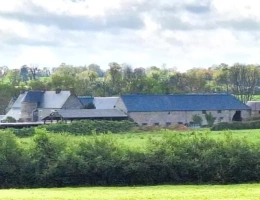
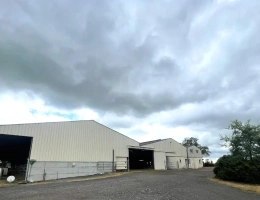
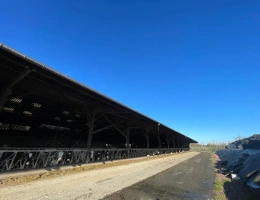
Almost every caprine unit on the Caux plateau came out of a conversion: housing freed when a dairy herd stopped, a storage building partitioned off, sometimes a barn within a walled clos-masure reworked. Inspection begins with the atmosphere inside, since wind and damp shape the climate here: cladding, roof lights, windbreak netting, the fall of the bedded areas, drainage of liquids and insulation of the milk room. The milking block comes next, its milk line, washing system, tank capacity and electrical supply, then the effluent stores, whose compliance spares heavy work. A stoned or surfaced access, needed for the tanker as much as for retail customers, counts in the value too.
The processing side often makes the difference. Make room, drying room, cellar, cold store and shop form a whole valued according to the approval held, the volumes handled and how steady the outlets are. Herds that send milk away depend instead on a collection round passing within reach, which narrows the possible areas. Where a farm is handed on with house, brick-and-flint outbuildings and meadows, call for a breakdown: Norman stonework holds value in its own right, quite apart from the farming asset.
Holdings come up mostly in the Pays de Bray, from Forges-les-Eaux to Neufchâtel-en-Bray and Gournay-en-Bray: grass, hedgerows, a cheesemaking tradition and land cheaper than on the plateau. The Pays de Caux, from Yvetot to Cany-Barville and Goderville, stays dominated by arable farming, where every hectare is keenly contested and grassland grows scarce. The valleys of the Seine, the Bresle, the Yères and the Durdent keep wet meadows and a few suitable farms. The Caux coast and the country around Dieppe add a useful tourist clientele.
No goat designation applies in the department, Neufchâtel being a cow's milk cheese: value therefore comes from farm-gate sales, the markets of Rouen, Le Havre and Dieppe, producers' shops and boxes delivered into town. That dense urban demand offsets how few units come free, without easing one of the firmest land markets in the north-west.
A dairy goat holding is judged on its paperwork as much as its buildings: by numbers the herd falls under declaration, registration or authorisation within the French classified installations regime, with any change of operator notified to the prefecture; below that, the departmental health regulation imposes siting distances and spreading rules, sensitive near villages and water catchments. Run-off on the chalk plateau deserves attention: swallow holes, buffer ponds, tracks and soft hydraulic works can bind the new owner. Ask as well for the herd's health record, CAEV monitoring, paratuberculosis screening and cell counts.
As soon as milk is processed, the food safety plan, the approval or the derogation covering direct supply and the self-monitoring results should be handed over before an offer; organic certification is checked with the certifying body. On land, rural leases continue with the buyer subject to the owner's agreement, and the transaction falls under the structures control, the French authorisation regime for taking over farmland, then under SAFER, heavily called upon wherever arable farmers are looking to expand.
Behind every listing stands a private seller, an agency specialising in rural property or a notarial office in the Caux, the Bray or the Bresle valley. Sort by grassland area, by budget or by how the milk is valued, then arm an e-mail alert, because a caprine smallholding seldom comes up in this department. Selling your own? Post the listing. Widen out to goat farms for sale in Normandy.