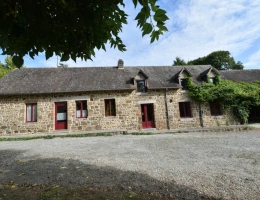

Looking for a goat farm for sale in Orne takes you into a department where grass is never short and where goats have found a place between the dairy and suckler herds, kept by modest holdings that almost always make their own cheese. The properties gathered here reach us from breeders preparing to step back, from firms specialising in agricultural estates and from notarial offices across the bocage and the Perche; every description states how many dairy goats are milked, what the shed consists of, whether a make room is attached and how meadow and rough grazing are split. You will find them within our national record of goat farms for sale.
What a listing leaves out comes next: what local pasture is worth, which districts release a holding most often, how to read old stonework and which checks a farmhouse dairy calls for. Before committing to a takeover, work through our white paper « Créer une exploitation agricole » (in French), which sets out the administrative steps and the grants that can be drawn on.
Land weighs heavily on the budget for a goat farm. Transfers published by the French tax authorities (DVF, excluding vineyards) put the median for farmland in Orne (61) at €6,432/ha in 2025, with an average of €6,818/ha over 307 sales. Eight transactions in ten settle between €4,427 and €10,000/ha, where the national median is €5,307/ha.
A second reference, the SAFER land value benchmark, sets vacant land and pasture at €7,250/ha for 2025, -1.6% in a year and +16.7% over a decade; the French average is €6,460/ha, and a sitting tenant costs a plot roughly 17% of its value.
Past the acreage, the asking price of a dairy goat holding rests on the working tool and on goodwill: the quality of the shed and its air flow, the parlour and bulk tank, the make room with drying room and ripening cellar, cold store, sales point and hay storage. Then come the animals, their breeds and their replacement stock, followed by the outlets already in place, whether market stalls, box schemes or a tanker round. Weigh those against our land price observatory and our financial calculators.
Caprine units here rarely sit in a purpose-built shed: most occupy converted cowsheds, reworked longhouses or farm barns partitioned off. Inspection starts with the atmosphere inside, because a damp bocage climate forgives poor ventilation badly: height under the roof frame, roof lights, opening gables, the condition of the bedded areas and how liquids drain away. The milking block follows, with its milk line, its washing system and the tank capacity, then the muck pad and the slurry store, whose compliance decides what has to be spent. A sound building served by a lane usable all year sells well above one that would have to be rebuilt throughout.
Processing changes how the property reads. Where an approved make room, a drying room, a cellar and a sales point come with it, the buyer takes on a trade as much as a herd, and a settled customer base weighs in the negotiation. A unit delivering to a dairy is judged instead on the steadiness of collection and the terms of its contract. When the sale covers a house, stone outbuildings and land together, ask for a breakdown: across the Perche, the residential share climbs quickly.
Goat holdings turn up first in the Perche, around Mortagne-au-Perche, Bellême and Rémalard, where grass is plentiful, the stonework has character, markets are lively and Paris customers lie within reach. The Pays d'Ouche and the country around L'Aigle offer quieter grassland farms at contained prices. Westwards, the Domfront bocage and the Flers and Tinchebray area stay shaped by dairy cattle and by pear orchards, though a few caprine units thrive there on farm-gate sales. The plains of Argentan and Alençon, largely given over to field crops, leave little room for grass and show the most contested land in the department.
No protected goat cheese designation covers Orne: value is built on the farm's own name, weekly markets, producers' shops and a well-established demand for organic produce. Being close to the Paris region and to the roads towards Le Mans and Caen makes selling easier, while the districts most sought after for second homes, the Perche above all, pull farmstead prices upward.
Taking over a goat cheese farm means establishing which tier applies to the herd: declaration, registration or authorisation under the French classified installations regime according to numbers, with any change of operator notified to the prefecture; below the threshold the departmental health regulation sets distances from dwellings and the conditions for storing effluent. Call for the herd's record, CAEV monitoring, the caprine arthritis-encephalitis virus, paratuberculosis screening, official testing results and cell counts, along with the on-farm register. In a densely settled bocage, getting on with the neighbours deserves thought, particularly over odours and muck spreading.
Where the unit processes milk, insist on the food safety plan, the health approval or the derogation covering direct supply, and the recent self-monitoring results; organic certification is confirmed with the certifying body before any offer. On land, rural leases over rented parcels continue with the buyer subject to the landlord's agreement, and the deal passes through the structures control, the French authorisation regime for taking over farmland, then through SAFER, which watches how reclaimed grassland will be used.
Retiring breeders, rural estate agencies and notaries across the department feed this page as holdings come up. Narrow by grassland area, by budget or by whether a cheese room is included, then set an e-mail alert: a small caprine smallholding rarely appears here and finds a buyer fast. Arranging your own handover? Post the listing. Carry on towards goat farms for sale in Normandy.