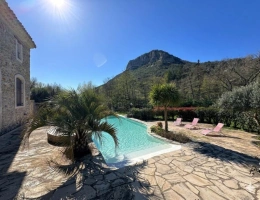
Looking for a mill for sale in Occitanie means exploring a region where mills take a different form depending on the climate: watermills in the Cévennes and Rouergue, former silk mills in Gard, olive-oil mills around Béziers, and windmills on the windy plains of Aude and the Lauragais. On this page, ma-propriete.fr brings together the mills for sale in Occitanie: watermills to restore in Aveyron, former silk mills in the Cévennes, Languedoc olive-oil mills and millers' houses with water rights.
You will also find price benchmarks based on actual sales, an overview of the areas by department, and the specific points to check before buying a mill. To prepare your project, read our white paper on setting up a rural gîte, useful for converting a mill's outbuildings.
There are no official statistics dedicated to mills: sales are too rare and too varied (a ruin to restore, a habitable mill, a flour mill with a turbine). The most reliable market benchmark remains the price of country houses, which a habitable mill resembles, with a premium for the water, the character and the water rights, and a discount for the work required.
How much does a country house cost in Occitanie? According to DVF data (notarised sales) analysed by the ma-propriete.fr observatory, the median price of a country house in Occitanie stood at €210,000 in 2025, with an average price of €220,462 and a median price of €1,987/m² of living space (14,163 house sales in rural municipalities over the year). 10% of houses sold for less than €107,500 (floor price, 1st decile) and 10% for more than €347,000 (ceiling price, 9th decile). The typical country house offers 111 m² of living space on an average plot of 4,162 m², i.e. around 0.4 ha.
The region is above the national median (€189,200). Since the second half of 2020, the regional median price has risen from €189,000 to €210,000, i.e. +11.1%; over one year (2024-2025) the change is +1.4%.
| 2025 indicator | Occitanie | France |
|---|---|---|
| Median price | €210,000 | €189,200 |
| Average price | €220,462 | €207,100 |
| Floor price (1st decile) | €107,500 | €90,000 |
| Ceiling price (9th decile) | €347,000 | €340,000 |
| Median price per m² of living space | €1,987/m² | €1,830/m² |
| Average living space | 111 m² | 108 m² |
| Average plot size | 4,162 m² | 3,181 m² |
| Number of sales in 2025 | 14,163 | 150,313 |
Differences between departments are significant: the median ranges from €160,000 in Ariège (09) to €295,000 in Pyrénées-Orientales (66). The table below compares 2025 prices and their change since 2020.
| Department | Median price 2025 | Average price 2025 | Median price per m² | Change 2020-2025 | Sales 2025 |
|---|---|---|---|---|---|
| Ariège (09) | €160,000 | €167,339 | €1,650/m² | +5.3% | 663 |
| Aude (11) | €210,000 | €213,564 | €1,973/m² | +12.6% | 1,112 |
| Aveyron (12) | €162,300 | €169,155 | €1,606/m² | +16.0% | 1,149 |
| Gard (30) | €265,000 | €279,110 | €2,584/m² | +10.4% | 1,532 |
| Haute-Garonne (31) | €242,000 | €246,017 | €2,219/m² | +5.2% | 2,104 |
| Gers (32) | €176,800 | €190,399 | €1,672/m² | +8.0% | 1,272 |
| Hérault (34) | €294,425 | €304,890 | €2,726/m² | +10.2% | 1,144 |
| Lot (46) | €168,508 | €179,607 | €1,685/m² | +12.3% | 1,295 |
| Lozère (48) | €166,850 | €174,916 | €1,726/m² | +25.5% | 326 |
| Hautes-Pyrénées (65) | €187,000 | €194,927 | €1,750/m² | +20.6% | 897 |
| Pyrénées-Orientales (66) | €295,000 | €309,953 | €2,732/m² | +18.0% | 464 |
| Tarn (81) | €193,000 | €194,538 | €1,799/m² | +10.3% | 1,018 |
| Tarn-et-Garonne (82) | €200,000 | €199,749 | €1,857/m² | +11.1% | 1,187 |
A regional average also hides large gaps between municipalities. A smallholding to renovate, a restored longère with its outbuildings, a farmhouse on several hectares of land or a manor house with parkland do not sell at the same price, and the location matters as much as the building: coastline, tourist area, peri-urban countryside close to a job market or deep countryside. The table below shows the median price of country houses in Occitanie by type of municipality (cumulative sales from mid-2020 to 2025) and its change between 2021 and 2025.
| Type of municipality | Median price 2020-2025 | Median price per m² | Change 2021-2025 | Sales 2020-2025 |
|---|---|---|---|---|
| Tourist coastline | €267,000 | €2,579/m² | -7.0% | 693 |
| Residential coastline | €277,750 | €2,686/m² | +12.0% | 326 |
| Inland tourist areas (hinterland, mountains) | €169,000 | €1,742/m² | +8.2% | 11,987 |
| Peri-urban countryside (city catchment area) | €234,951 | €2,163/m² | +2.2% | 42,813 |
| Deep countryside (outside urban influence) | €179,000 | €1,688/m² | +4.8% | 31,306 |
These benchmarks help you assess a listing, estimate a property before putting it up for sale, or set your budget, whether you are looking for a holiday home, a permanent move to the French countryside or a property to turn into a rural gîte. To go further, see our observatory of country house prices in France (national, regional and departmental analysis, downloadable annual report) and work out the full cost of your purchase, including French notary fees, with our notary fees calculator.
In Aveyron and Lot, the Lot, Célé, Aveyron and Tarn rivers powered hundreds of watermills built of limestone, often used for flour milling or fulling wool. In Gard, the Cévennes valleys (Gardon, Cèze) keep many former silk mills, factories once driven by water power, now converted into homes. In Hérault and Aude, the Mediterranean climate favoured olive-oil mills, while the windier plains of the Lauragais and the Narbonne area saw the development of flour windmills, rare but sought after. In Hautes-Pyrénées, streams flowing down from the mountains also drove fulling mills tied to the foothills' former wool industry.
In Haute-Garonne and Gers, the Garonne, Gers and Baïse rivers carried lowland flour mills. In Pyrénées-Orientales, Ariège, Hautes-Pyrénées, Tarn and Tarn-et-Garonne, watermills remain linked to Pyrenean streams or foothill rivers (Ariège, Salat, Agout). Lozère, more mountainous and granitic, has notably fewer. In Ariège, a few former mills also served as forges, a traditional metalworking activity of the Pyrenean foothills. A handful of these mills also still show traces of their original grinding stones, a detail worth checking during a visit.
The Lot and Célé valleys, around Figeac and Cahors, offer a highly sought-after picturesque setting. The Cévennes in Gard, around Alès and Anduze, hold former silk mills at prices that remain accessible. In Hérault, the Minervois foothills between Béziers and Pézenas offer olive-oil mills, while Aude around Carcassonne and the Canal du Midi is attractive for its heritage. Nîmes's TGV station and Montpellier airport make Gard and Hérault easier to reach for buyers coming from other regions.
The closer you get to Toulouse, Montpellier or the Languedoc coast, the higher the prices. Conversely, Lozère, northern Aveyron and rural Ariège remain among the most affordable areas in Occitanie for a mill to renovate. Tarn, around Gaillac and Cordes-sur-Ciel, also offers mills on the Tarn and Aveyron rivers at still-reasonable prices. Local heritage associations in the Cévennes can also share useful documentation on a former silk mill's industrial history. A short-term rental strategy for such a gîte can perform particularly well close to hiking trails.
Check the water rights (a mill fondé en titre or holding an authorisation), the condition of the millrace, weir and sluice gates. On classified rivers in the Cévennes and the Massif Central, ecological continuity rules can constrain a hydroelectric turbine project. Sudden Cévennes flash floods expose some mills to a real flood zoning risk: get precise information on this point before buying. It is also worth asking neighbouring owners about the river's typical flow pattern across the seasons.
A former silk mill needs a specific assessment of its industrial structure, usually larger than a simple flour mill. Outbuildings (miller's house, drying room, silkworm house for silk mills) often make it possible to plan a gîte, a promising activity in a tourist region such as the Cévennes or the Lot valley. Also check, on the Aude and Béziers coastlines, exposure to strong winds (tramontane, mistral), which can weaken an old roof. An old olive mill also calls for checking the condition of the vats and pressing system, which is often outdated in older properties.
On ma-propriete.fr, mill listings in Occitanie are published by private sellers, estate agents and notaries. Filter by budget, living space and land area, set up an email alert to be told of new listings, and browse all rural properties for sale if your search extends beyond mills. Do not hesitate to ask the town hall for the history of the millrace and water rights before committing.