
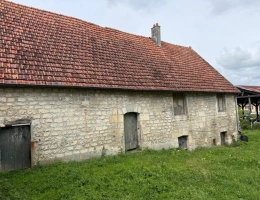
Looking for a country house for sale in Val-de-Marne (94)? An urban department of the inner Paris ring, it retains only a very small rural fringe, to the south-east around Villecresnes and the Notre-Dame forest; elsewhere, from Vitry-sur-Seine to Saint-Maur-des-Fossés, apartment blocks and suburban houses occupy almost the entire territory. This page nonetheless brings together the country houses for sale available in and near Val-de-Marne, published on ma-propriete.fr by private sellers, estate agents and notaries.
Here we give you Île-de-France-wide price benchmarks, the department's small rural pocket in the south-east, and the neighbouring areas where a genuine country house with land can be found. Our complete guide to buying a country house in France details the criteria to know, from surveying an old building to financing.
Val-de-Marne has virtually no rural municipalities as defined by INSEE: the statistics below cover country houses across the whole Île-de-France region, where the closest properties to this department are located.
How much does a country house cost in Île-de-France? According to DVF data (notarised sales) analysed by the ma-propriete.fr observatory, the median price of a country house in Île-de-France stood at €280,000 in 2025, with an average price of €295,207 and a median price of €2,603/m² of living space (3,611 house sales in rural municipalities over the year). 10% of houses sold for less than €171,000 (floor price, 1st decile) and 10% for more than €435,000 (ceiling price, 9th decile). The typical country house offers 116 m² of living space on an average plot of 1,590 m², i.e. around 0.2 ha.
The region is well above the national median (€189,200). Since the second half of 2020, the regional median price has risen from €274,325 to €280,000, i.e. +2.1%; over one year (2024-2025) the change is +3.6%.
| 2025 indicator | Île-de-France | France |
|---|---|---|
| Median price | €280,000 | €189,200 |
| Average price | €295,207 | €207,100 |
| Floor price (1st decile) | €171,000 | €90,000 |
| Ceiling price (9th decile) | €435,000 | €340,000 |
| Median price per m² of living space | €2,603/m² | €1,830/m² |
| Average living space | 116 m² | 108 m² |
| Average plot size | 1,590 m² | 3,181 m² |
| Number of sales in 2025 | 3,611 | 150,313 |
Differences between departments are significant: the median ranges from €250,600 in Seine-et-Marne (77) to €346,650 in Yvelines (78). The table below compares 2025 prices and their change since 2020.
| Department | Median price 2025 | Average price 2025 | Median price per m² | Change 2020-2025 | Sales 2025 |
|---|---|---|---|---|---|
| Seine-et-Marne (77) | €250,600 | €259,889 | €2,368/m² | +2.3% | 2,149 |
| Yvelines (78) | €346,650 | €378,718 | €2,966/m² | -1.0% | 763 |
| Essonne (91) | €284,600 | €297,767 | €2,741/m² | +3.5% | 433 |
| Val-d'Oise (95) | €333,000 | €336,830 | €2,993/m² | +0.5% | 266 |
A regional average also hides large gaps between municipalities. A smallholding to renovate, a restored longère with its outbuildings, a farmhouse on several hectares of land or a manor house with parkland do not sell at the same price, and the location matters as much as the building: coastline, tourist area, peri-urban countryside close to a job market or deep countryside. The table below shows the median price of country houses in Île-de-France by type of municipality (cumulative sales from mid-2020 to 2025) and its change between 2021 and 2025.
| Type of municipality | Median price 2020-2025 | Median price per m² | Change 2021-2025 | Sales 2020-2025 |
|---|---|---|---|---|
| Inland tourist areas (hinterland, mountains) | €250,000 | €2,369/m² | -1.3% | 135 |
| Peri-urban countryside (city catchment area) | €289,000 | €2,645/m² | -5.6% | 22,270 |
These benchmarks help you assess a listing, estimate a property before putting it up for sale, or set your budget, whether you are looking for a holiday home, a permanent move to the French countryside or a property to turn into a rural gîte. To go further, see our observatory of country house prices in France (national, regional and departmental analysis, downloadable annual report) and work out the full cost of your purchase, including French notary fees, with our notary fees calculator.
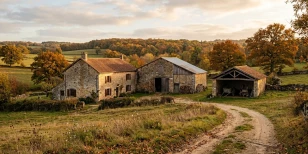
Val-de-Marne is overwhelmingly urban, between the Marne loop at Saint-Maur-des-Fossés and the large developments of Créteil and Vitry-sur-Seine. To the south-east, however, around Villecresnes, Mandres-les-Roses and Santeny, a few bourgeois houses and old market-garden farmhouses in millstone grit or ashlar stone survive on the edge of the Notre-Dame forest and the Brie plateau, an area that long supplied Paris with vegetables before the rest of the department was urbanised. Agricultural outbuildings - barns, drying sheds - can still be found there, though a true planted orchard is rarer. This market-gardening past explains why wells and irrigation basins can still be found around Villecresnes, now repurposed as ornamental garden features.
Elsewhere in the department, available land is limited to gardens of a few hundred square metres around early 20th-century millstone-grit houses in Saint-Maur-des-Fossés, Nogent-sur-Marne or Champigny-sur-Marne, nothing comparable to a genuine holiday home or smallholding. The energy rating of this old housing stock is often middling, since insulation work rarely suits the original millstone-grit façades. These often semi-detached millstone-grit houses are quite different from the isolated farmhouses with outbuildings usually sought under the country house label. Buyers often underestimate how much a well-kept millstone-grit façade can cost to restore once repointing and roof work are included.
For a move to the countryside project with land, Seine-et-Marne to the east offers Brie-style farmhouses in stone and brick with land and sometimes a pond, from the Marne valley (Tournan-en-Brie, Coulommiers, Rozay-en-Brie) onwards. To the south, Essonne, towards the Gâtinais and the Yvette valley, retains a fuller rural housing stock, between cereal plateaux and steep-sided valleys. Val-de-Marne has no TGV station: the high-speed network is reached via Paris-Lyon station or Orly airport, around twenty minutes away depending on the commune. Buyers who accept moving a little further east or south typically gain several times the plot size for a comparable budget. A quick call to the town hall usually confirms these points before a viewing.
Within the department itself, the few semi-rural areas in the south-east (Villecresnes, Marolles-en-Brie, Santeny) remain noticeably more expensive than any country house further out, for a plot nothing like the scale of a whole Brie farmstead. A structural survey of the roof and foundations is particularly worthwhile on Brie farmhouses left unoccupied for a long period.
Once outside Val-de-Marne, the usual criteria carry full weight again: the condition of the old building, roof and insulation quality, energy rating, a quiet hamlet setting, and the size of the plot available for a garden, vegetable patch or outbuildings. Private drainage, common in rural Seine-et-Marne or Essonne, should be checked, along with local plan zoning before extending a barn or drying shed. Comparing two or three neighbouring departments against these criteria usually moves the search along faster than browsing listings one at a time. A short visit to the town hall's planning department can quickly confirm what extensions are actually permitted.
Also check travel time to Paris via the RER or the nearby Paris-Lyon TGV station, fibre-optic coverage for remote working, and exposure to clay-shrinkage subsidence, common on the loamy plateaux of Brie. Proximity to a regional or Intercités station, in the absence of a local TGV line, remains a decisive factor for regular use as a holiday home. Comparing a handful of listings side by side often reveals the real price gap between departments.
On ma-propriete.fr, since the supply of country houses in Val-de-Marne is very limited, widen your search directly to all country houses for sale in Île-de-France, and filter by budget, living space and land area to target the best-suited neighbouring departments.