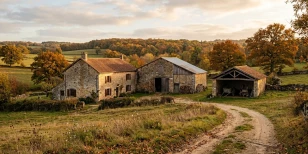

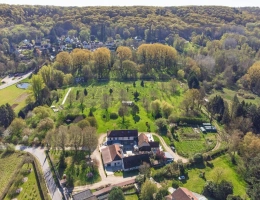
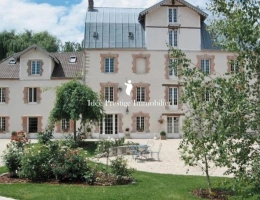
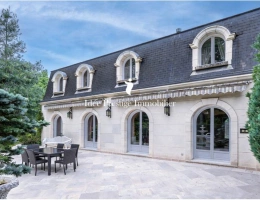
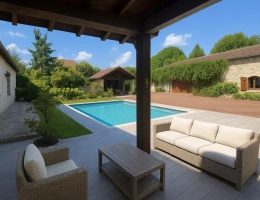
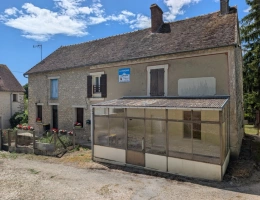
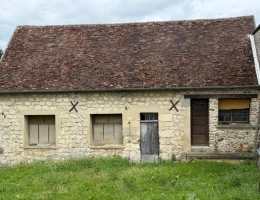
Looking for a country house for sale in Hauts-de-Seine (92)? This department, the most densely urbanised in the inner Paris ring, has almost no rural communes: from Nanterre to Boulogne-Billancourt, via Neuilly-sur-Seine and Antony, the built environment is almost entirely suburban houses or apartment blocks. This page nonetheless brings together the country houses for sale available in and near Hauts-de-Seine, published on ma-propriete.fr by private sellers, estate agents and notaries.
Here we present Île-de-France-wide price benchmarks, the department's few pockets of greenery (the Meudon woods, the Seine banks at Sèvres) and, above all, the neighbouring departments where a genuine country house with land remains within reach. Our complete guide to buying a country house in France details the criteria to know, from surveying an old building to financing.
Hauts-de-Seine has virtually no rural municipalities as defined by INSEE: the statistics below cover country houses across the whole Île-de-France region, where the closest properties to this department are located.
How much does a country house cost in Île-de-France? According to DVF data (notarised sales) analysed by the ma-propriete.fr observatory, the median price of a country house in Île-de-France stood at €280,000 in 2025, with an average price of €295,207 and a median price of €2,603/m² of living space (3,611 house sales in rural municipalities over the year). 10% of houses sold for less than €171,000 (floor price, 1st decile) and 10% for more than €435,000 (ceiling price, 9th decile). The typical country house offers 116 m² of living space on an average plot of 1,590 m², i.e. around 0.2 ha.
The region is well above the national median (€189,200). Since the second half of 2020, the regional median price has risen from €274,325 to €280,000, i.e. +2.1%; over one year (2024-2025) the change is +3.6%.
| 2025 indicator | Île-de-France | France |
|---|---|---|
| Median price | €280,000 | €189,200 |
| Average price | €295,207 | €207,100 |
| Floor price (1st decile) | €171,000 | €90,000 |
| Ceiling price (9th decile) | €435,000 | €340,000 |
| Median price per m² of living space | €2,603/m² | €1,830/m² |
| Average living space | 116 m² | 108 m² |
| Average plot size | 1,590 m² | 3,181 m² |
| Number of sales in 2025 | 3,611 | 150,313 |
Differences between departments are significant: the median ranges from €250,600 in Seine-et-Marne (77) to €346,650 in Yvelines (78). The table below compares 2025 prices and their change since 2020.
| Department | Median price 2025 | Average price 2025 | Median price per m² | Change 2020-2025 | Sales 2025 |
|---|---|---|---|---|---|
| Seine-et-Marne (77) | €250,600 | €259,889 | €2,368/m² | +2.3% | 2,149 |
| Yvelines (78) | €346,650 | €378,718 | €2,966/m² | -1.0% | 763 |
| Essonne (91) | €284,600 | €297,767 | €2,741/m² | +3.5% | 433 |
| Val-d'Oise (95) | €333,000 | €336,830 | €2,993/m² | +0.5% | 266 |
A regional average also hides large gaps between municipalities. A smallholding to renovate, a restored longère with its outbuildings, a farmhouse on several hectares of land or a manor house with parkland do not sell at the same price, and the location matters as much as the building: coastline, tourist area, peri-urban countryside close to a job market or deep countryside. The table below shows the median price of country houses in Île-de-France by type of municipality (cumulative sales from mid-2020 to 2025) and its change between 2021 and 2025.
| Type of municipality | Median price 2020-2025 | Median price per m² | Change 2021-2025 | Sales 2020-2025 |
|---|---|---|---|---|
| Inland tourist areas (hinterland, mountains) | €250,000 | €2,369/m² | -1.3% | 135 |
| Peri-urban countryside (city catchment area) | €289,000 | €2,645/m² | -5.6% | 22,270 |
These benchmarks help you assess a listing, estimate a property before putting it up for sale, or set your budget, whether you are looking for a holiday home, a permanent move to the French countryside or a property to turn into a rural gîte. To go further, see our observatory of country house prices in France (national, regional and departmental analysis, downloadable annual report) and work out the full cost of your purchase, including French notary fees, with our notary fees calculator.
Along with Paris, Hauts-de-Seine is the most urbanised area in France: early 20th-century millstone-grit town houses in Boulogne-Billancourt, Colombes or Rueil-Malmaison, Haussmann-style buildings in Neuilly-sur-Seine, and large developments around La Défense and Nanterre. The clay-and-limestone subsoil of the Seine loop never supported a true farming region comparable to neighbouring departments: you will find no longère, no smallholding, no farmhouse to convert, and any old building with a substantial plot disappeared decades ago under property pressure, replaced by suburban housing estates or apartment schemes. Even the postwar social-housing programmes around Nanterre and La Défense left no room for detached houses with meaningful gardens, reinforcing just how thin the rural fringe of the department has become.
The few houses with a garden that remain, in Ville-d'Avray, Meudon, Sèvres or Vaucresson, are 19th-century bourgeois villas in millstone grit or ashlar stone under slate roofs, built when wealthy Parisians came to the hillsides above the Seine for cleaner air. They have no orchard or agricultural outbuildings, and sit on plots of only a few hundred square metres, overlooking the Meudon woods or the Saint-Cucufa pond - far from a true country house profile. Their energy rating is often poor, since insulation work is rarely compatible with these protected old façades.
For a holiday home or a move to the countryside project with land, you need to leave the inner ring. Yvelines, to the west, offers stone or millstone-grit houses with a garden and sometimes a pond from the Chevreuse valley (Chevreuse, Dampierre-en-Yvelines, Cernay-la-Ville) onwards, at the edge of the Rambouillet forest; the Mantois area further north along the Seine adds half-timbered farmsteads. Val-d'Oise, towards the Vexin français, and Essonne, between the Yvette valley and the Gâtinais, retain a fuller rural housing stock. Hauts-de-Seine has no TGV station of its own: it is served by RER and Transilien trains to Paris-Montparnasse or Saint-Lazare, with the nearest TGV station at Massy, around twenty minutes' drive depending on the commune. Buyers who compromise on distance from Paris typically gain several times the plot size for a comparable budget once they cross into these more rural departments.
Within the department itself, the least urbanised areas - Meudon, Ville-d'Avray, Vaucresson, Marnes-la-Coquette - remain noticeably more expensive than any country house further out, for an incomparably smaller plot: what you pay for is proximity to Paris and scarce leafy land, not garden size.
Once outside Hauts-de-Seine, the usual country house criteria apply again in full: the condition of the old building, tile or slate roof quality, insulation and energy rating, a quiet hamlet setting close to amenities, and the size of the plot available for a garden, a vegetable patch or outbuildings. Private drainage, common as soon as you move away from town centres, deserves close inspection, as does the commune's local plan zoning if you plan to extend a barn or outbuilding.
Also consider travel time to Paris via the RER, Transilien or a nearby TGV station (Massy, or the Paris stations themselves), fibre-optic coverage for remote working, and exposure to clay-shrinkage subsidence, a well-documented risk across Île-de-France that can crack old houses built on clay soil. A short list of two or three departments, compared side by side on these criteria, usually narrows the search faster than browsing listings department by department.
On ma-propriete.fr, since the supply of country houses in Hauts-de-Seine is very limited, widen your search directly to all country houses for sale in Île-de-France, and filter by budget, living space and land area to target the neighbouring departments best suited to your project.