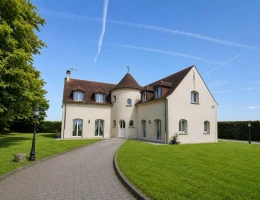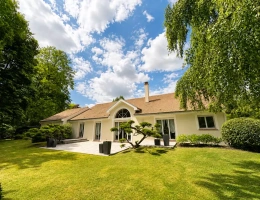
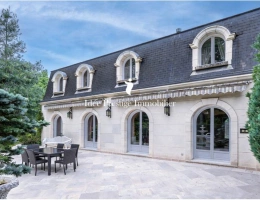
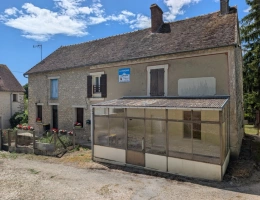
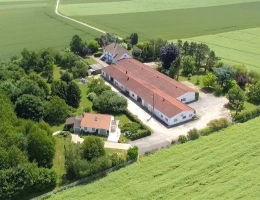
Looking for a country house for sale in Seine-et-Marne (77)? Between the Brie plain, the Gâtinais and the Fontainebleau forest, the department offers varied rural housing typical of the greater Paris region: Brie farmhouses in millstone (meulière) and brick, manor-style houses in market towns, half-timbered longères in the Multien area, former farm buildings to renovate. This page brings together the country houses for sale in Seine-et-Marne published on ma-propriete.fr by private sellers, estate agents and notaries.
We present the actual prices of country houses in Seine-et-Marne, the areas worth knowing around Meaux, Provins and Fontainebleau, and the criteria that determine the value of a property less than an hour from Paris. Our complete guide to buying a country house in France completes these benchmarks, from surveying an old building to financing.
How much does a country house cost in Seine-et-Marne (77)? According to DVF data (notarised sales) analysed by the ma-propriete.fr observatory, the median price of a country house in Seine-et-Marne (77) stood at €250,600 in 2025, with an average price of €259,889 and a median price of €2,368/m² of living space (2,149 house sales in rural municipalities over the year). The price range is wide: 10% of houses sold for less than €158,000 (floor price, 1st decile) and 10% for more than €376,344 (ceiling price, 9th decile). The typical country house here offers 112 m² of living space on an average plot of 1,549 m², i.e. around 0.2 ha.
This market is below the regional median (Île-de-France: €280,000) and well above the national median (€189,200). Since the second half of 2020, the median price has risen from €245,000 to €250,600, i.e. +2.3%; over one year (2024-2025) the change is +2.3%.
| 2025 indicator | Seine-et-Marne | Île-de-France | France |
|---|---|---|---|
| Median price | €250,600 | €280,000 | €189,200 |
| Average price | €259,889 | €295,207 | €207,100 |
| Floor price (1st decile) | €158,000 | €171,000 | €90,000 |
| Ceiling price (9th decile) | €376,344 | €435,000 | €340,000 |
| Median price per m² of living space | €2,368/m² | €2,603/m² | €1,830/m² |
| Average living space | 112 m² | 116 m² | 108 m² |
| Average plot size | 1,549 m² | 1,590 m² | 3,181 m² |
| Number of sales in 2025 | 2,149 | 3,611 | 150,313 |
A departmental average hides large gaps. A smallholding to renovate, a restored longère with its outbuildings, a farmhouse on several hectares of land or a manor house with parkland do not sell at the same price, and the location matters as much as the building: coastline, tourist area, peri-urban countryside close to a job market or deep countryside. The table below shows the median price of country houses in Seine-et-Marne (77) by type of municipality (cumulative sales from mid-2020 to 2025) and its change between 2021 and 2025.
| Type of municipality | Median price 2020-2025 | Median price per m² | Change 2021-2025 | Sales 2020-2025 |
|---|---|---|---|---|
| Inland tourist areas (hinterland, mountains) * | €215,000 | €2,111/m² | -2.0% | 95 |
| Peri-urban countryside (city catchment area) | €257,500 | €2,410/m² | -3.6% | 13,201 |
* Between 30 and 99 sales: indicative value.
These benchmarks help you assess a listing, estimate a property before putting it up for sale, or set your budget for a holiday home or a permanent move to the French countryside. To go further, see our observatory of country house prices in France (national, regional and departmental analysis, downloadable annual report) and work out the full cost of your purchase, including French notary fees, with our notary fees calculator.
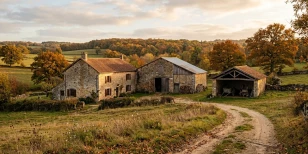
The Brie farmhouse, laid out around a closed courtyard, combines walls in meulière (millstone) or local stone with brick surrounds, under a flat-tile roof, a style found around Crécy-la-Chapelle or Rozay-en-Brie. In the Multien area and the north of the department, half-timbered façades still survive, while Provins, Moret-sur-Loing and the market towns of the Gâtinais retain manor-style houses in limestone, often built by local notables in the 19th century. These courtyard farms, once self-sufficient, now lend themselves to conversion into several dwellings or to a mixed live-work use. A number of these farmhouses also retain a dovecote tower, once a marker of manorial status, now a decorative feature.
The land around these properties ranges from an enclosed village garden to a large farm complex with several hectares of clay farmland. Outbuildings — barn, dovecote, hayloft — are numerous and lend themselves to conversion into a gîte, a workshop or a separate dwelling, an appealing option for a second home within easy reach of Paris. Many of these estates are still held in family co-ownership, a point worth checking before any negotiation.
The Brie, a grain-growing plain around Meaux and Coulommiers, offers large millstone farmhouses at varying distances from Paris. The Fontainebleau area and its forest, along with the Loing valley (Moret-sur-Loing, Nemours), attract buyers seeking peace and nature less than an hour from the capital, with TGV access from Marne-la-Vallée-Chessy station for long-distance travel. To the east, the medieval town of Provins and the Gâtinais, around Montereau-Fault-Yonne, offer a more rural, less pressured market. Towns served by the Transilien, such as Nangis or Verneuil-l'Étang, allow a main-home use with a daily commute to Paris.
Areas close to the Marne valley, Fontainebleau and the fast lines to Paris sit well above the regional average, while the Provins area and the Gâtinais, further out, offer more affordable country houses with land, popular for remote working or as a second home. These more outlying areas also suit a second-home use for Parisian buyers seeking space.
Travel time to Paris, whether by RER, Transilien or road, remains the main price factor, ahead of the condition of the building. Many old Brie farmhouses carry a poor energy rating and need energy-efficiency work before they can serve as a comfortable main home. On the clay soils typical of the Brie plain, the risk of clay-shrinkage subsidence, a common cause of wall cracking, is also worth checking. Cracks linked to clay-shrinkage subsidence are common and should be distinguished from simple lack of maintenance during a viewing.
Check the drainage system (often private in scattered rural housing), the condition of the farm outbuildings, fibre-optic coverage — increasingly sought for remote working — and the planning rules, particularly agricultural zoning in the local plan, before any project to convert a barn. Have a full survey done of the farm outbuildings, often built without permits, before any conversion project. Buyers converting a barn into living space should also confirm that any existing agricultural easements do not restrict the change of use.
On ma-propriete.fr, filter Seine-et-Marne country houses by budget, living space and land area, set up an email alert so you never miss a new listing, and if needed widen your search to all country houses for sale in Île-de-France.