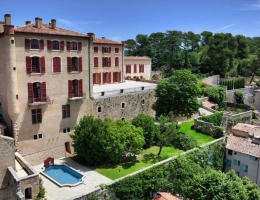
A historic monument for sale in Provence-Alpes-Côte d'Azur can be a fortified farmhouse in the Luberon, a Provençal bastide in Vaucluse stone, an alpine chateau in the Durance valley or a Belle Époque villa on the Côte d'Azur. From the Vaucluse to the Alpes-Maritimes, by way of the Bouches-du-Rhône, the Var and the alpine valleys, the region holds protected heritage shaped by Roman, comital and Mediterranean history. The market spans classified buildings already restored down to their outbuildings and registered residences still waiting for a complete renovation. Browse the historic monuments for sale listed by the region's private owners, agencies and notaries.
This page sets out the protected typologies found across Provence-Alpes-Côte d'Azur, the areas where they cluster, the obligations and grants attached to a classified or registered building, and the checks to carry out before buying. To place this project within the wider approach to purchasing a character residence, read our guide to buying prestige property in France.
Golden limestone from the Luberon and the Alpilles, tuff and river pebble from the Comtat Venaissin, schist from the alpine valleys and dressed stone from Riviera villas make for a sharply contrasted palette of materials. The dominant typologies are the Provençal bastide with its canal-tile roof, the comital chateau remodelled in the seventeenth and eighteenth centuries, the fort or military citadel of the alpine valleys, and the villa or town mansion of the Côte d'Azur coastline. Olive mills and Romanesque chapels also punctuate this protected heritage.
Outbuildings, a dovecote, a private chapel, a dry-stone sheepfold and a terraced garden, often count among the protected elements on the same footing as the main house. Many of these residences retain original features, barrel vaults, fireplaces or frescoes, while still standing as a residence to restore with care, particularly the canal-tile roofs vulnerable to weathering. Recent projects favour local materials and contractors trained in Provençal and alpine techniques.
The Vaucluse, around Avignon, the Luberon and the Comtat Venaissin, holds a comital heritage and a high density of bastides. The Bouches-du-Rhône, between Aix-en-Provence, Arles and Marseille, adds varied urban and rural heritage. The Var, from the Maures massif to the Saint-Tropez peninsula, brings together coastal bastides and wine-growing estates. The Alpes-Maritimes, from Nice to the Grasse hinterland, combines Belle Époque villas with alpine building. The Alpes-de-Haute-Provence and the Hautes-Alpes, away from the coast, complete the picture with forts, citadels and more secluded rural residences around Digne-les-Bains, Gap and Briançon.
Avignon TGV, Aix-en-Provence TGV, Marseille Saint-Charles, Toulon, Les Arcs-Draguignan and Nice are served by TGV, while the Alpes-de-Haute-Provence and the Hautes-Alpes remain linked by road and more local rail connections. Only the Bouches-du-Rhône, the Var and the Alpes-Maritimes front the Mediterranean; the most sought-after areas remain the Côte d'Azur coastline and the Luberon, while the alpine valleys and inland Var offer more accessible protected properties.
Establish from the outset whether the property is classified or merely registered: a classified building requires prior approval from the Architecte des Bâtiments de France and the regional heritage office for any intervention, including to its surroundings, whereas a registered building allows more room for routine maintenance. The historic-monument tax regime, which allows certain costs to be deducted, applies under conditions, to be checked with a notary, along with any grants available from the Fondation du patrimoine or the Provence-Alpes-Côte d'Azur regional heritage office.
Bear in mind that a protected property cannot be sold without informing the buyer of its status and, for a classified building, notifying the administration; confirm that the seller has already completed this step. On the technical side, have the stability of terraced dry-stone walls on sloping ground checked, along with wildfire risk in wooded massifs and the moderate seismic exposure of the alpine valleys; entrust restoration quotations to a qualified contractor trained in Provençal and alpine techniques.
Historic monument listings in Provence-Alpes-Côte d'Azur come from private owners, agencies specialising in protected residences and notaries; filter them by protection status, outbuildings and works already carried out, and set an e-mail alert to follow new listings. To widen your search to the region's full range of high-end properties, browse prestige property for sale in Provence-Alpes-Côte d'Azur.