

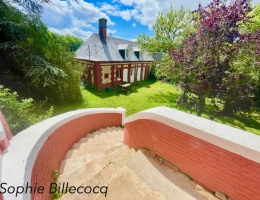
A historic monument for sale in Oise often turns out to be a royal abbey built of Valois stone, a former hunting lodge on the edge of a state forest, or a classified townhouse in the Beauvais area. From Beauvais to Compiègne, by way of the Valois, the Clermont area and the Bray country, the department holds dense classified and registered heritage shaped by its closeness to the royal court and its great forests. Properties range from residences restored at the forest edge to older houses still needing renovation. Browse the historic monuments for sale listed by the department's private owners, agencies and notaries.
This page sets out the protected building types found in Oise, the areas where they are concentrated, the obligations and grants attached to historic-monument status, and the points worth checking before purchase. To place this project within a broader buying strategy, read our guide to buying prestige property in France.
The protected heritage of Oise owes much to its closeness to the royal court and its great forests: limestone from the Valois for the townhouses and abbeys of Senlis, Compiègne and Chantilly, and Picard brick further north around the Beauvais area and the Bray country. Priories, manorial chapels and former hunting lodges on the edges of the Compiègne, Chantilly and Ermenonville forests form a group of classified or registered buildings, often linked to the history of royal and imperial hunting.
The outbuildings follow the same vocabulary: brick outbuildings, a dovecote, sometimes an orangery or an ice house tied to former holiday residences. Many of these buildings were converted into bourgeois residences in the nineteenth century after a more rustic earlier use, which explains their generous proportions and well-kept façades, but also older technical installations that need careful modernisation.
The Beauvais area, around Beauvais and the Bray country, retains classified religious and bourgeois heritage, while the Clermont area, between Clermont and Saint-Just-en-Chaussée, offers more rural residences. The Valois, around Senlis, Compiègne, Chantilly and Ermenonville, holds the greatest number of protected monuments, set among state forests and the Oise and Automne valleys. To the south, the Pays de France, on the edge of greater Paris, offers classified residences sought after by Paris-based buyers.
The department has no TGV station; Intercités and TER services link Beauvais, Compiègne, Senlis and Creil to Paris in under an hour, and Paris-Beauvais airport adds further connections to the north. The A1 and A16 motorways cross Oise from south to north. The most sought-after areas remain the Valois around Chantilly and Senlis; the Clermont area and the Bray country offer protected monuments that are more accessible for comparable size.
A classified building and a registered building do not answer to the same level of control, and this point is worth settling before committing to any works project. No façade, roof or area within the surroundings can be altered without the prior agreement of the Architecte des Bâtiments de France, and for a classified building, without the additional opinion of the regional heritage office at the Hauts-de-France DRAC. The tax regime reserved for historic monuments, which can ease the cost of restoration, remains tied to precise criteria that a professional in the field should check in advance. Finally, note that selling a classified building means clearly informing the buyer, with the authorities notified of the change of ownership at the same time.
On the technical side, look closely at the roofs and timber frames of residences at the edge of a forest, often exposed to persistent damp beneath the tree cover around Chantilly, Compiègne or Ermenonville. In the Beauvais area and the Bray country, both marked by former chalk quarries, a ground survey helps rule out hidden cavities before any foundation work begins. Drainage in isolated residences, often dated, is worth checking during the first visit, along with the rainwater system around the outbuildings. Finally, plan for a heritage architect and craftsmen familiar with the requirements of protected monuments in Oise to work together on the project.
Historic-monument listings in Oise are placed by private owners, agencies specialising in character properties and notaries; filter them by building type, protection status and outbuildings, and set an e-mail alert to follow new listings. To compare with Nord, Pas-de-Calais, Somme and Aisne, browse the historic monuments for sale in Hauts-de-France.


