

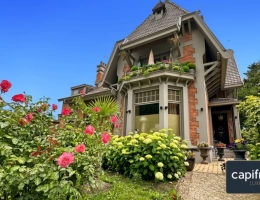
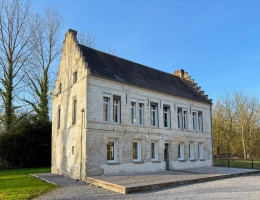
A historic monument for sale in Nord most often takes the form of a Flemish brick townhouse, a secularised abbey or a fortified farmhouse in the Avesnois, all protected under French heritage law. From the Lille conurbation to the Douai area, taking in the Cambrésis, the Flanders coast and the Hainaut, the department retains a dense stock of classified and registered heritage shaped by textiles, coal and the Flemish border. Properties on offer range from restored townhouses with ornate plaster salons to fortified farmsteads still needing complete renovation. Browse the historic monuments for sale listed by the department's private owners, agencies and notaries.
This page sets out the protected building types found in Nord, the areas where they cluster, the obligations and grants tied to historic-monument status, and the checks worth making before any commitment. To place this project within a broader purchase strategy, read our guide to buying prestige property in France.
The protected heritage of Nord reads first through brick: stepped-gable façades around Bergues and Cassel on the Flanders coast, neoclassical or Art Nouveau townhouses from the eighteenth and nineteenth centuries in Lille, and fortified farmsteads built of blue stone in the Avesnois. Several of the department's civic belfries form part of the Belfries of Belgium and France recognised by UNESCO, though many other classified or registered buildings remain far less known: secularised abbeys, priories, beguinage chapels and windmills on the Flanders plain.
The outbuildings often matter as much as the main house: a paved courtyard, brick outbuildings, a dovecote, sometimes a private chapel or a pigeon loft listed alongside the residence. Many of these buildings served industrial or farming uses well into the twentieth century, leaving interiors that need reworking but façades, dormers and joinery that survive intact. Recent restorations favour lime mortars compatible with old brickwork and the retention of original window frames rather than their replacement.
The Lille conurbation and its surroundings, between Lille, Marcq-en-Barœul and Bailleul, hold the greatest concentration of classified townhouses and urban residences. The Douai and Cambrai areas, around Douai, Cambrai and Le Cateau-Cambrésis, retain abbeys and merchants' houses tied to the textile trade and the former mining basin. The Flanders coast, from Bergues to Cassel and Hondschoote, keeps windmills and beguinages close to the Belgian border. Further south, the Avesnois and Hainaut, around Avesnes-sur-Helpe and Maubeuge, offer fortified farmsteads and blue-stone residences in a more rural, less built-up landscape.
Lille-Europe and Lille-Flandres stations are served by TGV, as are the stations at Douai and Valenciennes; the A1 motorway links Paris to Lille and the A2 serves the Cambrésis and Hainaut towards Belgium. The most sought-after areas remain the Lille conurbation and the Flanders coast near Cassel; the rural Avesnois and Cambrésis, further from the fast roads, stay markedly more accessible for a protected residence of comparable size.
Before making an offer, take time to work out whether the building carries classified or registered status, since the degree of oversight applied to future works differs sharply between the two. Any project touching the exterior, the structure or the surroundings needs the approval of the Architecte des Bâtiments de France and, for a classified building, the opinion of the regional heritage office attached to the DRAC; the historic-monument tax regime can ease the cost of works, subject to conditions that should be checked with a professional. Bear in mind, too, that selling a classified building obliges the owner to disclose that status to the buyer, and the authorities must be told at the same time.
On the technical side, have the brick façades checked for rising damp and frost damage, and look into possible ground movement linked to former mine workings in the Douai and Valenciennes areas. On the Flanders coast, water levels and proximity to canals call for a careful check of foundations and drainage. For a property of this kind, it pays to bring in a heritage architect and contractors experienced with protected monuments from the outset, rather than discovering their requirements once works are already under way.
Historic-monument listings in Nord are placed by private owners, agencies specialising in character properties and notaries; filter them by building type, protection status and outbuildings, and set an e-mail alert to follow new listings. To compare with Pas-de-Calais, Somme, Oise and Aisne, browse the historic monuments for sale in Hauts-de-France.


