

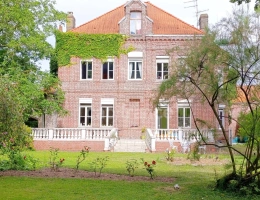
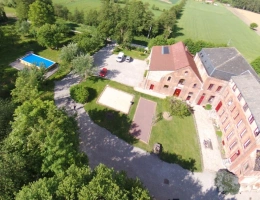
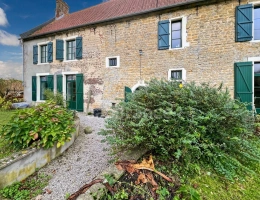
Looking for a historic monument for sale in Pas-de-Calais usually means finding a house built of Marquise stone or Picard brick, a garrison chapel or a former mining building under protection, somewhere between the Opal Coast and the Artois. From Arras to Boulogne-sur-Mer, by way of the Boulonnais, the Ternois and the former mining basin, the department holds a wide range of classified and registered heritage shaped by the sea, chalk and coal mining. Properties range from restored manor houses to former presbyteries or fortified farmsteads still needing complete renovation. Browse the historic monuments for sale listed by the department's private owners, agencies and notaries.
This page sets out the protected building types found in Pas-de-Calais, the areas where they are concentrated, the obligations and grants attached to historic-monument status, and the points worth checking before purchase. To approach this project within a broader buying strategy, read our guide to buying prestige property in France.
Protected buildings in Pas-de-Calais draw on two very different materials: Marquise stone, a grey limestone used in the residences and fortifications of the Boulonnais, and Picard brick in the merchants' houses of the Artois and the former mining basin. Coastal fortifications inherited from Vauban and the guard-houses of Boulogne-sur-Mer sit alongside registered abbeys and priories inland around the Ternois and the Hesdin area. Some mining complexes, workers' settlements and industrial buildings form part of the Nord-Pas-de-Calais mining basin listed as a UNESCO World Heritage site.
Outbuildings remain a key feature of these residences: brick outbuildings, a dovecote, occasionally an orangery, a private chapel or an underground ice house. Many buildings served farming or industrial uses into the twentieth century, leaving interiors to be reworked but original roof timbers and façades still legible. Recent projects favour lime renders and the renewal of slate or flat-tile roofs depending on the area.
The coastline, from Boulogne-sur-Mer to Le Touquet and the Canche estuary, holds protected villas and residences facing the English Channel. The mining Artois, around Béthune, Lens and Liévin, retains classified or registered industrial and bourgeois heritage. Arras and its surroundings, the historic heart of the department, hold the greatest concentration of townhouses and secularised convents. Further south, the Ternois around Saint-Pol-sur-Ternoise and the Hesdin area towards Hesdin and Montreuil-sur-Mer offer more secluded rural residences and priories, set among chalk hills.
The stations at Arras, Béthune, Lens and Boulogne-sur-Mer are served by TGV, as is Calais-Fréthun; the A26 motorway crosses the department from north to south and the A16 runs along the coast. The most sought-after areas remain the Opal Coast around Le Touquet and the historic centre of Arras; the more rural Ternois and Hesdin area offer protected residences that stay markedly more affordable for comparable size.
Start by pinning down the exact protection regime, since classified and registered status give the State very different rights over future works. As soon as a project reaches a façade, a roofline or the immediate surroundings, sign-off from the Architecte des Bâtiments de France becomes mandatory, and for a classified building the regional heritage office also examines the file on behalf of the DRAC. The tax regime specific to historic monuments, which can allow part of the restoration costs to be deducted under certain conditions, is worth reviewing with a notary or tax adviser before committing, since its application depends closely on the nature of the works and the building's future use. Keep in mind, too, that a classified building cannot be sold like an ordinary property: the seller must warn the buyer of its status, and the relevant authorities are notified at the same time.
On the technical side, façades along the coast, from Le Touquet to Boulogne-sur-Mer, warrant close inspection for salt-air damage and moisture, since sea spray accelerates the erosion of stone and mortar joints. In the former mining basin around Béthune, Lens and Liévin, a ground engineer should rule out settlement linked to old mine workings before any extension or groundworks go ahead. Further south, in the chalk valleys of the Ternois and the Hesdin area, cellars and foundations cut into chalk need regular monitoring for damp, since the rock reacts readily to surface water. For work of this kind, it helps to bring in a heritage architect trained in protected monuments early on, followed by building professionals who have already worked on classified or registered buildings in the region.
Historic-monument listings in Pas-de-Calais are placed by private owners, agencies specialising in character properties and notaries; filter them by building type, protection status and outbuildings, and set an e-mail alert to follow new listings. To compare with Nord, Somme, Oise and Aisne, browse the historic monuments for sale in Hauts-de-France.


