

A historic monument for sale in Calvados belongs to very different architectural families: a fortified castle in the Bessin, a timber-framed manor in the Pays d'Auge, an abbey or a townhouse in Caen built of Caen stone, or a former presbytery in the Bocage virois. The department retains a remarkable number of classified or registered buildings, inherited from its ducal, religious and agricultural history, spread between open farmland and hilly hedgerow country. Properties on offer range from a restored residence open to visitors to a fortified farmstead still awaiting consolidation, with outbuildings of every scale. Browse the historic monuments for sale listed by the department's private owners, agencies and notaries.
This page presents the protected building types found in Calvados, the areas where they are most numerous, the obligations and grants attached to a classified or registered property, and the technical and administrative checks worth making before an unhurried purchase. To approach the purchase of a character property as a whole, read our guide to buying prestige property in France. Processing times for works applications also vary depending on the exact nature of the protection in place.
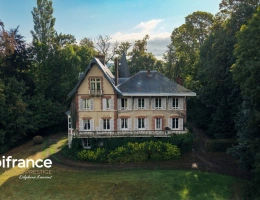
Calvados's protected heritage stands out for the diversity of its materials: golden Caen limestone, used for abbeys and townhouses, timber framing and cob in the Pays d'Auge manors, and the darker granite of the Bocage virois. Moated castles surrounded by farm outbuildings sit alongside townhouses in Caen, Bayeux or Lisieux, marked by classical façades or exposed timber frames dating from the sixteenth and seventeenth centuries.
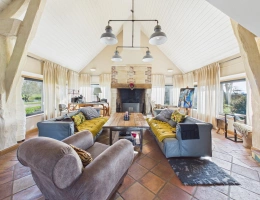
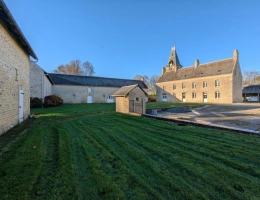
Outbuildings often form an ensemble as large as the main house: dovecotes, private chapels, timber-framed barns, cider presses and stables. Many buildings retain monumental fireplaces, old roof timbers and vaulted cellars, while others need a full restoration of the roof or the joinery. Recent restoration work favours lime, local timber and insulation that respects old walls, particularly on timber frames exposed to sea spray and rain blowing in from the Channel.
The Bessin, around Bayeux, and the Caen plain hold a dense concentration of religious and seigneurial heritage, while the Pays d'Auge, between Lisieux, Livarot and Pont-l'Évêque, lines up timber-framed manors and cider presses in a hedgerow landscape of orchards. The Côte Fleurie, from Deauville to Honfleur, and the Côte de Nacre, near Arromanches and Courseulles, offer residences close to the coast, much sought after by buyers from Paris looking for a Norman retreat. Further south, the Bocage virois and Suisse normande, around Vire, Condé-en-Normandie and Thury-Harcourt, offer more secluded properties in hilly terrain, between steep valleys and small beech woods.
Calvados has no TGV station; trains to Paris run as Intercités or TER services from Caen, Lisieux or Bayeux, and the A13 motorway links the department to the Paris region. The most sought-after areas remain the Côte Fleurie and the surroundings of Bayeux and Caen; the Bocage virois and the interior of the Pays d'Auge offer comparable properties in a more rural setting.
Before any purchase, establish whether the building is classified or only registered: the scope of oversight differs, a classified building requiring prior approval from the regional heritage conservation office for the smallest intervention, while a registered building follows a lighter declarative regime with the DRAC. Within the surroundings of a protected building, any exterior project needs the approval of the Architecte des Bâtiments de France, which lengthens the timeline for works and steers the choice of materials and colours, down to the shade of the slates and the joinery.
The tax regime specific to historic monuments, which allows certain restoration costs to be deducted under conditions, deserves checking with a professional before committing, as does the obligation to inform the buyer of the protection status at the time of sale. On the technical side, have the roof timbers, the condition of the timber framing and the damp levels in the stone walls checked, and entrust the works to qualified contractors experienced with protected sites. Also check the status of rural access tracks and any rights of way, common around isolated residences in the bocage.
Historic monument listings in Calvados come from private owners, agencies specialising in character properties and local notaries; filter them by type, outbuildings, area and protection status, and set an e-mail alert to hear about new listings as soon as they go live. To widen your search beyond the department, browse the historic monuments for sale in Normandy. Many properties are best visited more than once before an offer is made, given how much condition can vary behind a similar façade.