
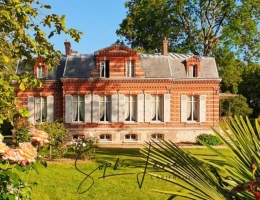
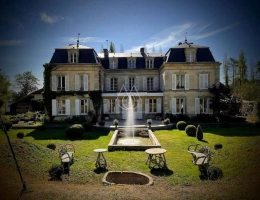

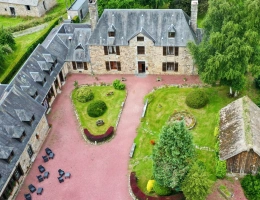

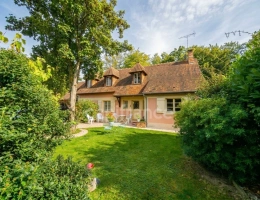
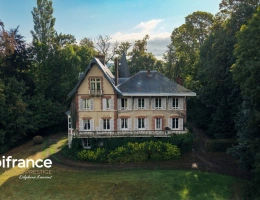
A historic monument for sale in Normandy covers a particularly dense built heritage: medieval abbey churches and priories, half-timbered or Caen-stone chateaux and manor houses, town mansions and mills set along Norman valleys. From the Eure to the Manche, by way of the Seine-Maritime, Calvados and Orne, each department retains protected heritage rooted in a long religious, military and agricultural history. Properties on offer range from a fully restored classified building to a registered residence still awaiting renovation. Browse the historic monuments for sale listed by the region's private owners, agencies and notaries.
This page sets out the protected typologies found across Normandy, the areas where they are most common, the obligations attached to a classified or registered building along with the grants available, and the checks to carry out before buying. To place this project within the wider approach to purchasing a character residence, read our guide to buying prestige property in France.
Norman protected buildings are read first through their materials: timber framing and cob infill in the Pays d'Auge and the Perche ornais, golden Caen stone across urban Calvados, flint and brick in the Caux country, granite in the Avranchin near Mont-Saint-Michel. The dominant typologies are the abbey church and priory born of major monastic foundations, the fortified chateau remodelled during the Renaissance, the manor house with its stair turret, and the town mansion of episcopal cities such as Rouen or Bayeux. A handful of mills on the Orne, the Touques or the Risle complete this picture.
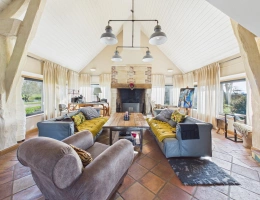
Outbuildings often matter almost as much as the main house: a dovecote, a seigneurial chapel, timber-framed farm buildings, a cider press and orchards of cider or dessert apples depending on the area. Many of these residences retain original roof timbers and fireplaces, but stand as a residence to restore with care, particularly the timber framing exposed to Atlantic damp. Recent restorations favour lime renders, local timber and joinery that respects the original design.
The Eure holds a dense heritage around Évreux, the Seine valley and the Ouche district, with access to the Seine estuary but no coastline of its own. The Seine-Maritime, from the Caux country to the Rouen meander by way of the Alabaster Coast, combines chalk cliffs with country manors. Calvados brings together the Bessin, the Côte de Nacre and the Pays d'Auge, coastal and bocage areas much sought after around Caen, Bayeux and Deauville. The Manche, from the Avranchin to the Cotentin, adds religious heritage close to Mont-Saint-Michel and a coastal granite building tradition. The Orne, the only department in the region with no coastline, completes the picture with the Perche and the Alençon area.
No Norman department is served by a TGV station: connections to Paris run by Intercités and TER trains from Rouen, Caen, Évreux or Lisieux, backed up by the A13 motorway and Deauville-Normandy airport. The most sought-after areas remain the Calvados coast and the Pays d'Auge, along with the surroundings of Mont-Saint-Michel in the Manche; further inland, in the Orne and southern Eure, protected residences remain more affordable for a comparable size.
Before making an offer, establish the exact status of the property: a classified building falls under stricter oversight from the Architecte des Bâtiments de France and the regional heritage office (DRAC de Normandie) than a registered building, including for routine maintenance work. Any exterior work, and sometimes certain interior alterations, on a classified building requires prior authorisation; the surroundings of the monument are likewise subject to the ABF's opinion. The historic-monument tax regime, which allows certain costs to be deducted, applies under conditions, to be checked with a notary or tax adviser before purchase.
Selling a protected building requires the buyer to be informed of its status and, for a classified building, the administration to be notified; check that this formality has already been anticipated by the seller. On the technical side, have the timber framing and roof structures checked for wood-boring insects and dry rot, both common in this damp climate, along with the condition of slate or flat-tile roofing and the drainage system, which often needs upgrading in rural villages; entrust any quotation to a qualified contractor experienced with historic monuments.
Historic monument listings in Normandy come from private owners, agencies specialising in protected residences and notaries; filter them by protection status, outbuildings and works already carried out, and set an e-mail alert to follow new listings. To widen your search to the region's full range of high-end properties, browse prestige property for sale in Normandy.


