

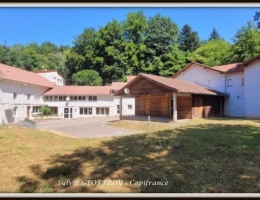
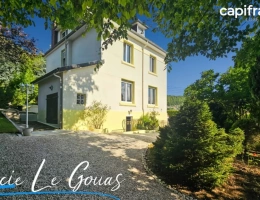
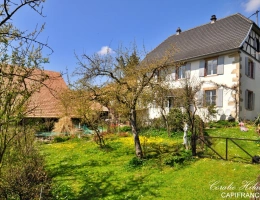
A manor house for sale in Grand Est is recognised first by the range of stone used: golden Champagne limestone around Reims and Troyes, pink Vosges sandstone towards Épinal, Meuse stone in the valley of the same name, and Alsatian half-timbering in Bas-Rhin and Haut-Rhin. From the Ardennes massif to the Champagne vineyard, by way of the Langres plateau and the Nancy and Metz areas, the region holds a highly varied stock of noble buildings, often tied to a wine, forestry or military past. Browse the manor houses for sale listed by the region's private owners, agencies and notaries.
This page brings together real price benchmarks for large residences across Grand Est, the areas where supply is strongest from one department to the next, what sets the building style apart between massifs, and the checks specific to an old residence in a continental climate. To approach the purchase of a prestige property as a whole, read our guide to buying prestige property in France.
DVF land registry data does not identify manor houses as such: the benchmarks below cover sales of houses over 300 m² of living space on 0.05 to 10 ha, above €1,000/m², tracked by our observatory. They frame the market for large residences without describing it entirely: an estate with 30 ha of parkland or a listed monument sold with its farmland falls outside this scope.
In Grand Est, 149 sales were recorded in 2021-2025, with a median price of €550,000, a floor/ceiling range (P10–P90) of €371,900 to €892,000 and a median of €1,475/m² of living space (average 355 m² of living space on 8,007 m² of land). Nationally, the 2025 median stands at €822,000 across 981 sales, with a ceiling (P90) of €3,100,000.
| Scope | Sales | Median price | Floor – ceiling (P10–P90) | €/m² living space (median) |
|---|---|---|---|---|
| Grand Est (2021-2025) | 149 | €550,000 | €371,900 – €892,000 | 1,475 |
| France (2025) | 981 | €822,000 | €428,000 – €3,100,000 | 2,308 |
The breakdown by stratum (coastal, rural tourist, ordinary rural) and the five-year trend are in our observatory of prestige property prices in France (in French). Before making an offer, work out purchase costs and borrowing capacity with our financial tools and calculators.
Source: DVF (DGFiP), transactions from 1 January 2021 to 31 December 2025, processed by ma-propriete.fr; prices rounded to the nearest €100.
In Champagne, across the Marne and the Aube, golden or white limestone dominates the facades, often paired with vaulted cellars dug out for storing wine. Towards the Ardennes and the Meuse, greyer stone, sometimes schist, forms solid houses suited to a harsh climate and wooded relief. In Alsace, across the Bas-Rhin and Haut-Rhin, large rural residences combine timber framing and masonry, under steeply pitched roofs of flat tile, while in Lorraine, around Nancy and Metz, pink sandstone and limestone sit side by side in a plainer building style, with corner quoins often left slightly proud of the render.
Outbuildings often reflect a wine-growing past in Champagne, a forestry one in the Vosges and the Ardennes, or a farming one in Meurthe-et-Moselle and the Meuse: vaulted cellars, timber-framed barns, dovecotes and sometimes a private chapel. A manor with outbuildings remains common in Haute-Marne and the Meuse, while already-restored properties cluster more around Reims, Nancy and Strasbourg, the areas where demand stays highest.
The Ardennes, around Charleville-Mézières, Sedan and the Meuse valley, offer houses that are often wooded and secluded. The Marne concentrates sought-after residences in the Champagne vineyard, between Reims, Épernay and the Côte des Blancs, while the Aube, around Troyes and the Othe forest, offers more affordable building stock. Haute-Marne, on the Langres plateau, and the Meuse, in its valley and the Argonne, hold houses set in open countryside. Further east, Meurthe-et-Moselle, around Nancy and the Saintois, and Moselle, around Metz and the Pays Messin, offer varied building styles, while the Vosges, in both mountain and plain, and Bas-Rhin and Haut-Rhin, between Strasbourg, Colmar and the wine route, complete the regional picture with highly sought-after Alsatian residences.
Charleville-Mézières and Sedan, Reims and Champagne-Ardenne TGV station, Meuse TGV, Nancy, Metz and Lorraine TGV, Épinal and Saint-Dié, plus Strasbourg, Colmar and Mulhouse, give dense TGV access towards Paris and Germany; the Aube and Haute-Marne rely on Intercités and TER links. The most sought-after areas remain the Champagne vineyard and the Alsace wine route; the Haute-Marne and Meuse plateaus stay more affordable for a house of comparable size.
Some of the region's noble buildings, particularly in the Champagne vineyard and along the Alsace wine route, are registered historic monuments or sit within a designated heritage site: establish the exact status, since exterior works require the approval of the Architecte des Bâtiments de France. In municipalities near former military sites, notably in the Meuse and the Ardennes, easements or pyrotechnic pollution risks should be checked before any groundworks.
On the technical side, check the roof timbers and covering, often old on timber-framed houses in Alsace and Lorraine, as well as the vaulted Champagne cellars, which are prone to damp. Private drainage deserves a systematic check in rural areas, as does the status of access tracks, sometimes jointly owned with neighbouring forestry or wine estates. In Bas-Rhin, Haut-Rhin and Moselle, ask the notary to confirm which points of local Alsace-Moselle law still apply to the property, since land registration and some easement rules differ from the rest of France.
Manor house listings in Grand Est come from private owners, specialist agencies and notaries; filter them by price, living space, land and outbuildings, and set an e-mail alert to follow new listings. To widen your search, browse prestige property for sale in Grand Est.


