

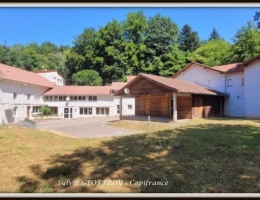
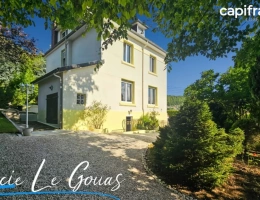
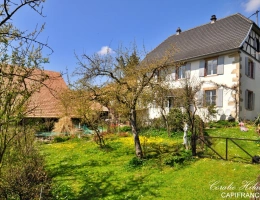
A manor house for sale in Bas-Rhin often takes the form of an Alsatian noble farmyard: a main house in half-timbering or stone, set around a courtyard closed by a gateway, with farm outbuildings lined up along the walls. Local usage sometimes favours "gentleman's residence" or "seigneurial house" over "manor", but the term still refers to these noble rural houses scattered from the Kochersberg to the Outre-Forêt district. Browse the manor houses for sale listed by the department's private owners, agencies and notaries. This architecture, closer to Rhineland models than to a classic château, appeals to buyers as attentive to regional heritage as to modern comfort.
This page brings together real price benchmarks for these Alsatian noble farmyards, the areas where they cluster, what sets their timber-framed architecture apart and the checks specific to the local law of Alsace. To prepare the purchase of a character property as a whole, read our guide to buying prestige property in France.
DVF land registry data does not identify manor houses as such: the benchmarks below cover sales of houses over 300 m² of living space on 0.05 to 10 ha, above €1,000/m², tracked by our observatory. They frame the market for large residences without describing it entirely: an estate with 30 ha of parkland or a listed monument sold with its farmland falls outside this scope.
DVF statistics do not cover this department, which is governed by the Livre foncier land register: only figures for the Grand Est region are given. Across the Grand Est region, the 2021-2025 median stands at €550,000 (149 sales), against €822,000 in France in 2025 (981 sales).
| Scope | Sales | Median price | Floor – ceiling (P10–P90) | €/m² living space (median) |
|---|---|---|---|---|
| Grand Est (2021-2025) | 149 | €550,000 | €371,900 – €892,000 | 1,475 |
| France (2025) | 981 | €822,000 | €428,000 – €3,100,000 | 2,308 |
The breakdown by stratum (coastal, rural tourist, ordinary rural) and the five-year trend are in our observatory of prestige property prices in France (in French). Before making an offer, work out purchase costs and borrowing capacity with our financial tools and calculators.
Source: DVF (DGFiP), transactions from 1 January 2021 to 31 December 2025, processed by ma-propriete.fr; prices rounded to the nearest €100.
The Alsatian noble farmyard pairs a stone ground floor, often in pink Vosges sandstone, with an upper storey of exposed half-timbering, its beams sometimes carved and marked with the Saint Andrew's cross patterns typical of the Kochersberg and the Zorn valley. Steeply pitched roofs, covered in biberschwanz tiles, shelter attics once used for drying tobacco or hops, crops that shaped the Bas-Rhin plain. Some farmyards still carry a dated inscription painted on the wall plate, giving the year the main house was built or rebuilt.
The enclosed courtyard remains the organising feature: a large carriage gateway opens onto a group of barns, byres and sometimes a former wine press or a private chapel. Half-timbering, exposed to damp and wood-boring insects, needs regular upkeep, while lime renders and oak joinery remain the preferred choice to respect the character of listed or inventoried facades. Buyers restoring a badly weathered section often call on a carpenter trained specifically in traditional Alsatian framing techniques.
The Kochersberg, north-west of Strasbourg, and the Saverne area hold a large number of noble farmyards, set in a landscape of cereal-growing hills. To the north, the Outre-Forêt district and the Wissembourg area keep rural residences close to the German border, while the south of the department, around Molsheim and Obernai, offers houses on the edge of vineyard land, without any direct link to the wine trade itself. The Bruche valley, to the west, offers more wooded properties towards Schirmeck. The Hanau district, around Bouxwiller, rounds out the offer with noble farmyards tucked against the first Vosges foothills.
The stations at Strasbourg, Saverne and Sélestat are served by TGV, with Strasbourg under two hours from Paris; the A4 and A35 motorways link the whole department quickly. The most sought-after areas remain the outskirts of Strasbourg and the vineyard belt between Molsheim and Obernai; the rural Kochersberg and the Outre-Forêt, further out, offer more affordable properties for a comparable size.
Bas-Rhin falls under the local law of Alsace-Moselle: property is recorded in the Livre foncier land register, requiring the notary to carry out a specific check of entries and a publication period specific to this regime, different from the property file used in the rest of France. A share of the noble farmyards are also listed in the regional heritage inventory, which governs work visible from the public road.
Have the half-timbering assessed, since it is sensitive to rising damp and insects, along with the roof timbers and the biberschwanz tile covering, whose partial replacement must respect the original appearance. Also check the drainage system, often needing upgrading in Kochersberg villages, and the status of the tracks giving access to adjoining farmland. Finally, ask about any communal hunting rights attached to farmland near the estate.
Manor houses and noble farmyards in Bas-Rhin are offered by private owners, agencies specialising in character properties and notaries; filter listings by price, floor area, land and outbuildings, and set an e-mail alert to follow new ones. To compare with other departments in the region, browse the manor houses for sale in Grand Est. The local notary remains the reference contact for any question tied to the Livre foncier before signing.


