

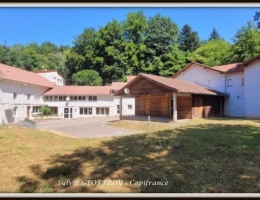
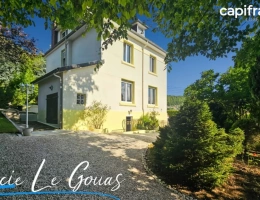
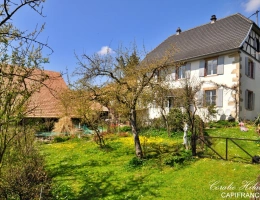
A manor house for sale in Moselle often stands out through a blend of French and Rhineland influences, visible in the shape of the roofs, occasional half-timbering and the local vocabulary that readily favours "gentleman's residence" over "château". From the Nied district to the Saulnois, by way of the northern Vosges and the Moselle valley, these residences accompany a rural building stock shaped by the former salt and wine trades. Browse the manor houses for sale listed by the department's private owners, agencies and notaries. Some of these houses belonged to families of local standing, tied to the salt or wine trades or, later, to the industrial growth of the coal basin.
Here you will find real price benchmarks for these Moselle houses, the areas where they cluster, what marks out their mixed architecture and the points to watch in a department governed by local law. For a full view of buying a character property, read our guide to buying prestige property in France.
DVF land registry data does not identify manor houses as such: the benchmarks below cover sales of houses over 300 m² of living space on 0.05 to 10 ha, above €1,000/m², tracked by our observatory. They frame the market for large residences without describing it entirely: an estate with 30 ha of parkland or a listed monument sold with its farmland falls outside this scope.
DVF statistics do not cover this department, which is governed by the Livre foncier land register: only figures for the Grand Est region are given. Across the Grand Est region, the 2021-2025 median stands at €550,000 (149 sales), against €822,000 in France in 2025 (981 sales).
| Scope | Sales | Median price | Floor – ceiling (P10–P90) | €/m² living space (median) |
|---|---|---|---|---|
| Grand Est (2021-2025) | 149 | €550,000 | €371,900 – €892,000 | 1,475 |
| France (2025) | 981 | €822,000 | €428,000 – €3,100,000 | 2,308 |
The breakdown by stratum (coastal, rural tourist, ordinary rural) and the five-year trend are in our observatory of prestige property prices in France (in French). Before making an offer, work out purchase costs and borrowing capacity with our financial tools and calculators.
Source: DVF (DGFiP), transactions from 1 January 2021 to 31 December 2025, processed by ma-propriete.fr; prices rounded to the nearest €100.
The Moselle noble residence combines facades of Vosges sandstone or Saulnois limestone with, here and there in the east of the department, sections of half-timbering inherited from Alsatian and Rhineland influence. Steeply pitched roofs, covered in flat tile or slate, and finely worked dormers point to construction often carried out in stages between the seventeenth and nineteenth centuries. The oldest residences still have vaulted cellars and storerooms, evidence of a wine-growing tradition now gone from much of the department. On the oldest buildings, a worn coat of arms or an inscription carved above the gateway sometimes recalls the name of the founding family.
The outbuildings, barns, byres, a dovecote and sometimes a former private chapel, are arranged around a courtyard closed by a gateway. The Saulnois keeps the memory of salt production through former annex buildings now converted, while the Nied district holds more modest noble farmhouses. Recent restorations favour lime renders and local sandstone for facade repairs.
The Saulnois, around Château-Salins and Vic-sur-Seille, and the Nied district, near Boulay-Moselle, offer rural residences away from the main urban areas. The Moselle valley, from Metz to Thionville, holds houses close to urban centres and the Luxembourg border, much sought after by cross-border commuters. To the north-east, the first foothills of the northern Vosges and the Bitche district offer more wooded and secluded properties, on the edge of Alsace. Further south, Sarrebourg and the Sarrebourg-Moselle Sud area, more rural, offer secluded residences in a landscape of ponds and forest close to Meurthe-et-Moselle.
Metz and Lorraine TGV stations reach Paris in a little over ninety minutes, with TER connections towards Nancy, Saarbrücken and Luxembourg; the A4 and A31 motorways cross the department. The most expensive areas lie near Metz and along the border corridor towards Luxembourg; the Saulnois and the Bitche district remain markedly more affordable for a manor of equivalent size.
Moselle falls under the local law of Alsace-Moselle: property here is recorded in the Livre foncier land register rather than the standard French property file, which brings specific land-registration formalities at the point of sale and calls for a thorough check of mortgage entries by the notary. This regime, inherited from the annexation period, also applies to planning rules and sometimes to hunting rights attached to certain estates.
On the technical side, have the roof timbers and covering checked, since they are often old, along with vaulted cellars exposed to damp. Check the status of the access tracks, the private drainage system, and, for properties in a former wine-growing area, any galleries or cellars cut into the hillside, which can affect ground stability. Finally, check whether a hunting right is attached to the estate, common in rural Moselle and sometimes transferred with the property.
Moselle manor houses are offered by private owners, agencies specialising in character properties and notaries; filter listings by price, floor area, land and outbuildings, and set an e-mail alert to follow new ones. To compare with other departments in the region, browse the manor houses for sale in Grand Est. Ask the notary for a recent Livre foncier extract before making any offer.


