

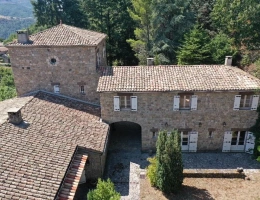
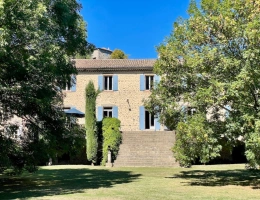

A manor house for sale in Ardèche rarely fits local vocabulary, which more often speaks of a bastide, a manor farmhouse or a fortified mas to describe the department's grand rural residences. What the market groups under the word manor is often a noble residence built of volcanic stone from the Coiron, granite from the Cévennes ardéchoises or limestone from the Ardèche verte, surrounded by dry-stone terraces and chestnut groves. Browse the manor houses for sale listed by private owners, agencies and notaries across the department.
This page brings together real price benchmarks for grand residences in Ardèche, the areas where they are spread across the Ardèche verte, the Coiron and the Cévennes, the character of the local building tradition, and the checks specific to an old residence on steep terrain. To prepare the purchase of a prestige property as a whole, read our guide to buying prestige property in France.
DVF land registry data does not identify manor houses as such: the benchmarks below cover sales of houses over 300 m² of living space on 0.05 to 10 ha, above €1,000/m², tracked by our observatory. They frame the market for large residences without describing it entirely: an estate with 30 ha of parkland or a listed monument sold with its farmland falls outside this scope.
The local market is too thin to publish a reliable department-level benchmark (28 sales in five years): we give the figures for the Auvergne-Rhône-Alpes region. Across the Auvergne-Rhône-Alpes region, the 2025 median stands at €860,000* (87 sales), against €822,000 in France in 2025 (981 sales).
| Scope | Sales | Median price | Floor – ceiling (P10–P90) | €/m² living space (median) |
|---|---|---|---|---|
| Auvergne-Rhône-Alpes (2025) | 87 | €860,000* | €492,700 – €2,670,000 | 2,542 |
| France (2025) | 981 | €822,000 | €428,000 – €3,100,000 | 2,308 |
The breakdown by stratum (coastal, rural tourist, ordinary rural) and the five-year trend are in our observatory of prestige property prices in France (in French). Before making an offer, work out purchase costs and borrowing capacity with our financial tools and calculators.
Source: DVF (DGFiP), transactions from 1 January 2021 to 31 December 2025, processed by ma-propriete.fr; prices rounded to the nearest €100. * Fewer than 100 sales: read as an indication only.
The Ardèche manor farmhouse stands out through materials closely tied to local geology: dark basalt from the Coiron plateau, granite and schist from the Cévennes ardéchoises, pale limestone from the Ardèche verte and the Bas-Vivarais. Roofs, covered in canal tiles in the south and in slate or stone slabs in the Cévennes heights, follow slopes that vary with altitude and exposure. The plan often combines a two-storey main house, an enclosed courtyard and sometimes a watchtower, a remnant of clustered settlement built for defence.
Outbuildings include barns, silkworm houses and sometimes a chestnut-drying kiln, a reminder of a rural economy founded on chestnut groves and silkworm rearing until the twentieth century. Many houses have kept their dry-stone terraces, costly to maintain today, along with original floors and fireplaces. Recent restorations favour lime renders, restoring traditional roofing and careful water management, a scarce resource in summer on the heights. Stone cisterns or storm-water tanks, dug into the hillside, are often still the only water storage available on isolated properties.
The Ardèche verte, around Annonay and the Doux valley, offers a building tradition of limestone and timber closer to Dauphiné influence, while the Coiron plateau in the centre keeps basalt residences set apart in a landscape of volcanic uplands. The Cévennes ardéchoises, from Largentière to Vals-les-Bains and Aubenas, keep granite and schist houses clinging to the slopes, surrounded by terraced hillsides. Further south, the Gorges de l'Ardèche and the Bas-Vivarais, around Vallon-Pont-d'Arc and Ruoms, attract tourist demand that pushes up prices for the best-located properties.
The department has no TGV station of its own; rail access runs through Valence TGV station, on the other side of the Rhône, or by road from Montélimar. The most expensive areas remain the Gorges de l'Ardèche and the touristic Bas-Vivarais, along with the area around Aubenas; the more rural and remote Ardèche verte and Cévennes ardéchoises offer comparable old residences on markedly more accessible terms. Distances in the Cévennes ardéchoises can be deceptive, since winding mountain roads make travel times longer than a straight-line reading of the map would suggest.
The department's steep terrain calls for particular care with old residences built on terraced hillsides: have the stability of the dry-stone retaining walls and the drainage of run-off water checked, since it can be particularly violent during autumn Cévenol storms. In the Gorges de l'Ardèche and other designated areas, the local development plan and protected-site status strictly limit new building and extensions visible from tourist viewpoints.
On the technical side, check the condition of the roof timbers, often old, and dampness in the dry-stone walls, which are prone to seepage. Check the private drainage system, which frequently needs upgrading in isolated rural areas, along with the availability of drinking water, which can depend on a private spring in the heights of the Cévennes ardéchoises, and the municipal or private status of access tracks. Wildfire risk, real on the wooded slopes of the Coiron and the Cévennes ardéchoises, often requires mandatory brush clearance around buildings.
Listings for manors, bastides and manor farmhouses in Ardèche come from private owners, agencies specialising in character properties and notaries; filter them by price, living space and outbuildings, and set an e-mail alert to follow new listings. To compare with neighbouring departments, browse the manor houses for sale in Auvergne-Rhône-Alpes.


