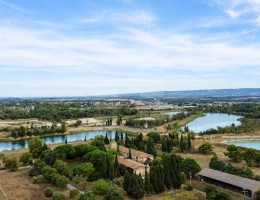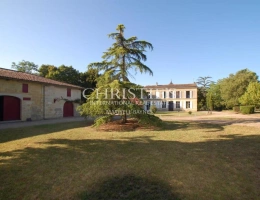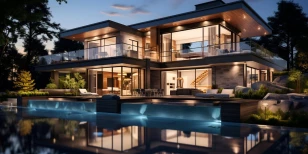
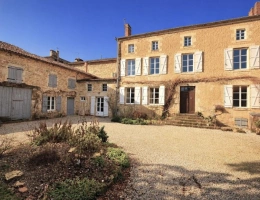
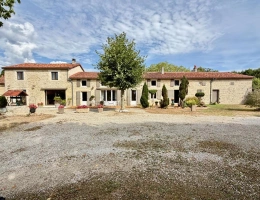
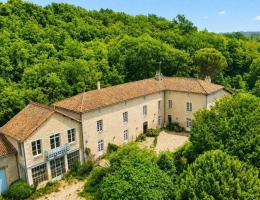
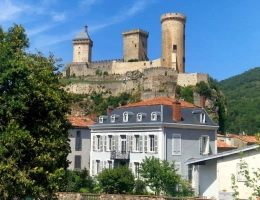
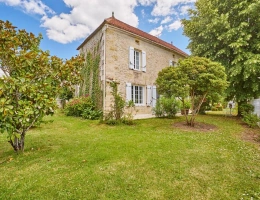
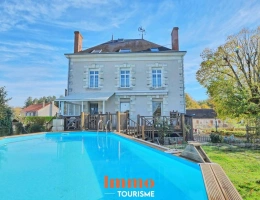
A maison de maître for sale can be recognised before you even cross the threshold: a symmetrical façade of three or five bays, tall small-paned windows, front steps and a fanlight over the door, a slate or tile roof over two principal storeys and attics, a walled park with its outbuildings. Built between the eighteenth and the early twentieth century by a local notable, a merchant, an industrialist or a landowner, it is the most widespread of France's grand houses, found in every market town and every wine region. It gives this section its name but does not exhaust it: here you will find all the fine residences listed in the luxury property category of ma-propriete.fr, bourgeois houses, bastides and mas of character, chartreuses, seaside villas, architect-designed houses and contemporary properties in parkland, wherever the living space exceeds 300 m² or the price approaches a million euros and the property belongs neither to the chateaux, nor the manor houses, nor the historic monuments. Listings are placed by private owners, specialist agencies and notaries, across France and its overseas territories.
Here you will find the prices actually paid for these residences, region by region, the profile of the properties currently on the market, what distinguishes a maison de maître from a manor house, a bourgeois house or a villa, where to look, the checks to carry out before buying and answers to the most frequent questions. To organise your project, rely on our guide to buying luxury property in France.
Maisons de maître and fine residences form the core of the segment tracked by our prestige property observatory, which analyses in the DVF database of the French tax administration the sales of houses with more than 300 m² of living space on 0.05 to 10 hectares, above €1,000 per m². In 2025, 981 sales were recorded in France at a median price of €822,000 and an average of €1,321,374; 80% of transactions closed between €428,000 and €3,100,000, at a median of €2,308 per m² of living space, for a typical residence of 368 m² on 1.2 hectares. The median has risen by 17% since the second half of 2020, through a complete cycle: record volumes in 2021, rising prices until 2023, a volume correction in 2024 and a recovery in 2025.
Regional differences are considerable and owe less to the buildings than to the location: the table below ranks the thirteen mainland regions by 2025 median price (2021-2025 aggregate for Corsica and Grand Est, where fewer than thirty sales were recorded in 2025).
| Region | Sales | Median price | €/m² living space |
|---|---|---|---|
| Corsica * | 33 | €3,752,796 | 8,183 |
| Provence-Alpes-Côte d'Azur | 151 | €2,520,000 | 6,914 |
| Île-de-France | 90 | €1,445,000 | 4,247 |
| Brittany | 44 | €987,500 | 2,607 |
| Auvergne-Rhône-Alpes | 87 | €860,000 | 2,542 |
| Normandy | 57 | €760,000 | 2,017 |
| Hauts-de-France | 79 | €756,850 | 2,131 |
| Pays de la Loire | 57 | €750,000 | 2,006 |
| Occitanie | 126 | €662,500 | 1,804 |
| Nouvelle-Aquitaine | 171 | €615,027 | 1,692 |
| Centre-Val de Loire | 52 | €591,475 | 1,570 |
| Bourgogne-Franche-Comté | 43 | €590,000 | 1,714 |
| Grand Est * | 149 | €550,000 | 1,475 |
These benchmarks place a listing within its market; they do not replace a valuation of the residence itself, whose worth depends on the condition of roofs and timbers, the quality of the surviving interiors, the outbuildings and the park. Detail by department, by stratum (coastal, rural tourist, ordinary rural) and by year is in our observatory of luxury property prices in France (in French); our financial tools and calculators then let you work out purchase costs and borrowing capacity.
Source: DVF (DGFiP), transactions from 1 July 2020 to 31 December 2025, processed by ma-propriete.fr; rounded prices. * Corsica and Grand Est: 2021-2025 aggregate.
As of 28 September 2026, the section lists 267 properties in France at a median asking price of €978,000 (average €1,520,334); 80% of properties are offered between €485,000 and €2,750,000, for a median living space of 372 m² on 1.0 hectare of land, or €2,864 per m² of living space. These are asking prices, before negotiation; they compare with the actual sale prices in the previous section, which are generally lower.
| Asking price | Listings | Share |
|---|---|---|
| under €500,000 | 33 | 12 % |
| €500,000 to €800,000 | 58 | 22 % |
| €800,000 to €1.2M | 70 | 26 % |
| €1.2M to €2M | 67 | 25 % |
| €2M to €5M | 31 | 12 % |
| over €5M | 8 | 3 % |
The departments with the most listings in France:
| Department | Listings | Median asking price |
|---|---|---|
| Gironde (33) | 33 | €1,290,000 |
| Bouches-du-Rhône (13) | 13 | €2,490,000 |
| Guadeloupe | 12 | €839,450 |
| Vaucluse (84) | 12 | €1,700,000 |
| Lot-et-Garonne (47) | 11 | €815,000 |
| Charente-Maritime (17) | 11 | €638,000 |
| Gard (30) | 10 | €997,500 |
| Landes (40) | 9 | €827,000 |
Statistics calculated on the listings published in the section on 28 September 2026; they change daily with new listings and withdrawals.
On ma-propriete.fr, this section takes in the prestige properties that fit no other classification: neither chateau, nor manor house, nor historic monument, nor agricultural, wine or forest estate, nor equestrian property. In practice these are houses with more than 300 m² of living space, or properties priced above €700,000 to €800,000, whatever their period: maison de maître and bourgeois house, Provençal bastide and mas, chartreuse of the South-West, prestige longère, large seaside or mountain villa, architect-designed house, contemporary property in parkland, creole residence overseas. The listings online bear this out: maisons de maître in the strict sense sit alongside estates, residential domains, villas and architect-designed houses.
The term means the house of the "master", the owner of an estate, a factory or a trading business, as opposed to the dwellings of his employees and tenant farmers. Appearing in the seventeenth century, the maison de maître had its golden age between 1750 and 1900: a rectangular plan, a symmetrical elevation, a central stone or oak staircase, reception rooms opening one into the next on the ground floor, bedrooms upstairs, kitchens and service rooms in the basement or a wing. Ceilings are often over three metres high; parquet floors, marble fireplaces, panelling and plasterwork are the rule. It differs from the manor house, a rural seigneurial residence from before the seventeenth century, from the chateau, larger and endowed with towers or pavilions, and from the urban bourgeois house, later and without an estate. The maison de notable, the merchant's house, the gentilhommière and, in the South-West, the chartreuse are local variants; English-speaking buyers often simply call it a French mansion.
For the older residences, the plan is the same everywhere, the materials are not: golden stone and curved tiles in the South-West, checkerboard brick and flint in the pays de Caux, Caen stone in Normandy, granite in Brittany and the Massif Central, tuffeau in the Loire valley, red brick in the North and Lorraine, limestone and slate in Burgundy, pebbles and tiles in Provence where the bastide plays the same role. Hipped roofs, dormers and finials point to the eighteenth century; rusticated façades, cast-iron balconies and glass canopies to the nineteenth. Outbuildings follow the original activity: winery and vat room in wine country, cider press in cider country, stables and coach houses, orangery, dovecote, caretaker's cottage. Recent fine residences, villas and architect-designed houses, are judged on other criteria: build quality and materials, orientation and views, energy performance, pool, pool house and the layout of the grounds.
The maison de maître is first of all a house in a market town or on the edge of a village, which makes it more practical than an isolated chateau: shops, schools and station within walking distance. The wine regions, Gironde, Charente, Hérault, Aude, Burgundy, Champagne and the Loire valley, offer the largest number, often with a few hectares of vines or land. Normandy, Picardy, the North and rural Île-de-France attract Parisian buyers within two hours of the capital; the Dordogne, the Lot, the Gers and the Tarn appeal to French and foreign buyers looking for sunny countryside; Brittany and the Pays de la Loire offer logis and malouinières at more moderate levels. Our article on the best regions to buy a luxury property in France compares these markets, and our guide for non-resident buyers covers the practical side of buying from abroad.
An old residence is judged from the top down: roofs, timbers and flashings are the heaviest repair items, followed by façades, old joinery and services. Check for damp in cellars and footings, dry rot in the North-West and termites in the South-West, the nature of the soil (clay, cavities, marl pits) and the constraints of the local planning document, particularly within the surroundings of a historic monument, where the Architecte des Bâtiments de France has a say. A full survey by an architect or an old-buildings specialist, before the offer, is the rule; our article on renovating a listed residence sets out the constraints and the grants. On a contemporary property, attention turns to the compliance of the buildings and the pool with planning permissions, to any construction guarantees still running and to running costs.
These residences sell more slowly on average than an ordinary house: the pool of buyers is smaller, viewings take time and the negotiation concerns condition as much as price. For the buyer, financing often combines equity, a mortgage and a works budget; taxation, transfer duties, the property wealth tax above the threshold, heritage protection regimes, is prepared in advance, as our article on the taxation of luxury real estate explains. Some of the finest residences change hands without advertising: our analysis of off-market luxury property describes how to reach them. For the seller, the valuation must separate the value of the buildings, that of the interiors and outbuildings, and that of the land; our criteria for valuing a prestige property provide the framework.
Yes, as soon as it exceeds 300 m² of living space or its price approaches a million euros: the section gathers fine residences of every period that do not belong to the chateaux, manor houses or historic monuments.
The maison bourgeoise is urban or suburban, generally post-1850, without an estate or farm outbuildings; the maison de maître is the house of an estate or a business, with a park and service buildings. In listings the two terms often overlap: the plan, the date and the outbuildings settle the matter.
In 2025, half of all large rural residences of more than 300 m² sold between €428,000 and €3,100,000, with a median of €822,000; a village maison de maître to restore in central or eastern France is well below these levels, a residence in good condition within an hour of Paris or on the coast well above.
Over five years, the median price of this segment has risen by 17% despite higher interest rates; value rests on scarcity and location more than on the general market. Running costs, roofs, heating, park, are on the other hand out of all proportion to those of a recent house and must be part of the calculation.
Yes, without restriction for EU nationals and for other nationalities alike; bank financing and taxation differ according to residence, which justifies taking advice before making an offer.
Listings of maisons de maître and fine residences are placed by private owners, specialist agencies and notaries; filter them by region, department, price, living space, land and outbuildings, then set an e-mail alert to follow new properties as they come to market. Depending on your project, extend your search to chateaux for sale, manor houses for sale or country houses. If you are selling a residence of this kind, place your listing to reach qualified buyers in France and abroad.