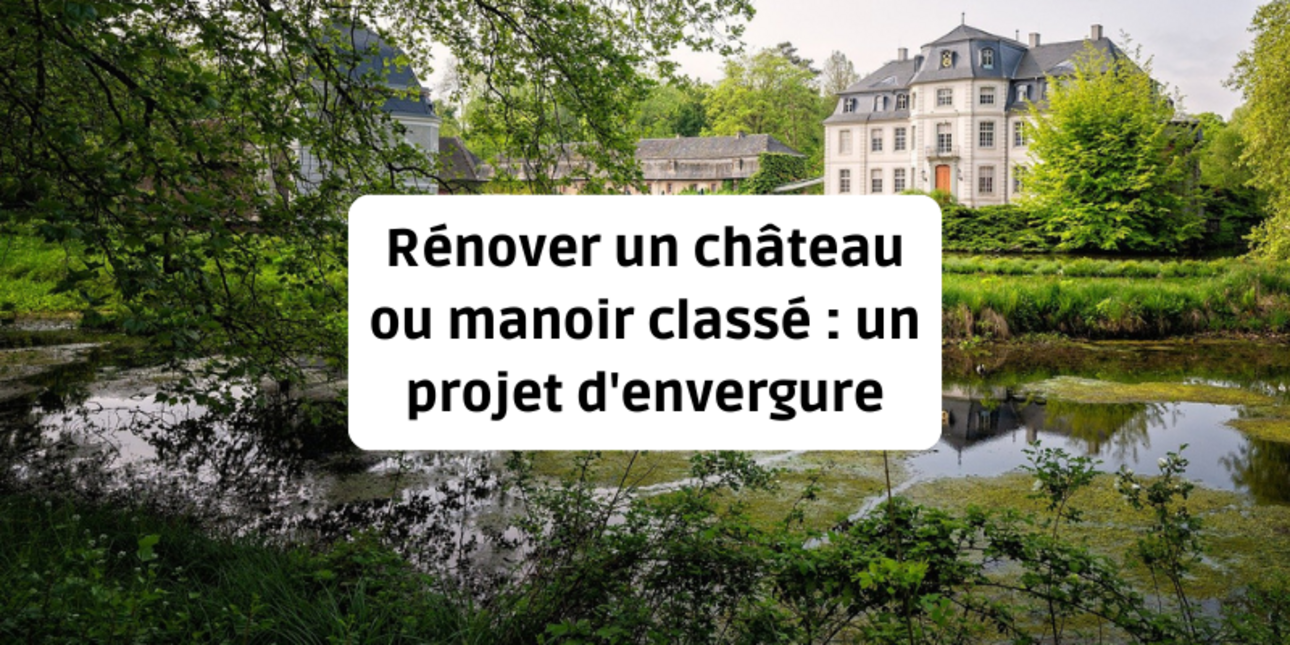
Have you just purchased a historic estate or are you considering the acquisition of a château requiring significant renovation work? Renovating a historic monument (a château or manor house listed as a historic monument) is an ambitious project that goes well beyond simple restoration. It involves not only restoring period features (roofs, timber frames, dressed stone, woodwork, etc.), but also preserving the building's style and authenticity while adapting it to modern standards (comfort, safety).
This heritage adventure involves numerous administrative and technical procedures, as well as securing appropriate financing.
The Ma-propriete.fr Expert's Advice: Before you start, get in touch with the UDAP (Departmental Architecture and Heritage Unit) for your department or the DRAC (Regional Directorate of Cultural Affairs) for your region. These State services are your first points of contact to validate the project, define the architectural rules to be respected and consider the possible financial support available.
Preserving architectural and historical integrity. A listed château or manor house represents heritage that is often unique and protected. Each element (stone façade, timber framework, carved decorations, etc.) must be restored with care. Traditional materials and techniques (lime, dressed stone, period tiles, etc.) compatible with the original structure must be chosen.
The aim is to preserve the soul of the place: for example, recovering the colour of the original renders, relaying the tiles using traditional methods, or restoring the ironwork in the period style. This work of "identical restoration" can prove costly and time-consuming, but it is what guarantees the building's heritage value.
Complying with regulations and the ABF's opinion. Historic monuments are strictly regulated. For any work (painting, joinery, interior fittings, etc.), it is essential to first obtain authorisation from the DRAC, together with the opinion of the Architect of the Buildings of France (ABF). The ABF – a heritage specialist – validates the work's compliance with regard to the building's history (style, materials, colours).
Any undeclared modification can result in penalties (restoration obligations, fines, or even criminal proceedings). In practice, a building permit or prior declaration is filed with the town hall, which will be reviewed by the DRAC/ABF. These procedures ensure that the renovation is carried out in compliance with the standards for protected heritage.
Surrounding yourself with specialised professionals. A project of this scale requires a qualified team: a heritage architect or BEA architect (for listed monuments), specialised engineering firms, and experienced craftspeople (stonemasons, journeyman carpenters, traditional roofers, etc.).
These experts understand the technical constraints (traditional masonry, bio-sourced insulation, rainwater drainage that respects the structure, etc.) and manage the coordination of the worksite. Engaging a specialised architect is also often required to unlock State subsidies.
The Ma-propriete.fr Expert's Advice: Never begin work without authorisation. As the Ministry of Culture explains, "to discuss the project's eligibility and put together the application, it is recommended to consult the decentralised service of the Ministry of Culture (DRAC/UDAP) for your region beforehand". Careful planning (historical audit, technical assessment) avoids unpleasant surprises and speeds up administrative approval.
The Ma-propriete.fr Expert's Advice: Put together a solid application. Include in your applications the preliminary studies and detailed estimates for each trade. A well-prepared file (photos, description of the works, justified estimates) increases your chances of obtaining the necessary subsidies and approvals.
Works on historic monuments are financially demanding, but several public schemes (national and local) and tax mechanisms can ease the cost. Here are the main resources:
The Ma-propriete.fr Expert's Advice: Optimise your tax support. Consider the Historic Monuments property deficit status: the full deduction of restoration works from your income (property or overall) is possible. Combined with DRAC subsidies (around 40% for a listed monument), this significantly reduces the budget. Do not overlook the advantages of the Foundation label either (reduced VAT, "instant" tax relief on works).
Modern comfort and suitable insulation. Renovation does not mean rejecting progress. Contemporary equipment (high-performance central heating, new plumbing, secure electrical systems) can be integrated without sacrificing authenticity. For example, a wood pellet boiler or a latest-generation heat pump is often installed, while keeping historic stoves in certain rooms. The insulation must be breathable (hemp wool, wood fibre, cellulose wadding) to let the old structure "breathe". An insulating inner lining can be fitted to the walls, or the loft insulated, taking care not to block water vapour. Old windows and doors can be restored identically, sometimes combined with discreet insulating glazing.
Energy renovation and support. Even a listed château can benefit from "green" schemes: MaPrimeRénov' covers part of insulation or heating works, and VAT is reduced to 5.5% on energy renovation invoices. Don't forget any local support (region, department) that often supplements these schemes. In addition, the DRAC can also provide financial backing for eco-renovation projects.
The Ma-propriete.fr Expert's Advice: Favour sustainable materials. Opt for plant-based insulation (hemp, flax, wood) and a high-performance heating system (heat pump, pellet boiler). Take advantage of MaPrimeRénov' and the 5.5% VAT rate: they also apply to châteaux, including listed ones. This will significantly reduce your energy bill while respecting the old structure.
Estimating the overall budget for a heritage worksite precisely is tricky, as each project is unique (condition of the building, scope of works, finishes, etc.). However, you should expect very high costs per square metre. For example, studies indicate that a complete renovation of a château of around 800 m² generally ranges between €1,500 and €2,000 per m² (and this can rise further for high-end finishes or heavy structural works). In addition, don't forget to factor in the annual running costs: heating (an old château can cost €40,000–€70,000 per year in heating and electricity depending on its size), insurance, maintenance staff, etc.
This works budget must always be weighed against the purchase price. According to the official DVF data from our Prestige Property Price Observatory, a large rural property in need of renovation is often acquired at around €700,000 in rural areas (median price for the segment). For an 800 m² residence, a complete renovation at €1,500–2,000/m² therefore represents an additional €1.2 to €1.6 million: the cost of the works can thus equal, or even exceed, the purchase price. This is precisely what justifies thinking in terms of overall cost from the outset rather than the mere asking price.
To keep this budget under control, have a realistic costing carried out by a heritage architect right from the design phase. An experienced professional will identify the major items (roofing, framework, refurbishment of floors or façades, upgrading of utility networks) and avoid unpleasant surprises (worm-eaten timber frames, fragile vaults, foundations needing reinforcement).
Despite the substantial investment, the successful renovation of a château brings a significant increase in heritage value. A restored monument generally sees its value multiply compared with its "before works" state. What's more, you can consider profitable activities to make the place pay (event venue rentals, prestige guest rooms, film shoots, etc.). Heritage rehabilitation is therefore also a project of lasting enhancement: it ensures the building's longevity and turns it into a high-end asset.
The Ma-propriete.fr Expert's Advice: Be prepared for a five- or six-figure budget. Based on concrete examples, count on at least €1,500 per m² for an overall renovation (or more if the château is very dilapidated). Always ask a specialised architect or project manager for a detailed estimate: they will refine these figures. And don't forget to provision for routine upkeep (heating, charges, staff), which can amount to several tens of thousands of euros per year.
Renovating a listed château or manor house is a major undertaking combining a passion for heritage with technical challenges. By surrounding yourself with specialists (heritage architect, Historic Monuments-certified craftspeople) and complying with the administrative constraints, you guarantee the quality of the works and the acceptance of the application by the authorities (DRAC, ABF). Public subsidies (DRAC) and tax mechanisms ("Historic Monuments" deduction, Fondation du Patrimoine label, etc.) are essential to finance this exceptional worksite. In the end, this renovation contributes to safeguarding the national heritage and enhances an exceptional estate: your restored château will pass history on to future generations while constituting a prestige property investment.