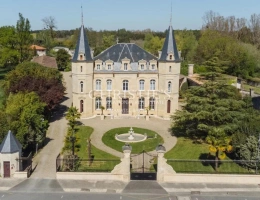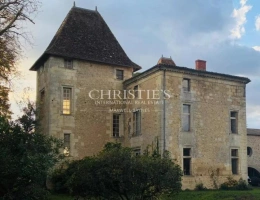
A chateau for sale in Gironde most often refers to a wine estate, since the word has become part of everyday Bordeaux appellation vocabulary, though the department also holds pleasure residences without vineyards, notably around Bordeaux, in the Entre-deux-Mers and towards the Arcachon basin. The building stock mixes noble townhouses, low Landes-style chartreuses, monumental wineries and nineteenth-century turreted houses built during the boom of the Bordeaux wine trade. Browse every chateau for sale listed by the private owners, agencies and notaries of Gironde.
This page gathers real price benchmarks for Gironde, the areas from the Médoc to the Sauternes district, the particularities of buildings often tied to a vineyard, and the checks specific to this kind of property. To plan a purchase from start to finish, read our guide to buying prestige property in France.
DVF land registry data does not identify chateaux as such: the benchmarks below cover sales of houses over 300 m² of living space on 0.05 to 10 ha, above €1,000/m², tracked by our observatory. They frame the market for large residences without describing it entirely: an estate with 30 ha of parkland or a listed monument sold with its farmland falls outside this scope.
In Gironde, 235 sales were recorded from 2021 to 2025, with a median price of €772,000, a floor/ceiling range (P10–P90) of €430,800 to €1,984,400 and a median of €2,072/m² of living space, for an average of 379 m² of living space and 16,475 m² of land. Across the Nouvelle-Aquitaine region, the 2025 median stands at €615,000 (171 sales), against €822,000 in France in 2025 (981 sales).
| Scope | Sales | Median price | Floor – ceiling (P10–P90) | €/m² living space (median) |
|---|---|---|---|---|
| Gironde (2021-2025) | 235 | €772,000 | €430,800 – €1,984,400 | 2,072 |
| Nouvelle-Aquitaine (2025) | 171 | €615,000 | €400,000 – €1,480,000 | 1,692 |
| France (2025) | 981 | €822,000 | €428,000 – €3,100,000 | 2,308 |
The breakdown by stratum (coastal, rural tourist, ordinary rural) and the five-year trend are in our observatory of prestige property prices in France (in French). Before making an offer, work out purchase costs and borrowing capacity with our financial tools and calculators.
Source: DVF (DGFiP), transactions from 1 January 2021 to 31 December 2025, processed by ma-propriete.fr; prices rounded to the nearest €100.
Local usage applies the word "chateau" both to a genuinely old building and to a simple wine estate carrying a commercial name: beyond the label, it is worth checking whether a listing is a real historic residence or a modern winery attached to a farmhouse. Gironde chartreuses, long low single-storey houses topped by an attic, sit alongside two-storey houses with turrets and pediments inherited from the nineteenth century, a period when the wine trade funded many rebuilds.
Wine estates almost always include a winery, sometimes on an industrial scale, plus service buildings for equipment and staff housing. Non-wine estates tend instead to have an orangery, stables and a landscaped park. The condition of the winery, vat rooms and their electrical systems should be assessed separately from the residential buildings, with a direct impact on the overall value of the estate. Buyers should also confirm whether the winery holds any current AOC certification separately from the residence, since the two are not always transferred together.
The Médoc, between Bordeaux and the Pointe de Grave, holds the best-known residences, often tied to an appellation vineyard; the Entre-deux-Mers, between the Garonne and the Dordogne, offers more rural, more affordable buildings. The Sauternes district and the Libourne area around Saint-Émilion hold old houses built into well-known wine estates. Further west, the Arcachon basin and the Gironde coastline form a different market, geared more towards seaside villas than rural chateaux. Buyers new to the area often benefit from a first visit guided by a local specialist familiar with the estates on offer.
Access is a major strength of the department: Bordeaux Saint-Jean station, served by TGV, puts Paris a little over two hours away, and Libourne station completes the network towards the Libourne area. The A10, A63 and A62 motorways serve the whole territory. The most sought-after, and therefore most expensive, areas remain the Médoc near Bordeaux and the Libourne area around Saint-Émilion; the eastern Entre-deux-Mers and the north of the department stay more affordable.
When a property is sold with its vineyard, it is essential to have the farming status clarified: vines held outright, tenancy or share-cropping, appellation and any planting rights attached, all of which weigh heavily on value and future use. Some residences in the Médoc and Libourne area are listed or registered historic monuments, which subjects exterior work to the opinion of the Architecte des Bâtiments de France. Protected surroundings tied to the most prestigious appellations can also constrain new building nearby.
On the technical side, check flood zoning along the Garonne and the Dordogne for properties in low-lying areas, as well as the drainage arrangements for both winery and residence. The heating cost of large Gironde chartreuses, poorly insulated when originally built, is worth planning for. For a wine estate, also have the built land, the vines and the farming equipment valued separately before making an offer. It is also worth confirming whether the SAFER land agency holds a pre-emption right over adjoining vineyard or farmland, a common feature in this department.
Chateau listings in Gironde are published by private owners, specialist agencies and notaries; you can filter them by price, living space, vineyard area and the presence of a winery, then set up an e-mail alert to follow new properties as they come to market. To widen your search, browse the chateaux for sale in Nouvelle-Aquitaine.