


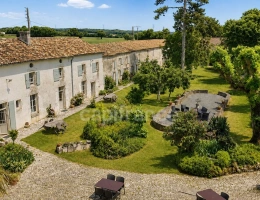


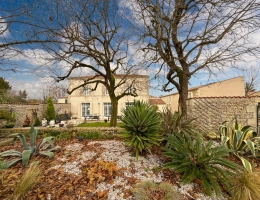
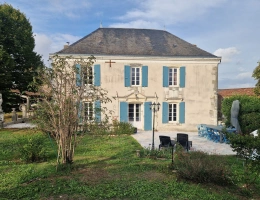
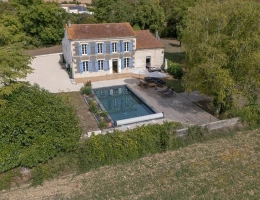
A chateau for sale in Charente-Maritime often stands between marshland, vineyards and an Atlantic coastline, from the Saintes area to the Rochefort district, taking in the outskirts of La Rochelle and the Île de Ré. Local buildings, in pale limestone, range from eighteenth-century Charente-style residences to wine-estate manor houses, some surrounded by cognac vineyards in the north of the department. Browse every chateau for sale listed by the private owners, agencies and notaries of Charente-Maritime.
This page presents real price benchmarks for large residences on the coast and inland, the most sought-after areas, the character of local buildings and checks specific to the territory. To plan a heritage purchase, read our guide to buying prestige property in France. Buying plans here vary considerably depending on proximity to the coast, ranging from a second home near the beaches to a wine estate geared toward cognac production.
DVF land registry data does not identify chateaux as such: the benchmarks below cover sales of houses over 300 m² of living space on 0.05 to 10 ha, above €1,000/m², tracked by our observatory. They frame the market for large residences without describing it entirely: an estate with 30 ha of parkland or a listed monument sold with its farmland falls outside this scope.
In Charente-Maritime, 154 sales were recorded from 2021 to 2025, with a median price of €652,000, a floor/ceiling range (P10–P90) of €412,500 to €1,444,500 and a median of €1,807/m² of living space, for an average of 369 m² of living space and 9,955 m² of land. Across the Nouvelle-Aquitaine region, the 2025 median stands at €615,000 (171 sales), against €822,000 in France in 2025 (981 sales).
| Scope | Sales | Median price | Floor – ceiling (P10–P90) | €/m² living space (median) |
|---|---|---|---|---|
| Charente-Maritime (2021-2025) | 154 | €652,000 | €412,500 – €1,444,500 | 1,807 |
| Nouvelle-Aquitaine (2025) | 171 | €615,000 | €400,000 – €1,480,000 | 1,692 |
| France (2025) | 981 | €822,000 | €428,000 – €3,100,000 | 2,308 |
The breakdown by stratum (coastal, rural tourist, ordinary rural) and the five-year trend are in our observatory of prestige property prices in France (in French). Before making an offer, work out purchase costs and borrowing capacity with our financial tools and calculators.
Source: DVF (DGFiP), transactions from 1 January 2021 to 31 December 2025, processed by ma-propriete.fr; prices rounded to the nearest €100.
Charente-Maritime buildings stand out for their pale limestone, known as Saintonge stone, found on both classical façades and the carved detailing of dormers and gateways. Roofs are canal tile in the south, closer to the Aquitaine influence, and slate or flat tile around Saintes and Rochefort. Some properties, in the wine-growing area around Cognac and Jonzac, combine the residence with cellars and vineyards, a configuration to weigh carefully from an economic standpoint. Lime-rendered façades and the region's typical louvred shutters offer effective protection against marine humidity when well maintained.
Estates frequently include outbuildings: service wings, a dovecote, a chapel and sometimes an attached farm still under mixed or cereal farming. Near the coast and the marshes, humidity and salt air speed up the wear of joinery and ironwork, a point to factor into the upkeep budget. The cellar, where still active, deserves particular attention regarding the condition of its roof timbers and natural ventilation.
Properties are spread between the Rochefort area and greater La Rochelle, Saintonge around Saintes, and the north of the department, toward Jonzac and Cognac, where vineyards dominate the landscape. The Rochefort and Brouage marshes, as well as the Gironde estuary to the south around Mortagne-sur-Gironde, bring open, wet landscapes. The Île de Ré and Île d'Oléron, prized for seaside housing, hold few genuine chateaux and belong to a separate market. Around Saintes, the Charente and Boutonne valleys keep a dense built heritage, while the area around Marennes stands out for its oyster-farming activity.
The department has TGV stations at La Rochelle and Surgères, connecting to Paris in a little over three hours, and the A10 serves the north toward Saintes and Rochefort. Areas close to La Rochelle and the coast remain the most sought-after and the most expensive, while the vineyard-covered north and the south toward Jonzac offer more affordable properties of comparable size. Areas close to La Rochelle and the Île de Ré remain the most sought-after, while the vineyard-covered north and the south toward Jonzac offer noticeably more accessible properties.
Part of the department's historic building stock is listed or registered as a historic monument, particularly around Saintes and Rochefort, which should be checked case by case before any works are planned. Coastal flooding zoning applies to much of the shoreline and marshland and should be checked before buying any property near the coast or an estuary. Attached vineyards mean checking the status of any current tenancy or wine-growing lease. It is also worth checking whether the property lies within a protected natural heritage site, common near the coastal marshes.
On the technical side, exposure to sea spray and marine humidity speeds up the deterioration of joinery, ironwork and renders, a point to budget for routine upkeep. The drainage system, roof condition and the stability of cellars dug into the limestone, common in Saintonge, also deserve checking. A full survey before the offer is recommended for any property near the coast or the marshes. Regular upkeep of ironwork and exterior joinery, heavily exposed to salt air, represents an expense worth anticipating.
Chateaux for sale in Charente-Maritime are listed by private owners, specialist agencies and notaries; you can filter listings by price, living space, land area and outbuildings, then set up an e-mail alert to track new properties coming to market. To widen your search across the region, browse the chateaux for sale in Nouvelle-Aquitaine. Listings often specify whether vineyards are currently under cultivation, a decisive criterion for buyers interested in the cognac-growing area.


