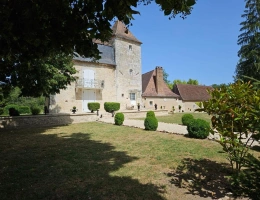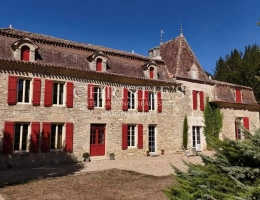
The market for a chateau for sale in Dordogne is among the richest in rural France, driven by the renown of the Périgord and by a long-standing concentration of noble residences along the Dordogne, Vézère and Isle valleys. Buyers find medieval chateaux perched on rocky spurs alongside eighteenth-century gentlemen's residences with pale stone façades, turreted manors of the Périgord Noir and wine-estate residences around Bergerac. Explore every chateau for sale listed by the private owners, agencies and notaries of the department.
This page sets out real price benchmarks recorded in Dordogne, the most sought-after areas from the Périgord Noir to the Périgord Vert, local materials and building types, and the checks to carry out on a property that often sits within a protected area. To plan a heritage purchase from start to finish, read our guide to buying prestige property in France.
DVF land registry data does not identify chateaux as such: the benchmarks below cover sales of houses over 300 m² of living space on 0.05 to 10 ha, above €1,000/m², tracked by our observatory. They frame the market for large residences without describing it entirely: an estate with 30 ha of parkland or a listed monument sold with its farmland falls outside this scope.
In Dordogne, 135 sales were recorded from 2021 to 2025, with a median price of €618,600, a floor/ceiling range (P10–P90) of €400,000 to €988,800 and a median of €1,667/m² of living space, for an average of 373 m² of living space and 24,753 m² of land. Across the Nouvelle-Aquitaine region, the 2025 median stands at €615,000 (171 sales), against €822,000 in France in 2025 (981 sales).
| Scope | Sales | Median price | Floor – ceiling (P10–P90) | €/m² living space (median) |
|---|---|---|---|---|
| Dordogne (2021-2025) | 135 | €618,600 | €400,000 – €988,800 | 1,667 |
| Nouvelle-Aquitaine (2025) | 171 | €615,000 | €400,000 – €1,480,000 | 1,692 |
| France (2025) | 981 | €822,000 | €428,000 – €3,100,000 | 2,308 |
The breakdown by stratum (coastal, rural tourist, ordinary rural) and the five-year trend are in our observatory of prestige property prices in France (in French). Before making an offer, work out purchase costs and borrowing capacity with our financial tools and calculators.
Source: DVF (DGFiP), transactions from 1 January 2021 to 31 December 2025, processed by ma-propriete.fr; prices rounded to the nearest €100.
Périgord architecture is known for its pale limestone, quarried locally, and for the traditional heavy limestone lauze roofs, laid at a steep pitch, found on the oldest residences of the Périgord Noir. Round towers topped with pepper-pot roofs, corner turrets and watch turrets often mark a medieval fortress reworked into a residence during the Renaissance or the classical period. Later houses, particularly around Bergerac, use canal-tile roofs and plainer façades closer to Bordeaux-area architecture. Some façades also show later repairs in brick or rendered stone, evidence of work carried out with whatever material was locally at hand.
Properties for sale often come with substantial outbuildings: square or round dovecotes, timber-framed barns, wineries where the estate includes vines, and sometimes dry-stone huts (bories) on the oldest plots. The condition of the lauze, a scarce and costly material to replace, and of the lime render on stone walls, should be examined closely before any negotiation.
The Périgord Noir, around Sarlat-la-Canéda and the Vézère and Dordogne valleys between Montignac and Domme, holds the highest concentration of chateaux and manor houses, set among oak forests and limestone cliffs. The Périgord Blanc around Périgueux, and the Périgord Pourpre around Bergerac and its appellation vineyards, offer more accessible residences. To the north, the Périgord Vert, between Nontron and Brantôme, stays more wooded, hillier and noticeably less sought after by overseas buyers.
Rail access runs through the stations at Périgueux and Bergerac, linked to Bordeaux and Paris by Intercités and TER services; the department has no TGV station. The A89 motorway crosses the north of the department towards Bordeaux and Clermont-Ferrand. The most expensive areas remain the Périgord Noir near Sarlat and the Dordogne valley; the Périgord Vert and the eastern part of the department, around Hautefort and Thenon, are more affordable for comparable buildings. Buyers drawn to the area for its produce, from walnuts to strawberries, often value a kitchen garden or orchard as much as the residence itself.
A significant share of Périgord chateaux are listed or registered historic monuments, particularly in the Périgord Noir where protected buildings are dense; exterior works there require the opinion of the Architecte des Bâtiments de France. The department's limestone subsoil, known for its caves and natural cavities, makes it worth checking for a ground-movement risk prevention plan in the relevant municipality. Easements linked to farm tracks or rights of way to neighbouring woodland are common on larger estates. Neighbouring cave systems used for tourism can also bring seasonal visitor traffic close to an otherwise quiet property.
On the technical side, check the condition of the roof timbers and lauze, whose restoration draws on a small pool of specialist craftsmen, along with the drainage system, often individual outside the towns. Flood zoning along the Dordogne and Vézère is worth checking for properties near the floodplain. Finally, for an estate that includes vines, ask for the winegrowing status and any leases to be clarified before committing.
Chateau listings in Dordogne are published by private owners, specialist agencies and notaries; you can filter them by price, living space, land area and outbuildings, then set up an e-mail alert to follow new properties as they come to market. To widen your search to neighbouring departments, browse the chateaux for sale in Nouvelle-Aquitaine.