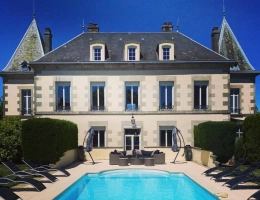
A chateau for sale in Haute-Vienne is usually found in the Limousin, between Limoges, Bellac and Saint-Junien, a territory of granite and bocage where medieval fortified residences were often remodelled during the classical period. Properties frequently combine a main building in local stone with farm outbuildings, set among wooded hills and lakes. Discover every chateau for sale listed by the private owners, agencies and notaries of Haute-Vienne.
This page brings together real price benchmarks for large residences in the department, the areas where they cluster, the character of local buildings and the points to check before a visit. To plan a heritage purchase, read our guide to buying prestige property in France. Projects here range from a fully restored family residence to an attached forestry estate, often sought after for hunting or woodland management.
DVF land registry data does not identify chateaux as such: the benchmarks below cover sales of houses over 300 m² of living space on 0.05 to 10 ha, above €1,000/m², tracked by our observatory. They frame the market for large residences without describing it entirely: an estate with 30 ha of parkland or a listed monument sold with its farmland falls outside this scope.
The local market is too thin to publish a reliable department-level benchmark (28 sales in five years): we give the figures for the Nouvelle-Aquitaine region. Across the Nouvelle-Aquitaine region, the 2025 median stands at €615,000 (171 sales), against €822,000 in France in 2025 (981 sales).
| Scope | Sales | Median price | Floor – ceiling (P10–P90) | €/m² living space (median) |
|---|---|---|---|---|
| Nouvelle-Aquitaine (2025) | 171 | €615,000 | €400,000 – €1,480,000 | 1,692 |
| France (2025) | 981 | €822,000 | €428,000 – €3,100,000 | 2,308 |
The breakdown by stratum (coastal, rural tourist, ordinary rural) and the five-year trend are in our observatory of prestige property prices in France (in French). Before making an offer, work out purchase costs and borrowing capacity with our financial tools and calculators.
Source: DVF (DGFiP), transactions from 1 January 2021 to 31 December 2025, processed by ma-propriete.fr; prices rounded to the nearest €100.
Haute-Vienne buildings rest on local granite, whose grey tone dominates façades and window surrounds, with slate or flat-tile roofs depending on the area. The heritage includes many medieval fortified residences, some flanked by round towers, remodelled during the Renaissance or the classical period into more comfortable homes. There are also nineteenth-century manor houses from farming or forestry estates, plainer than the larger chateaux. Carved granite lintels and window surrounds, sometimes finished with a simple chamfer, distinguish the oldest residences from later nineteenth-century rebuilds.
Outbuildings often include granite service wings, a chapel and farm buildings still in use, set in an environment where lakes and woodland are common. The harsher Limousin climate, wetter and cooler than in neighbouring departments, calls for particular attention to roof condition and the insulation of large volumes. The private chapel, where one survives, is often the best-preserved remnant of the original estate and deserves close attention during a viewing.
Properties are found first on the outskirts of Limoges and in the Vienne valley, then in the Monts d'Ambazac and Monts de Blond to the north, a landscape of granite moorland and forest. To the west, toward Bellac and the neighbouring Confolens district, bocage dominates, while to the south, toward Saint-Yrieix-la-Perche and the Basse-Marche, properties are more secluded, on the edge of Dordogne and Corrèze. Rochechouart to the west is known for its meteorite-linked subsoil, unrelated to the buildings but often mentioned locally. Between Ambazac and Saint-Léonard-de-Noblat, the hilly landscape of moorland and forest offers secluded properties, while the south toward Nexon remains more agricultural.
The department has no TGV station; rail access runs through Intercités and TER services to Paris via Limoges-Bénédictins, complemented by the A20 motorway crossing the department from north to south. Areas close to Limoges and the Vienne valley remain the most sought-after, while the north toward Bellac and the south toward Saint-Yrieix offer more affordable properties of comparable character. Communes close to Limoges see the strongest demand, while the north toward Bellac and the south toward Saint-Yrieix offer more affordable properties of comparable character.
Some fortified residences and chateaux in Haute-Vienne are registered historic monuments, particularly those keeping medieval features, which should be checked case by case before any restoration project. Easements linked to an attached farm track or fishing rights on a lake should also be clarified with the notary. Classification as a water-catchment area, common on this granite plateau, can restrict certain uses of the land. It is also worth checking whether the property lies within a protected natural heritage site, a status held in several parts of the department.
On the technical side, damp linked to the Limousin climate, the condition of slate roofs and the heating cost of older, often poorly insulated volumes are decisive points. The drainage system, non-mains in most rural areas, and the upkeep of any lakes on the property should be checked before the offer. A survey by a heritage professional before buying remains a reasonable precaution. Heating costs for large volumes, made heavier by the damp Limousin climate, should be anticipated before any permanent occupation.
Chateaux for sale in Haute-Vienne are listed by private owners, specialist agencies and notaries; you can filter listings by price, living space, land area and outbuildings, then set up an e-mail alert to track new properties coming to market. To widen your search across the region, browse the chateaux for sale in Nouvelle-Aquitaine. Listings often specify the area of attached woodland, a feature sought by buyers interested in hunting or forestry management.