
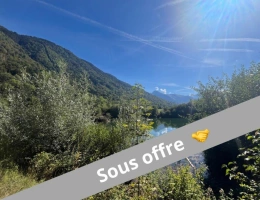
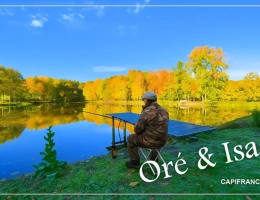
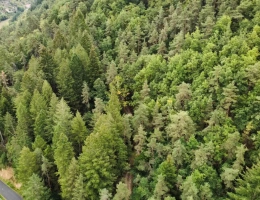
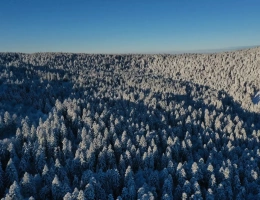
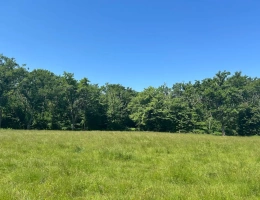
Looking for hunting property for sale in Isère means choosing between the mountains and the lowlands, which the departmental hunters’ federation divides into twelve hunting districts. To the east and south, Chartreuse, Belledonne, the Vercors, Oisans, Trièves and Matheysine offer Alpine hunting: chamois, red deer, roe deer and wild boar, mouflon on a few massifs, and black grouse and rock partridge above the treeline. To the west and north, the Chambaran plateau, the Bièvre plain, the Terres froides hills and the Isle-Crémieu combine broadleaved woods, farmland and marshes, home to wild boar and roe deer, with wildfowl around the ponds. Properties for sale range from a steep wood attached to a mountain farm to a lowland hunting ground with its own lake; those listed by private sellers, estate agents and notaires appear alongside our sporting properties for sale throughout France.
Below this introduction, a data block sets out the forest and pond prices recorded in Isère together with the official game bag figures, in which red deer, roe deer and wild boar all feature strongly. Next come the two main kinds of ground in Isère and the rules that shape the value of a purchase: municipal hunting associations, a multi-year cull plan and fencing.
A hunting estate is rarely valued with a single figure: its price adds up the value of the woodland, the ponds, the buildings and the shooting facilities. The statistics below give benchmarks for wooded land and ponds, based on sales actually recorded.
According to the ma-propriete.fr forest price observatory, built from sales recorded in the French DVF land registry database, the median price of a hectare of forest in Isère was €3,940/ha in 2025*, across 72 sales, with an average of €4,414/ha. That puts the department below the Auvergne-Rhône-Alpes median (€4,057/ha) and below the national median (€4,936/ha). Year on year, the departmental median moved by +12.6%: a change to read with caution on fewer than a hundred sales, where a few large estates can shift the median. Over the more robust 2020-2025 period, 424 sales give a median of €3,554/ha for a median plot size of 3.2 ha.
| Indicator | Isère (38) | Auvergne-Rhône-Alpes | France |
|---|---|---|---|
| Median price 2025 | €3,940/ha* | €4,057/ha | €4,936/ha |
| Average price 2025 | €4,414/ha* | €4,843/ha | €6,214/ha |
| Number of sales 2025 | 72 | 964 | 6,329 |
| Change in median 2024 → 2025 | +12.6%* | +1.3% | +1.9% |
| Median price 2020-2025 | €3,554/ha | €4,000/ha | €4,778/ha |
| Number of sales 2020-2025 | 424 | 5,257 | 35,100 |
Nationally, the price per hectare rises with size: the large properties that appeal to hunters sell for more per hectare than medium-sized woods.
| Size of forest sold (France, 2020-2025) | Median price | Number of sales |
|---|---|---|
| 10 to 20 ha | €4,010/ha | 3,161 |
| 20 to 50 ha | €5,330/ha | 1,850 |
| 50 to 100 ha | €6,810/ha | 581 |
| Over 100 ha | €7,361/ha | 320 |
Ponds trade at a very different level: a median of €32,708/ha for the 24 ponds sold without buildings in Isère between 2020 and 2025†, a sample too small to be representative; regionally, the median reaches €15,847/ha.
On the listings side, 18 hunting properties are offered on ma-propriete.fr across France as of 2 October 2026, none in Auvergne-Rhône-Alpes at that date. Their median asking price is €888,000 for a median size of about 68 ha. These asking prices apply to complete properties, often with buildings, a pond or hunting rights: they cannot be compared directly with DVF medians per hectare.
* 30 to 99 sales: indicative value. † 10 to 29 sales: sample too small to be representative of the local market. Source: DVF (French tax authority), processed by ma-propriete.fr; forests of 1 ha or more, cadastral type woodland; ponds without buildings of at least 2,000 m²; July 2020 to December 2025; Moselle, Bas-Rhin and Haut-Rhin are not covered by DVF. Listings recorded on ma-propriete.fr on 2 October 2026.
The game bag records published by the French Biodiversity Agency (OFB) measure hunting pressure and, indirectly, the presence of big game. In Isère, 1,199 red deer were taken in the 2024-2025 season, about 1.3% of the national total, alongside 7,245 roe deer and 7,654 wild boar.
| Species | 2021-2022 season | 2024-2025 season | Change |
|---|---|---|---|
| Red deer | 904 | 1,199 | +33% |
| Roe deer | 6,863 | 7,245 | +6% |
| Wild boar | 7,146 | 7,654 | +7% |
| Chamois | 1,729 | 1,746 | +1% |
| Mouflon | 347 | 166 | −52% |
Source: OFB, wild ungulates network, departmental big game bags (total culls, data published on data.gouv.fr).
In the massifs, hunting is mostly by stalking and driven days, on slopes of beech, silver fir and spruce that climb to the summer pastures. Chamois hold the limestone cliffs of Chartreuse and the Vercors, red deer use the large forests of the Pre-Alps, and among the mountain gamebirds, black grouse and rock partridge come under a cull plan, ptarmigan and hazel grouse under a maximum bag limit. The Chartreuse and Vercors regional nature parks oversee development in these massifs, while the core of the Écrins national park, on the Oisans and Valbonnais side, is closed to hunting: a plot inside that boundary is of no use to a hunter. Rather than large private holdings, you will find a hunting wood on a slope, hay meadows and a barn, whose appeal depends on winter access, the state of the forest tracks and how undisturbed the cover remains despite walkers and skiers.
Between the Isère valley and the Bièvre plain, the Chambaran plateau carries coppice of beech, sweet chestnut and oak where deer and wild boar find shelter; a state forest occupies its centre near Roybon, next to a military camp, and most of the rest belongs to small private owners. North of the Bièvre, the Bonnevaux forest and the Terres froides hills alternate woodland, maize and grassland: properties tend to be a wood of a few dozen hectares or a shoot attached to a farm, and the brown hare, whose hunting may come under an approved management plan, still has its place. To the north-east, the Isle-Crémieu plateau, part of the federation’s Haut-Rhône dauphinois district, and the Bourbre marshes, in its Balmes and Dauphiné marshes district, add ponds, reedbeds and passing duck. If you want water on your ground, see also our ponds and lakes in Isère.
Isère has an ACCA (approved municipal hunting association) in every commune, alongside several hundred private shoots. A holding below the opt-out threshold therefore stays hunted by the municipal association: the law sets that threshold at a minimum of 20 ha in one block and raises it to 100 ha for mountain land above the treeline. Above it, the owner can withdraw the land from the ACCA through a strict procedure and timetable; have the federation confirm the threshold that applies. For big game, the cull plan runs over several years, three for red and roe deer and six for chamois and mouflon, and its level tells you a good deal about the ground. Ask the seller as well about wild boar damage to maize in the Bièvre and the Terres froides: a holder of hunting rights who does not cull enough can be held liable.
If the property is fenced, check the fencing last. Under the act of 2 February 2023, a fence in a natural area must leave a 30 cm gap above the ground, stay no higher than 1.20 m and let wildlife pass; fences put up since 1993 must be adapted before 1 January 2027. Our page on hunting fences under the 2023 act sets out the exemptions, notably for farm fencing and fences around a dwelling.
Hunting properties in Isère listed on ma-propriete.fr come from private sellers, estate agents and notaires; narrow the list by size and price, and switch on an email alert to hear as soon as new ground is published. If you are selling, you can place your own listing there too. If the woodland matters more than the shooting, browse our woods and forests in Isère; to compare with Savoie or the Drôme, open the sporting estates for sale in Auvergne-Rhône-Alpes.