
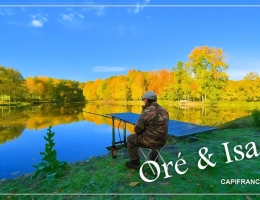
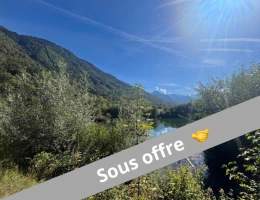
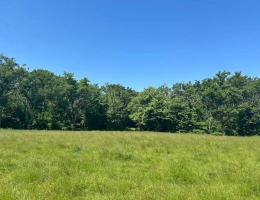
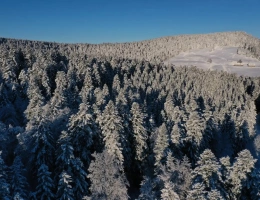
A hunting property for sale in Ain comes in two very different forms. In the west, the Dombes, a plateau of more than a thousand ponds between the Saône, the Côtière escarpment and the river Ain, is one of France’s great wildfowling areas: duck and snipe on the ponds, roe deer and wild boar in the woods between them; its closeness to Lyon made it a sought-after hunting ground from the early twentieth century. In the east, the Bugey, the Valromey and the Pays de Gex belong to the Jura range: beech, fir and spruce forests, chamois on the ridges, roe deer and wild boar everywhere. Whether you are after a duck pond, a mountain hunting wood or a Bresse farm with a few fields, offers from private sellers, estate agents and notaires are grouped with our shoot and estate listings across France.
The data block further down gives the forest and pond prices recorded in Ain and the official game bag figures, led here by wild boar. Next come the department’s two main territories and the local rules that affect the value of a purchase: how hunting is organised, minimum shooting areas, cull plans and fencing. If water is your priority, our lakes and ponds in Ain complement this page.
A hunting estate is rarely valued with a single figure: its price adds up the value of the woodland, the ponds, the buildings and the shooting facilities. The statistics below give benchmarks for wooded land and ponds, based on sales actually recorded.
According to the ma-propriete.fr forest price observatory, built from sales recorded in the French DVF land registry database, the median price of a hectare of forest in Ain was €4,374/ha in 2025*, across 52 sales, with an average of €5,194/ha. That puts the department above the Auvergne-Rhône-Alpes median (€4,057/ha) and below the national median (€4,936/ha). Compared with 2024, the median changed by −7.7%, a movement to interpret with care given the number of sales. Over the more robust 2020-2025 period, 295 sales give a median of €3,991/ha for a median plot size of 3.4 ha.
| Indicator | Ain (01) | Auvergne-Rhône-Alpes | France |
|---|---|---|---|
| Median price 2025 | €4,374/ha* | €4,057/ha | €4,936/ha |
| Average price 2025 | €5,194/ha* | €4,843/ha | €6,214/ha |
| Number of sales 2025 | 52 | 964 | 6,329 |
| Change in median 2024 → 2025 | −7.7%* | +1.3% | +1.9% |
| Median price 2020-2025 | €3,991/ha | €4,000/ha | €4,778/ha |
| Number of sales 2020-2025 | 295 | 5,257 | 35,100 |
Nationally, the price per hectare rises with size: the large properties that appeal to hunters sell for more per hectare than medium-sized woods.
| Size of forest sold (France, 2020-2025) | Median price | Number of sales |
|---|---|---|
| 10 to 20 ha | €4,010/ha | 3,161 |
| 20 to 50 ha | €5,330/ha | 1,850 |
| 50 to 100 ha | €6,810/ha | 581 |
| Over 100 ha | €7,361/ha | 320 |
Ponds trade at a very different level: a median of €11,471/ha for the 22 ponds sold without buildings in Ain between 2020 and 2025†, a sample too small to be representative; regionally, the median reaches €15,847/ha.
On the listings side, 18 hunting properties are offered on ma-propriete.fr across France as of 2 October 2026, none in Auvergne-Rhône-Alpes at that date. Their median asking price is €888,000 for a median size of about 68 ha. These are asking prices for complete properties: they describe the supply on offer more than the average price of a wooded hectare.
* 30 to 99 sales: indicative value. † 10 to 29 sales: sample too small to be representative of the local market. Source: DVF (French tax authority), processed by ma-propriete.fr; forests of 1 ha or more, cadastral type woodland; ponds without buildings of at least 2,000 m²; July 2020 to December 2025; Moselle, Bas-Rhin and Haut-Rhin are not covered by DVF. Listings recorded on ma-propriete.fr on 2 October 2026.
The game bag records published by the French Biodiversity Agency (OFB) measure hunting pressure and, indirectly, the presence of big game. In Ain, 313 red deer were taken in the 2024-2025 season, about 0.3% of the national total, alongside 3,822 roe deer and 7,942 wild boar.
| Species | 2021-2022 season | 2024-2025 season | Change |
|---|---|---|---|
| Red deer | 254 | 313 | +23% |
| Roe deer | 3,632 | 3,822 | +5% |
| Wild boar | 7,484 | 7,942 | +6% |
| Chamois | 125 | 191 | +53% |
Source: OFB, wild ungulates network, departmental big game bags (total culls, data published on data.gouv.fr).
The Dombes ponds were dug from the twelfth century onwards in clay left behind by glaciers, and they still follow an alternating cycle: periods of “évolage”, when the pond is flooded to raise carp, then a year of “assec”, when it is drained and cropped. That cycle shapes the shooting: the value of a property depends on the number of ponds, how much of them holds water during the season, the reedbeds that shelter duck and where the shooting positions stand along the banks. The woods between the ponds are hunted in driven days, and crops on drained ponds draw wild boar. The Dombes has been part of the Natura 2000 network since 2008 and a Ramsar site since 2023: work on dams, water levels and reedbeds has to take these designations into account, and an estate with well-kept ponds is worth more than a silted-up one.
East of the river Ain, the landscape changes: the Hauteville and Retord plateaus, the valleys of the Valromey, the ridges of the Grand Colombier and, to the north-east, the Haute Chaîne du Jura towering over the Pays de Gex. Beech, fir and spruce dominate, and hunting means driven days for wild boar and roe deer and stalking for chamois. Red deer are gradually settling in the Haut-Bugey, and the lynx, present in the range, has been studied by scientists working with hunters to understand its links with deer and chamois. Properties for sale are mainly hillside forests and wooded pastures served by forest roads that are best inspected before winter; a hunting ground in a single block is rare, which makes the local organisation of hunting decisive. Across the Rhône from Belley, the sporting properties of Savoie offer similar terrain.
Three models coexist in the department: municipal hunting societies, ACCAs (approved municipal hunting associations set up under the 1964 Verdeille act) and private shoots. Depending on the commune, a wood you buy may therefore stay within an ACCA if it falls below the opt-out threshold, be placed with a municipal society by agreement, or be yours to hunt freely: ask at the town hall which system applies before committing. Departmental rules also set minimum areas: 3 ha in one block for shot, and for rifle bullets 20 ha in the lowlands and 40 ha in the mountains, halved when every gun is placed on a raised stand. In Ain as elsewhere, red deer, roe deer and chamois are under a cull plan: the allocations of recent seasons give the measure of the ground.
In the Dombes, have the dams, the outlet sluices and the degree of silting inspected; our guide to looking after a sporting pond will help you cost the work. Fenced estates must also comply with the act of 2 February 2023: wire raised 30 cm off the ground, a maximum height of 1.20 m, free passage for wildlife, and compliance before 1 January 2027 for fences less than thirty years old when the act came in; our notes on fencing of sporting estates explain the exceptions.
Hunting properties in Ain on ma-propriete.fr bring together offers from private sellers, estate agents and notaires’ offices; sort them by size or price, set an alert to hear about new sales, or publish your own listing if you are selling a shoot. If woodland comes first, see our forests and woods to buy in Ain; to compare with Isère, Savoie or the Rhône, look at the shoots for sale in Auvergne-Rhône-Alpes.