
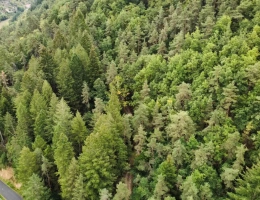
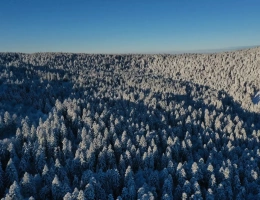
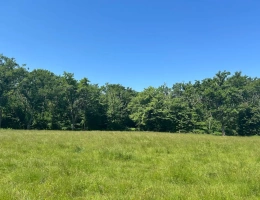
To find hunting property for sale in Drôme, it helps to think in terms of distinct areas, commonly counted as five, from the Drôme des collines to Drôme provençale. In the north, the hills and the Valence plain remain small game country, with pheasant, partridge and hare, and roe deer and wild boar in the woods. In the east, the Royans, the Vercors and the Diois offer mountain hunting: red deer, chamois, wild boar, black grouse and woodcock. In the south, the Baronnies, the Nyons area and the Tricastin take on a Mediterranean character, among oak woods, garrigue and lavender. Properties range from a hunting wood of a few dozen hectares to a mountain farm surrounded by forest; those listed by private sellers, estate agents and notaires are grouped with our nationwide hunting estate listings.
The data section below this introduction presents the forest prices recorded in Drôme and the official game bags, in which red deer and chamois feature prominently. You will then find a description of these areas and the checks specific to the department: ACCAs, cull plans, damage to orchards and fire risk.
A hunting estate is rarely valued with a single figure: its price adds up the value of the woodland, the ponds, the buildings and the shooting facilities. The statistics below give benchmarks for wooded land and ponds, based on sales actually recorded.
According to the ma-propriete.fr forest price observatory, built from sales recorded in the French DVF land registry database, the median price of a hectare of forest in Drôme was €2,489/ha in 2025*, across 65 sales, with an average of €2,850/ha. That puts the department below the Auvergne-Rhône-Alpes median (€4,057/ha) and below the national median (€4,936/ha). Year on year, the departmental median moved by +4.7%: a change to read with caution on fewer than a hundred sales, where a few large estates can shift the median. Over the more robust 2020-2025 period, 322 sales give a median of €2,686/ha for a median plot size of 4.2 ha.
| Indicator | Drôme (26) | Auvergne-Rhône-Alpes | France |
|---|---|---|---|
| Median price 2025 | €2,489/ha* | €4,057/ha | €4,936/ha |
| Average price 2025 | €2,850/ha* | €4,843/ha | €6,214/ha |
| Number of sales 2025 | 65 | 964 | 6,329 |
| Change in median 2024 → 2025 | +4.7%* | +1.3% | +1.9% |
| Median price 2020-2025 | €2,686/ha | €4,000/ha | €4,778/ha |
| Number of sales 2020-2025 | 322 | 5,257 | 35,100 |
Nationally, the price per hectare rises with size: the large properties that appeal to hunters sell for more per hectare than medium-sized woods.
| Size of forest sold (France, 2020-2025) | Median price | Number of sales |
|---|---|---|
| 10 to 20 ha | €4,010/ha | 3,161 |
| 20 to 50 ha | €5,330/ha | 1,850 |
| 50 to 100 ha | €6,810/ha | 581 |
| Over 100 ha | €7,361/ha | 320 |
Ponds trade at a very different level: with too few sales in Drôme, the benchmark is the regional median of €15,847/ha for ponds sold without buildings between 2020 and 2025.
On the listings side, 18 hunting properties are offered on ma-propriete.fr across France as of 2 October 2026, none in Auvergne-Rhône-Alpes at that date. Their median asking price is €888,000 for a median size of about 68 ha. These are asking prices for complete properties: they describe the supply on offer more than the average price of a wooded hectare.
* 30 to 99 sales: indicative value. Source: DVF (French tax authority), processed by ma-propriete.fr; forests of 1 ha or more, cadastral type woodland; ponds without buildings of at least 2,000 m²; July 2020 to December 2025; Moselle, Bas-Rhin and Haut-Rhin are not covered by DVF. Listings recorded on ma-propriete.fr on 2 October 2026.
The game bag records published by the French Biodiversity Agency (OFB) measure hunting pressure and, indirectly, the presence of big game. In Drôme, 1,067 red deer were taken in the 2024-2025 season, about 1.2% of the national total, alongside 3,889 roe deer and 12,392 wild boar.
| Species | 2021-2022 season | 2024-2025 season | Change |
|---|---|---|---|
| Red deer | 817 | 1,067 | +31% |
| Roe deer | 3,962 | 3,889 | −2% |
| Wild boar | 10,956 | 12,392 | +13% |
| Chamois | 328 | 240 | −27% |
Source: OFB, wild ungulates network, departmental big game bags (total culls, data published on data.gouv.fr).
On the Drôme side of the Vercors, around the Lente forest, beech and fir woods cover large blocks where red deer, chamois and wild boar are hunted by driving or stalking. The Vercors regional nature park oversees certain works, and the high plateaux, a designated nature reserve, have their own rules. Further south, the Diois, overlooked by the Glandasse cliffs, alternates pine, oak and upland meadows: red deer are well established, chamois hold the rock bands and black grouse are found on the ridges. A hunting estate in these areas is often a mountain farm with woodland and pasture; check winter access, whether the extraction tracks are usable and how undisturbed the lying-up areas are, as summer visitor numbers are high.
In the north, between Hauterives, Romans-sur-Isère and the Valence plain, oak and chestnut woods, crops and orchards make up mixed ground where small game still has its place, with partridge, pheasant, hare, quail and skylark on the plain alongside roe deer and wild boar. Properties are modest in size and often attached to a farm. In the south, Drôme provençale is a different world: holm and downy oak, garrigue, truffle oaks and lavender around Nyons, Buis-les-Baronnies and Grignan, where wild boar dominate the bag. The Saoû forest, owned by the Département, is a landmark between these two worlds. Across the Rhône, hunting estates in Ardèche offer similar terrain.
In Drôme, most communes have set up an ACCA (approved communal hunting association) or an inter-communal association (AICA). An owner can only withdraw and run a private shoot if the land exceeds 20 ha in a single block; the right of opposition must then be exercised in the required form and timeframe, and the owner takes on game control on the land. Below that size, the wood you buy continues to be hunted by the communal association. Then ask the seller about the cull plan for red deer, chamois and roe deer, including the allocations and actual culls of recent seasons, and about wild boar damage in apricot orchards, Royans walnut groves or vineyards: if the holder of the hunting rights fails to keep the boar in check, they may have to answer financially for that damage.
Drôme is also one of the departments where the Forestry Code deems woodland particularly exposed to fire: around a hunting lodge in Drôme provençale, statutory brush clearance is a cost to budget for. For enclosures, the act of 2 February 2023 applies here as elsewhere: in natural areas, fences of 1.20 m at most, raised 30 cm off the ground and passable by wildlife, with fences erected since 1993 to be brought into line before 1 January 2027. Our guide to fences in natural areas explains the exemptions.
On ma-propriete.fr, hunting properties in Drôme are offered by private sellers, estate agents and notaires; sort them by size or budget and save an email alert to hear about new offers. If you are selling a hunting ground, you can publish your listing there. For a project that is mainly about woodland, see our forests for sale in Drôme; to compare with Isère, Ardèche or Savoie, see the hunting properties in Auvergne-Rhône-Alpes.