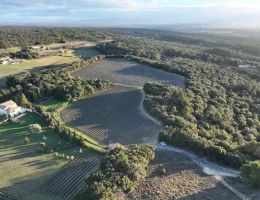
Acquiring one of the farms for sale in Drôme means choosing a climatic band before choosing an area: from the irrigated Rhône corridor to the lavender plateaux of the Baronnies, the same sum buys projects with nothing in common. The department has also built a strong identity around organic farming, so a great many holdings reach the market already certified, which alters both the value and the timetable for a buyer. The listings gathered here come from farmers winding up, from rural agencies, from local notarial offices and from handover advisers; they state the irrigation available, the plantings in place, the quality schemes and the tenure of the land, and join our selection of farms for sale in France.
What follows lights up the decision: land prices district by district, the productions that carry the department, the areas where holdings come free, and the checks without which an offer is a gamble. For projects still being shaped, our white paper « Créer une exploitation agricole » (in French) covers legal status, funding and the timetable for setting up.
Land forms the base of a farm's value. DVF, the property sales database published by the French tax administration (vineyards excluded), records a 2025 median of €8,000 per hectare in Drôme (26), an average of €8,181 and 63 sales; four transactions in five fall between €4,032 and €11,504, against a national median of €5,307.
The SAFER land value benchmark sets €7,190 per hectare for vacant land and pasture offered for sale in the same year, +5.9% over one year and +0.1% over ten, against €6,460 nationally. SAFER publishes no local figure for let land, too few sales being recorded; nationally, land sold with a farm tenancy in place trades at a discount of about 17%.
Against the Auvergne-Rhône-Alpes region, whose median is €3,887 per hectare, this department sits 106% higher. For commune-level detail and comparisons with neighbouring areas, see our land price observatory, then cost your purchase with our financial calculators.
Aromatic and perfume crops occupy the plateaux and sunny slopes of the south: lavender, lavandin, sage and lime blossom, on holdings whose value lies in the plantings, the still and the collection contracts as much as in the soil. Fruit-growing holdings — apricot, peach, cherry, walnut — crowd the Rhône terraces and the northern hills, where irrigation is indispensable. The Valence plain, a land of seed crops and varied market gardening, feeds a market in which land rarely stays available for long.
Livestock holds the higher ground: cheese-making goat units in the Diois and the hills, sheep flocks of the Baronnies and the Vercors run on rough grazing. The vineyard, split between northern slopes, the sparkling wines of the Diois and the Tricastin appellations, forms a compartment of its own, highly sensitive to the standing of each appellation. An agricultural property already farmed organically spares the buyer a conversion period: that advantage is priced in, but it is verified on the certificate, not on trust.
The Drôme des collines, around Romans and Saint-Donat, combines walnut groves, orchards and large cultivated blocks on molasse. The Valence plain, the most productive, faces competition from housing and Rhône-side logistics. The Diois, up the Drôme valley towards Die, lives on vines, goats and aromatic plants within narrow parcels. The Royans and the Vercors foothills belong to grass and forest. To the south, the Valdaine, the Tricastin and the Provençal Baronnies, from Grignan to Nyons and Buis-les-Baronnies, make up the country of the olive, the vine and lavender.
The highest values cluster on the irrigated terraces of the Rhône corridor and in the northern wine appellations, where supply is scarce and frequently settled before publication. The Baronnies, the upper Diois and the Vercors fringes leave more room for a measured project, with larger units but less certain yields and access that can be awkward.
Irrigation is what separates a viable orchard from a doomed one. Ask where the water comes from — gravity canal, groundwater abstraction, declared reservoir — what authorisation covers it, what volumes are allocated and what summer restrictions have applied. Then examine the age of the plantings, the replanting to be budgeted, the state of the netting and the frost protection: an orchard at the end of its cycle is bought at the price of the ground, not of a production asset. For vines and olives, whether the parcels lie inside the appellation area, and what planting rights attach to them, governs future returns.
The legal frame then applies: the sale is notified to SAFER, which holds a right of pre-emption; the right to farm, assessed against the regional structure plan applying in Auvergne-Rhône-Alpes; an agricultural lease protecting the sitting tenant, together with his priority to buy. If the holding is certified organic, transferring that certification requires a formal step with the inspection body: start it early, or the first harvest may lose its premium.
Sellers in this department do not always match the expected picture: alongside career farmers standing down, you meet recent entrants changing direction, couples who came from another trade, and plantation owners separating the house from the business. That variety explains how fast listings turn over. Combine the filters for production, irrigable area and budget, keep an e-mail alert running, or publish your holding if you are the seller. See also farms for sale in Auvergne-Rhône-Alpes.