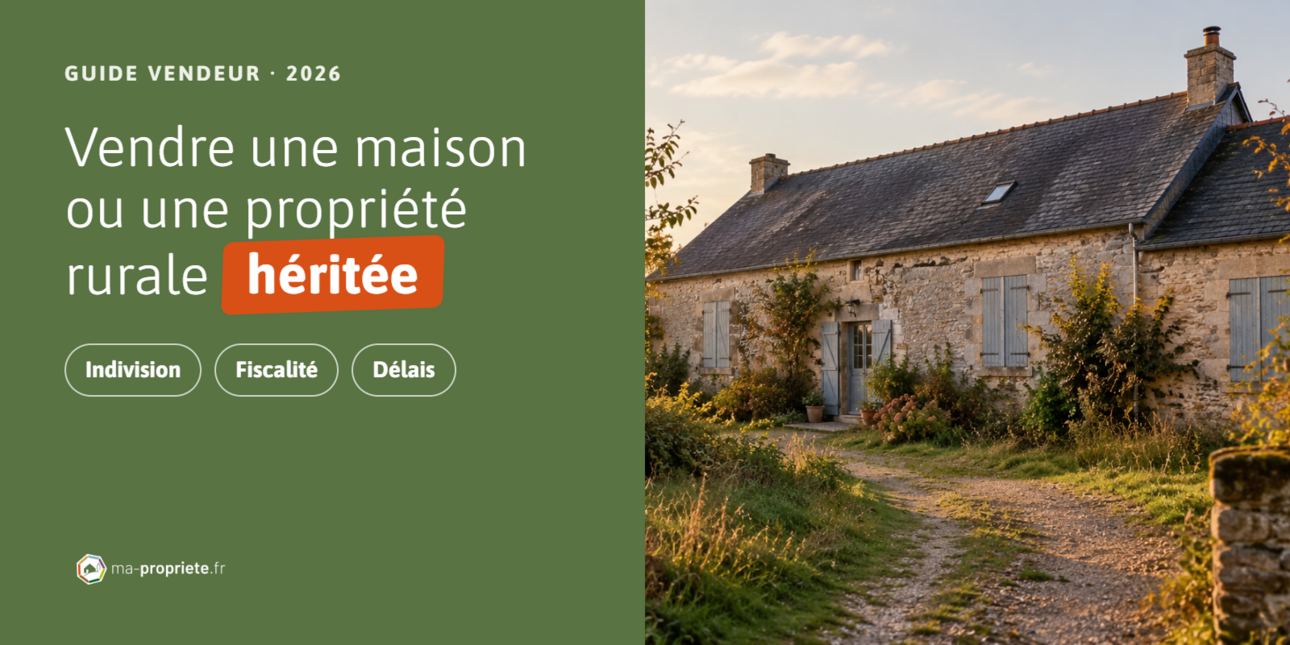
Every year in France, 519,000 homes change hands through inheritance. According to an INSEE study published in October 2026, 29% of these homes are sold by the heirs within three years of the succession. Selling an inherited house is therefore a common situation, but rarely a simple one: several heirs to bring into agreement, an estate to settle with the notary, specific tax rules and, in the countryside, regulations peculiar to farmland, woodland and agricultural buildings.
The typical heir's profile partly explains this tendency to sell: heirs are 54 years old on average, and 63% of heirs and donees already own their home before the transfer. The property received does not meet a housing need. When it is a country house, a former farm or a few hectares of woodland located far from where the heirs live, the question of selling arises very quickly.
This guide sets out the steps to follow, the obstacles to anticipate (particularly in joint ownership) and the points to watch that are specific to rural properties.
Contents
1. What INSEE reveals about what happens to inherited houses
2. Selling an inherited house: the stages of the succession
3. Selling a jointly owned property: unanimity, majority and the 2026 law
4. Valuing the inherited property: the succession value determines everything
5. Capital gains on an inherited property: how they are calculated
6. Land, woodland, farm buildings: the specific features of an inherited rural property
7. Vacant property and distant heirs: the cost of waiting
8. Sell, keep or let: the decision grid
9. Frequently asked questions
The study Insee Analyses No. 125 makes exhaustive use of the land files (fichiers fonciers) for the first time to track transfers of homes between 2018 and 2023. It records an average of 702,000 homes transferred each year: 519,000 through inheritance and 183,000 through lifetime gifts. The deceased is 78 years old on average, the heir 54.
INSEE also observed what had become of homes inherited in 2018, three years later:
|
Use of the home on 1 January 2022
|
Inherited homes
|
Gifted homes
|
|
Sold by the heirs or donees
|
29.4%
|
5.2%
|
|
Occupied by a previous owner (surviving spouse, usufructuary)
|
18.9%
|
17.7%
|
|
Let as a main residence
|
15.6%
|
30.3%
|
|
Main residence of an heir or donee
|
15.0%
|
19.6%
|
|
Second home
|
11.0%
|
14.4%
|
|
Vacant
|
7.8%
|
9.5%
|
What becomes of homes three years after their transfer (excluding "transferred again" and "other") — Source: INSEE, Insee Analyses No. 125, October 2026
Two lessons emerge. First, inheritance triggers a sale far more often than a lifetime gift: 29% resold versus 5%. A gift is usually a tool for planned transfer (often of the bare ownership, with the parents retaining the usufruct), whereas inheritance is a situation the heirs simply find themselves in. Second, nearly one inherited home in five is either vacant or used as a second home: this is often a waiting stage before a decision to sell.
One limitation should be pointed out: the study does not distinguish rural municipalities from towns, and it covers only homes (not farmland or forests). It is plausible that the share of properties sold or left vacant is higher in the countryside, where heirs rarely live nearby, but the published data do not allow this to be stated.
As soon as the estate includes real estate, going through a notary is compulsory. The notary draws up the act of notoriety (acte de notoriété, which identifies the heirs and their rights), then the property certificate (attestation immobilière), which records the transfer of ownership to the heirs and is published at the land registration office (service de la publicité foncière). Without this document, the heirs cannot prove they are the owners, and therefore cannot sell.
The inheritance tax return must be filed within six months of the death when the deceased died in metropolitan France, and within one year in other cases (Article 641 of the French General Tax Code). The duties are payable at that point, whether or not the house has been sold. When the heirs do not have the necessary cash, the notary can apply to the tax authorities for payment in instalments or deferred payment, or arrange for the duties to be settled out of the sale price.
Yes. There is no need to wait for the division of the estate to put the property on the market. Once the property certificate has been drawn up, the heirs can sign a preliminary sale agreement (compromis) and then the deed of sale, provided that all the joint owners agree. In practice, it is this last point that sets the timetable.
When there are several heirs, which is the case in the vast majority of successions (2.8 heirs on average according to INSEE when there is more than one), the property is held in joint ownership (indivision): each heir holds a share of the whole, with no exclusive right over any specific part.
Article 815-3 of the French Civil Code distinguishes two levels of decision:
This second point is essential for rural properties: letting land to a farmer under a rural lease (bail rural) requires the agreement of all the joint owners, just like a sale.
Lessons from experience: the joint owner who does not respond
During my years handling farm transactions, I came across many deadlocked joint ownerships, blocked not by an open refusal but by the silence of one or more heirs who did not respond to the others' requests. Without a response, no decision was possible.
The most frequent case involved the takeover of a farm where part of the land belonged to non-farming owners, in joint ownership. The incoming farmer needed certainty that he could buy or rent this land. On several occasions, the sale of the farm had to be postponed by several months while that certainty was obtained.
The verbal agreement of a few joint owners was never enough to secure the future tenant farmer. We systematically required a lease promise or a sale promise signed by all the joint owners. This is the direct consequence of the unanimity rule: a single absent joint owner is enough to make the lease or the sale impossible.
Bernard Charlotin, founder of ma-propriete.fr, real estate valuation expert
Since 2009, Article 815-5-1 of the French Civil Code has provided a way around the deadlock. Joint owners holding at least two thirds of the rights state their intention to sell before a notary. The notary serves notice of it on the others within one month. If they object or fail to respond within three months, the notary draws up an official report and the court (tribunal judiciaire) may authorise the sale, provided it does not cause excessive harm to the rights of the other joint owners.
There are two limitations: the sale then takes place by licitation (sale by auction), which does not guarantee the best price, and the procedure is excluded when ownership is split (usufruct and bare ownership), a frequent situation after the death of the first parent.
Law No. 2026-248 of 7 April 2026 aimed at simplifying exit from joint ownership brings two new features useful to heirs:
Before any court procedure, three amicable solutions exist: one heir buying out the shares of the others, selling only one's own share (the co-heirs then have a pre-emption right), or an amicable division, which allocates the property to one heir in return for an equalisation payment (soulte). As a last resort, any joint owner can request a court-ordered division, since no one can be compelled to remain in joint ownership.
The value declared in the succession is used twice. It is the basis for calculating inheritance tax, and it becomes the acquisition price used to calculate the capital gain on resale (Article 150 VB of the French General Tax Code).
Undervaluing the property reduces inheritance tax but increases the future capital gain, and exposes the heirs to a tax reassessment if the sale takes place shortly afterwards at a significantly higher price. The tax authorities then have an indisputable reference: the sale price itself. Overvaluing has the opposite effect. When a sale is planned in the short term, the heirs' interest is first and foremost to use a realistic market value.
For a rural property, the exercise is more complex than in town: the house, the outbuildings, the farmland (vacant or let) and the woodland are valued using different methods and in different markets. The price benchmarks published by our rural property price observatory and our observatory of agricultural land prices in France give an initial order of magnitude. For a composite or high-value property, a land valuation study or a valuation by a real estate valuation expert secures both the inheritance tax return and the asking price.
Unless one of the heirs has made it their main residence, the inherited house falls under the capital gains regime for private individuals:
Worked example
A longère (traditional long farmhouse) is declared at €180,000 in the succession; the deed fees and attributable duties amount to €4,000. The heirs sell it for €210,000 two years later. The taxable capital gain is €26,000 (210,000 − 184,000), with no allowance for the holding period. Income tax (19%) comes to €4,940, plus social security contributions.
Had the longère been undervalued at €150,000, the capital gain would be €56,000 and the income tax €10,640. The saving made on inheritance tax is largely clawed back on resale, with the added risk of a tax reassessment.
If the inherited land is let under a rural lease, the sitting tenant farmer has a pre-emption right provided he has been working in farming for at least three years and farms the land himself (Article L. 412-5 of the French Rural and Maritime Fishing Code). The notary must notify him of the price and terms of the sale. The current lease passes to the heirs and is binding on the buyer: let land therefore sells for considerably less than vacant land.
The sale of farmland, farm buildings and sometimes residential buildings forming part of a farm is subject to the pre-emption right of the SAFER (the regional land development and rural settlement agency) (Article L. 143-1 of the same Code). The notary notifies the planned sale, and the SAFER has two months to make its decision. This period must be built into the timetable from the signing of the preliminary agreement. The sitting tenant farmer's pre-emption right takes precedence over that of the SAFER.
When a property classified as woods and forests covering less than 4 hectares is sold, the owners of adjoining wooded plots have a right of first refusal (Article L. 331-19 of the French Forestry Code). The seller must notify them of the price and terms of the sale, and they have two months to come forward as buyers. The rule also applies to the transfer of undivided rights in such woodland.
Selling too quickly can be costly
Some rural properties benefit from partial exemptions from inheritance tax, subject to retention or commitment conditions:
Before signing a preliminary agreement, check in the inheritance tax return whether either of these regimes was applied.
According to INSEE, 8% of inherited homes are still vacant three years after the succession. For a country house, vacancy carries a cost that is rarely anticipated: insurance for an unoccupied property, property tax, grounds maintenance, minimal heating to prevent damp, and above all the gradual deterioration of the building. An old house left empty for two or three winters loses value, which reduces the final sale price accordingly.
The heirs' distance also complicates viewings and follow-up. We have detailed the solutions for selling a rural property remotely. Finally, it must be borne in mind that selling times are longer in rural areas than in town: waiting until the succession is settled before preparing the sale lengthens the vacancy period even further.
|
Criterion
|
Sell
|
Keep as a second home
|
Let
|
|
Agreement between heirs
|
Unanimity, or court procedure
|
Rules of use to be set (joint ownership agreement)
|
Two thirds (residential), unanimity (rural lease)
|
|
Cash required
|
None, frees up capital
|
High (costs with no income)
|
Possible works to meet standards
|
|
Day-to-day management
|
None after the sale
|
Shared upkeep, a source of tension
|
Substantial, or delegated to a managing agent
|
|
Suitable solution if
|
Heirs live far away or disagree
|
Family attachment and genuine use
|
Property in good condition, local rental demand
|
The three options for an inherited country house — Source: ma-propriete.fr
Keeping the property is not an absence of decision: it is a choice that commits all the joint owners over the long term. When one of them wishes to keep the house, buying out the others' shares is often healthier than prolonged joint ownership. If the property includes buildings, land and woodland, a sale in lots can also allow the family to keep the part it is most attached to.
They can delay it, but no longer block it indefinitely. Joint owners holding two thirds of the rights can have the sale authorised by the court (Article 815-5-1 of the French Civil Code), and since the law of 7 April 2026, the president of the court can authorise one joint owner to sell alone in an emergency. Expect several months of proceedings, however.
The duties are payable with the inheritance tax return, within six months of the death, regardless of the sale. The notary can, however, arrange for them to be paid out of the sale price, or apply for deferred or instalment payment.
If the sale price is close to the value declared in the succession, the capital gain is small or even nil. It becomes significant when the property was undervalued in the return, or when the sale takes place several years after a sharp rise in prices.
You need to add together the notary's time (drawing up the property certificate, often several months), the selling time itself, which is longer in rural areas, and the period between the preliminary agreement and the final deed, extended by two months when the SAFER pre-emption right has to be cleared. A year in total is a common order of magnitude when the heirs are in agreement.
Selling an inherited house is the most common outcome after a death: nearly one inherited home in three is sold within three years. In the countryside, the process combines three difficulties: the agreement of all the joint owners, a tricky valuation of composite properties, and pre-emption rights or rights of first refusal (tenant farmer, SAFER, neighbouring woodland owners) that lengthen timescales. Anticipating these points as soon as the succession opens, rather than when the property goes on the market, prevents the property from deteriorating and family relations from becoming strained.
When the heirs are ready, you can publish your sale listing to buyers who are specifically looking for rural properties.