
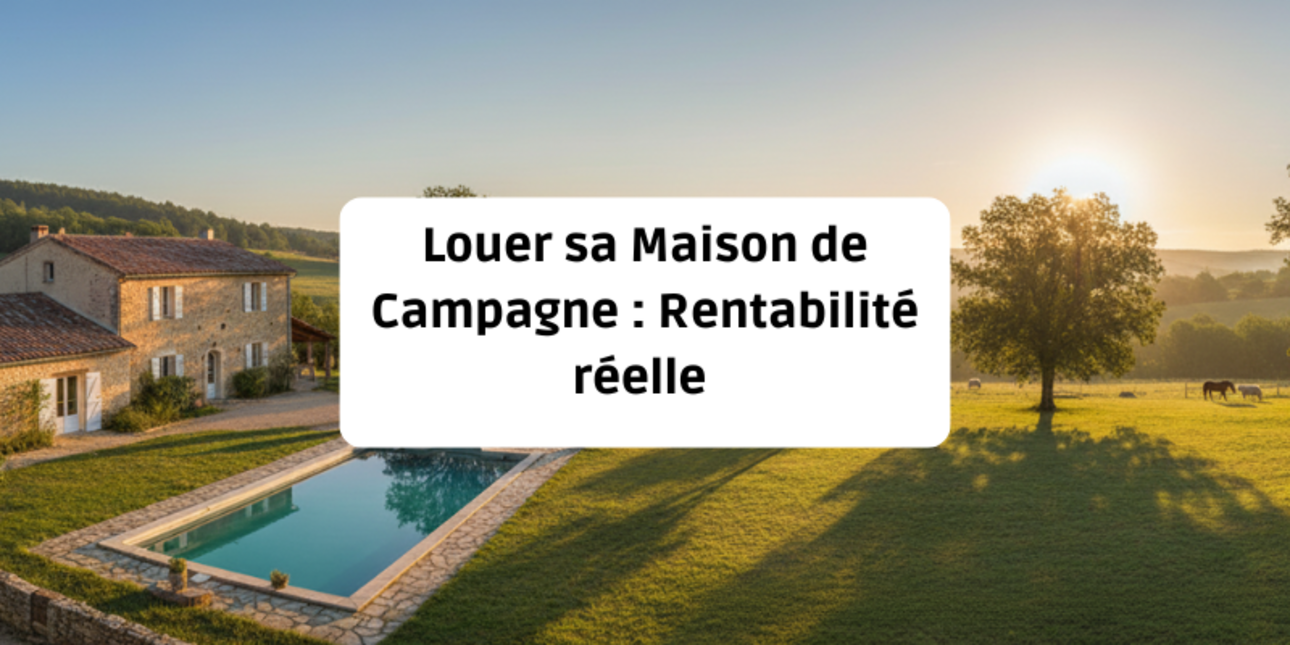
country house   

Renting out your country house: Real profitability and tips for financing your dream

Published at February 5, 2026 by Bernard Charlotin
Share
Renting out your country house: Real profitability and tips for financing your dream

This is the argument that often tips the scales when making a purchase decision: "What if we rent it out when we're not there?".
On paper, the idea is brilliant. Instead of leaving your beautiful house empty with closed shutters for 10 months of the year, you entrust it to families on holiday. The money comes in, pays the bills, and you enjoy your property for free the rest of the time.

But is it really that simple? Between the fantasy of the Airbnb "cash machine" and the reality of the expenses, what is the true profitability of a second home in 2025?

This report provides you with the key figures to build a realistic Business Plan. The goal is not necessarily to get rich, but to reach the "Break-even Point": the moment when your house completely self-finances.

Table of Contents
I. Rural Rental Potential: A market in transition
    Who are your customers?
    How much does it rent for? (2025 average rates)
II. The Economic Equation: Aiming for Self-Financing
Concrete Case Study
III. Key Success Factors (To rent for more and faster)
    1. The Swimming Pool: The income accelerator
    2. "Instagrammable" Decoration
    3. "Plus" Amenities
IV. Rental Taxation: LMNP and Deductions
    The Micro-BIC scheme (The simplest)
    The "Régime Réel" (The most optimized)
V. Managing Logistics: Alone or Accompanied?
Summary Table: Simplified Business Plan
Conclusion: Dare to rent, even just a little!

I. Rural Rental Potential: A market in transition

Forget the clichés. Vacationers are no longer just looking for the sea or the mountains. "Green Tourism" (Slow Tourism) has exploded. City dwellers are looking to disconnect, in a quiet setting, in authentic but comfortable houses.

Who are your customers?

  • Urban families: They are looking for a house with an enclosed garden (for children and the dog), a swimming pool (the absolute Holy Grail), and good kitchen equipment.
  • Groups of friends: They look for capacity (sleeps 10-12), a large living room, and no neighbors within 500 meters to allow for some noise.
  • Nomadic teleworkers: They rent off-season (May, June, September) for 2 or 3 weeks, provided there is Fiber internet and an ergonomic desk.

How much does it rent for? (2025 average rates)

Here are price ranges for a renovated 3-bedroom country house (6-8 people) with a garden:

  • Low Season (Winter/Autumn): €400 to €700 per week (difficult to rent).
  • Mid Season (May, June, September): €600 to €1,000 per week.
  • High Season (July, August, Christmas): €1,200 to €2,000 per week (if there is a pool: +30%).

II. The Economic Equation: Aiming for Self-Financing

Let's be clear: it is very difficult to pay off an entire 20-year mortgage solely with seasonal rentals of a country house (unless it is an exceptional property).
On the other hand, covering 100% of annual charges is a very realistic goal.

Concrete Case Study

Take the example of a house purchased in Sarthe or Yonne.

  • Your fixed annual charges (Property tax, housing tax, insurance, heating, garden maintenance, internet): Approximately €4,500 / year.

To pay these €4,500, how many weeks do you need to rent?

  • Average net owner price (after platform commission): €1,000 / week in summer.
  • Result: You only need to rent for 4.5 weeks per year (for example, 3 weeks in August + 1 week at Christmas + 2 weekends in May) so that your house costs you nothing in terms of current cash flow!

Everything you rent beyond these 5 weeks will be used to pay part of your mortgage or to finance future works (swimming pool, veranda).

III. Key Success Factors (To rent for more and faster)

Competition is tough on Airbnb and Vrbo. To stand out, your listing must check certain boxes.

1. The Swimming Pool: The income accelerator

In non-coastal rural areas, a swimming pool is the number one amenity.

  • Impact: It increases the weekly price by 30 to 40%.
  • Profitability: A €25,000 pool can pay for itself in 4 or 5 years thanks to the generated rental surplus.

2. "Instagrammable" Decoration

No more grandma's hand-me-down furniture and brown tiling from the 80s. Vacationers want "beauty".

  • Go for the "Country Chic" style: raw materials (wood, linen), light colors, visible wood stove, beautiful tableware. A nice photo of the living room can double the number of clicks on your listing.

3. "Plus" Amenities

  • Fiber Internet (Essential).
  • Table Football or Pinball (A huge hit for families).
  • Bicycles available (A real "zero carbon" marketing argument).

IV. Rental Taxation: LMNP and Deductions

The money you earn is taxable. However, France offers a very advantageous fiscal framework for furnished rentals: the LMNP status (Non-Professional Furnished Litterateur).

You have two main options for declaring your income:

The Micro-BIC scheme (The simplest)

  • You declare your gross income.
  • The state applies a flat-rate deduction of 50% (or 71% if your furnished property is "Classified as Tourism" by an official body). You are only taxed on the remaining 29% or 50%.
  • Tip: Get your furnished property classified (1 to 5 stars)! It's an inspection visit that costs €200 every 5 years, but the tax benefit is huge.

The "Régime Réel" (The most optimized)

  • You deduct all your actual expenses (mortgage interest, works, taxes, depreciation of the building walls...).
  • Often, this allows you to completely cancel out the tax on rents for years.
  • Constraint: You need a chartered accountant (approximately €400-600/year).

V. Managing Logistics: Alone or Accompanied?

This is the main hurdle: "Who is going to hand over the keys and wash the sheets?".

  • Option 1: Autonomy (You manage everything) ```
    • Maximum profitability (you keep 100% of the rent).
    • But a huge constraint: you must be on-site for every check-in/check-out. Impossible if you live 3 hours away.
    • Intermediate solution: Secure key box for self-check-in + local cleaning service provider.
  • Option 2: The Concierge Service (Absolute peace of mind)
    • They manage everything: listing, photos, guest messages, reception, cleaning, linen, small repairs.
    • Cost: 20% to 30% of the rental amount + cleaning fees paid by the tenant.
    • This is the recommended solution for a distant second home. Even after leaving a 25% commission, you earn money without lifting a finger.
  • ```

Summary Table: Simplified Business Plan

Example for a house purchased for €180,000 (€1,000/month mortgage), rented in mid-season.

Item

Monthly Amount (Smoothed average)

EXPENSES (Mortgage + Charges)

- €1,400

INCOME (Rental 10 weeks/year)

+ €850

ACTUAL SAVINGS EFFORT

- €550

Conclusion: Instead of costing you €1,400 per month, your dream house now only costs you €550 per month thanks to the rental. It becomes accessible!

Conclusion: Dare to rent, even just a little!

Do not see renting as a constraint, but as a project facilitator.
You don't have to rent all summer. By renting for just 3 or 4 strategic weeks, you wipe out your fixed charges. Your house becomes "free" to use.

It is often the key that helps convince your banker... or your spouse!

Return to main page: The Complete Guide to Buying