Updated on 2 June 2026 — this article now includes a section on land valuation based on the 2025 DVF data from our observatory of vineyard prices in France.
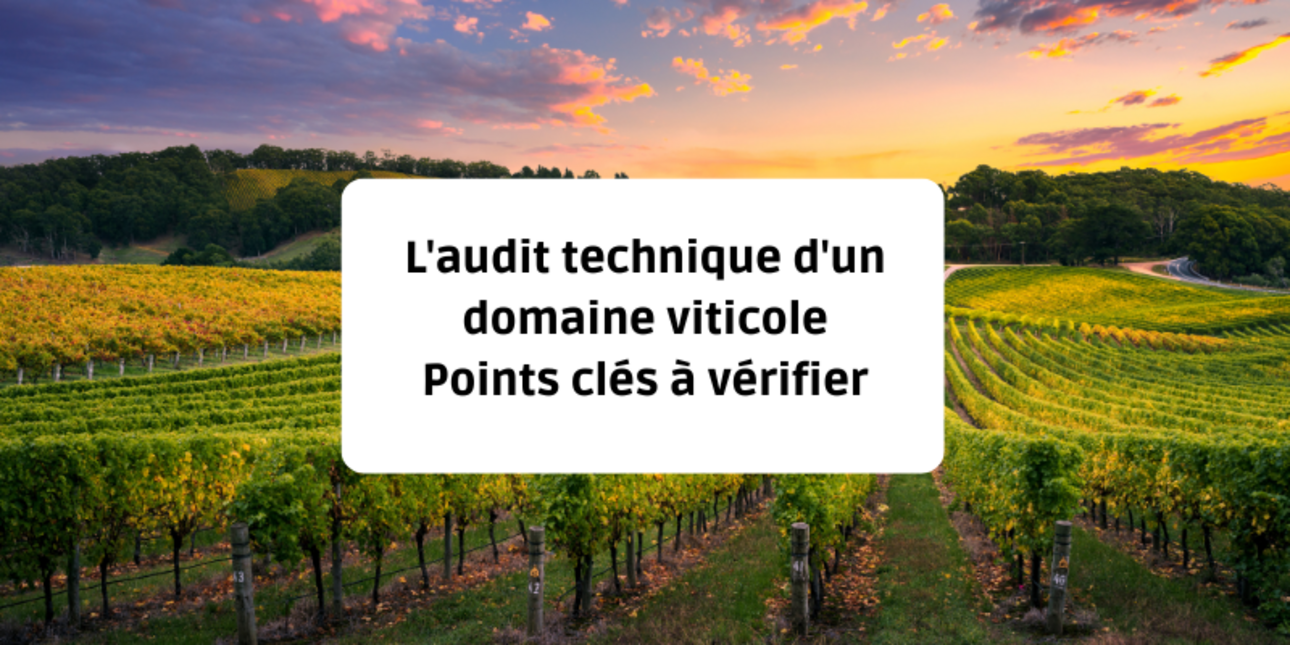
The technical audit is a crucial step in the process of acquiring a wine estate. It allows the potential buyer to thoroughly assess the condition of the estate, the quality of its production and its development potential.
This article details the essential points to check during a technical audit, in order to ensure a successful transaction and a sound investment in the world of wine.
Table of contents
Vineyard analysis
Condition of the vines and soil
Cultivation practices
Assessment of production facilities
The cellar and winemaking equipment
Traceability and control tools
Oenological analysis
Wine tasting
Laboratory analyses
Assessment of development potential
Production capacity
Improvement opportunities
Land value: checking the consistency of the asking price
Regulatory and legal aspects
Compliance with production standards
Rights and easements
Conclusion
Learn more
Assessing the condition of the vines is essential to determine the future quality of production. The following should be carefully examined:
A vineyard expert can carry out an in-depth soil analysis to assess its fertility and its ability to produce quality grapes. This step is essential to understand the estate's potential and to identify any problems to be resolved.
The audit must also address the cultivation practices used on the estate:
This information makes it possible to assess the sustainability of the practices and their impact on the quality of the grapes produced.
The audit must include a thorough inspection of the cellar and winemaking equipment:
It is important to verify that these facilities are suited to the estate's production volume and make it possible to produce quality wines.
As part of the audit, the traceability and control systems in place should be examined:
These elements are essential to ensure regulatory compliance and to optimise the management of the estate.
An important part of the audit consists of tasting the wines produced by the estate:
This tasting makes it possible to appreciate the overall quality of the production and its alignment with market expectations.
Laboratory analyses can complement the tasting:
These analyses provide objective information on the technical quality of the wines and their compliance with current standards.
The audit should make it possible to assess the estate's current production capacity and its potential for increase:
This information is crucial for determining the estate's growth prospects.
The audit must also identify opportunities to improve quality and profitability:
These elements make it possible to assess the estate's potential for value enhancement in the medium and long term.
A rigorous technical audit must also include a check on the consistency between the asking price and the actual land market. Too often, intuitive estimates or outdated references lead to difficult negotiations, or even to overvalued acquisitions.
Our observatory of vineyard prices in France, based on DVF data (Demandes de Valeurs Foncières — land transaction declarations) and covering nearly 17,600 transactions (second half of 2020 to the end of 2025), provides an objective benchmark: the national median price of vineyards stands at €23,985/ha in 2025. This figure represents the median value of actual transactions — that is, the level at which half of all vineyard sales in France are concluded.
The hierarchy between vineyards is very pronounced. As 2025 benchmarks:
These DVF data measure the ordinary buyer's market based on actual transactions, and constitute a benchmark that complements SAFER valuations (which give more weight to prestigious appellations). If the asking price for the estate's land deviates significantly from these benchmarks, a precise justification is required — land that is free or leased (leased land is subject to a discount of around 18% according to SAFER), quality of the appellation, health of the vines, etc.
The audit must verify the estate's compliance with the production standards in force:
These checks are very important in order to avoid any future legal risk.
It is important to examine the rights and easements attached to the estate:
These elements can have a significant impact on the value and development potential of the estate.
The technical audit of a wine estate is a crucial step in the acquisition process. It makes it possible to thoroughly assess the condition of the estate, the quality of its production and its development potential. Checking the consistency of the asking price with market data — in particular the 2025 DVF median price of €23,985/ha at the national level — is an integral part of this audit and determines the quality of the negotiation.
It is advisable to call on experts (winegrowers, oenologists, lawyers) to carry out this audit in a rigorous and comprehensive manner. A well-conducted audit forms the basis of a successful transaction and a promising wine-growing project.