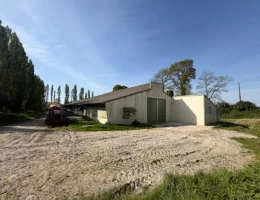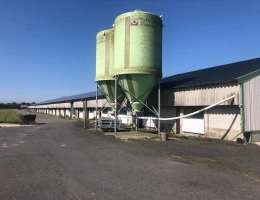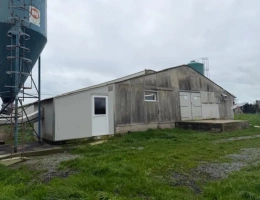
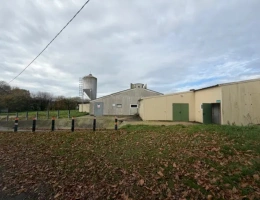
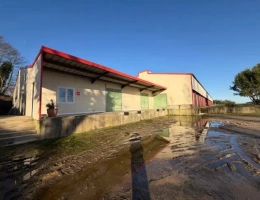
Brittany is France's leading poultry region, and the poultry farms for sale in Brittany cover every production: standard and label rouge broilers, turkeys, ducks, guinea fowl and laying hens. The listings gathered here, placed by farmers, rural agencies and notaries, state the building area, the production system and the producer organisation the unit belongs to. Together they make up the national offer of poultry farms for sale.
This page brings together what you need before buying or taking over a unit in the region: farmland prices, the departments where supply is densest, the condition of the buildings and the regulatory checks. To prepare a setting-up project, our white paper « Créer une exploitation agricole » (in French) describes the path from qualification to financing.
Land remains the largest item when buying a poultry farm. According to sales recorded by the French tax administration (DVF, vineyards excluded), the median price of agricultural land in Bretagne stood at €5,500/ha in 2025, with an average of €5,803/ha across 1,297 sales; 80% of transactions fall between €3,510 and €8,658/ha, against a national median of €5,307/ha.
The SAFER benchmark of land values (2025 figures) puts vacant land and pasture at €6,540/ha (+0.3% year on year, +16.8% over ten years), against a national average of €6,460/ha; land already let sells around 17% lower.
On a Breton holding, the difference rarely lies in the hectares alone. Most of the value sits in the buildings and their fittings: the condition of the frame, climate control, heating, silos, the biosecurity entry room and the washing area. To that you add the range attached to each house, the production contract or an established direct-sale customer base, the handling equipment and sometimes the replacement flock. To get your bearings, use our land price observatory and our financial calculators.
The region has large standard broiler houses as well as label rouge buildings with outdoor range, turkey and duck units and laying-hen houses in aviaries, on the floor or free range. Buyers look at the length and width of the building, its year of construction, ventilation, heating and insulation, the presence of a compliant biosecurity entry room and the condition of the silos. The density of downstream facilities, hatcheries, feed mills and abattoirs, is one of the region's lasting advantages: it secures outlets and limits logistics costs, which is reflected in the value of the holdings put on the market.
Most units work under contract with a producer group: the buyer should check the remaining term, the takeover conditions and the organisation's policy before committing. Organic units and farms selling direct are fewer and are valued separately, together with their customer base and processing facilities. Holdings comprising several buildings, land and a dwelling house naturally sell higher, but call for an item-by-item breakdown of the asking price.
Côtes-d'Armor has the highest density of units, around Loudéac and the Mené hills, with the whole supply chain nearby. Morbihan, from Pontivy to Josselin, combines poultry, pigs and crops, and regularly offers complete holdings with a dwelling house. Finistère, particularly in the Monts d'Arrée and around Morlaix, mixes poultry units with grassland, while Ille-et-Vilaine, closer to Rennes, offers more mixed holdings on dearer land.
Supply follows the age profile of the profession: handovers are frequent in the centre of the region and less common along the coast, where pressure on land limits the areas available. New entrants are therefore better served by widening their search to neighbouring departments than by focusing on a single area.
The density of units makes biosecurity and avian influenza prevention especially structuring: biosecurity plan, entry rooms, fencing and management of ranges and surroundings are among the basic checks. Depending on flock size, units fall under declaration, registration or authorisation as classified installations, and a change of operator must be notified to the prefecture. An old prefectural order may carry requirements that have become restrictive: it is worth reading before making an offer.
The second point is effluent management: spreading plan, storage capacity and nitrate vulnerable zones closely govern any extension project. Finally, land is expensive and often rented in Brittany: the rural lease continues with the buyer, subject to the landlord's agreement, and the transaction goes through the structures control and SAFER. The area available around the buildings governs spreading capacity, and therefore the potential to develop the unit.
The listings come from private sellers, rural estate agencies and notaries. Filter by department, area or price, set up an e-mail alert to follow new listings, and browse all farms for sale in Brittany.