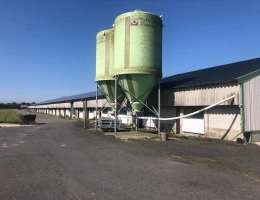
Taking over a poultry farm for sale in Finistère means settling in a department where poultry rarely stands alone: houses sit alongside pig units, dairy herds and, on the northern edge, field vegetables. Broilers, turkeys, ducks and laying-hen units make up a varied offer, from long standard buildings to small farmhouse sheds. Retiring farmers, rural estate agencies and notaries list their properties here with the covered area, the production system and the marketing organisation attached to the unit. Each one belongs to the wider national picture of poultry farms for sale.
You will also find the context a listing on its own never gives: where farmland values stand in the department, which areas see the most handovers, what condition to expect from buildings of a given age, and the checks the sector imposes. Our white paper « Créer une exploitation agricole » (in French) supports anyone preparing a project, from legal status to the funding package.
Land remains the largest item when buying a poultry farm. According to sales recorded by the French tax administration (DVF, vineyards excluded), the median price of agricultural land in Finistère (29) stood at €5,751/ha in 2025, with an average of €6,059/ha across 276 sales; 80% of transactions fall between €3,909 and €9,022/ha, against a national median of €5,307/ha.
The SAFER benchmark of land values (2025 figures) puts vacant land and pasture at €5,560/ha (+2.6% year on year, +16.3% over ten years), against a national average of €6,460/ha; land already let sells around 17% lower.
Acreage tells only part of the story on a broiler farm. Usable length of the buildings, ventilation and heating quality, silos and the feed chain, and a compliant outdoor range where the specification calls for one all count. So does the strength of the outlet: an integration contract, membership of a producer group, or a short-circuit customer base built over the years. Weigh the figure against our land price observatory, then run the takeover through our financial calculators.
The Finistère building stock went up in waves: narrow older sheds still in service, long standard houses from the decades that followed, and more recent buildings, better insulated and fitted with heat exchangers and automated climate control. On a visit, a buyer sizes up the frame, the roof, the cladding and the insulation, then the ventilation, the heating, the silos, the feed auger and the drinker lines. The condition of the concrete floor, the compliance of the biosecurity entry room and the presence of a washing bay decide how much must be spent before the first batch arrives. A poultry building already brought up to standard shifts the balance of the negotiation.
Value then rests on the outlet attached to the tool. Many Finistère units work under contract with a production organisation that delivers chicks and feed and arranges collection; the remaining term and the transfer conditions deserve reading before any offer. An egg farm, where laying hens are the whole business, is judged instead on its housing system and on the packing station that collects. Where the sale covers a dwelling house and land as well, ask for an item-by-item breakdown.
The centre of the department, around Châteaulin, Carhaix-Plouguer and the foot of the Monts d'Arrée, holds most of the indoor units and the downstream facilities that go with them. Further north, the Morlaix area and the Léon, from Landivisiau to Saint-Pol-de-Léon, combine poultry with field vegetables on land that is keenly sought after. Inland Cornouaille, from Rosporden to Quimperlé, offers holdings where the poultry unit rounds out forage ground. Around Quimper, Brest and the coast, farmland is scarce and prices markedly tighter. The pace of handovers varies noticeably from one canton to another, and patience often pays.
For a first purchase, inland communes away from the towns and the coast remain the most affordable: land is less contested and more buildings come free. Being close to a feed mill, a hatchery or an abattoir enters the calculation too, since it trims haulage costs and eases entry into a chain that is already organised. The trade-off between purchase price and day-to-day logistics is worth settling early.
A poultry unit falls under the French classified installations regime for environmental protection: depending on the flock present, it is subject to declaration, registration or authorisation, and any change of operator must be notified to the prefecture. Read the order in force, since older requirements can block a later extension. The biosecurity plan, the separation of zones, range management and the avian influenza measures are inspected regularly in western France, and a shortfall is put right at the buyer's expense. The flock register and the reports of the most recent veterinary visits are worth asking the seller for, alongside the batch records.
On land and effluent, check manure storage capacity, the spreading plan and whether the area is classed as a nitrate vulnerable zone, which governs any enlargement. Part of the ground is often rented: the rural lease carries on with the buyer subject to the landlord's agreement, and the deal goes through the structures control, the French authorisation regime for taking over farmland, and SAFER's pre-emption right. Have buildings, equipment and land valued separately rather than accepting a single figure.
Behind each property stands a farmer handing over, a specialist rural agency or a Finistère notary. Narrow the search by covered area, budget or production, switch on an alert so a new free-range poultry unit does not slip past, then widen the field to poultry farms for sale in Brittany.