
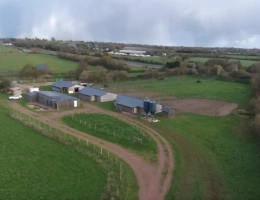
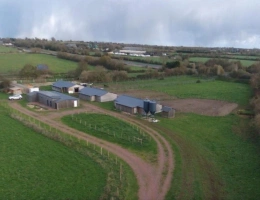
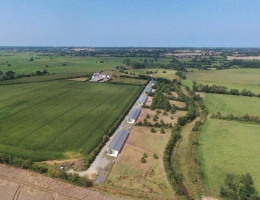
On a wide, open cereal plateau, a poultry farm for sale in Seine-Maritime often takes the shape of one or two houses standing within an arable holding, and less frequently that of a farm-scale unit run with outdoor range close to the towns. The properties come from farmers arranging a handover, from firms specialising in rural property and from notarial offices; the listing details the covered area, the age and fitting-out of the buildings, the production system and the channel that lifts or markets the batches. This department adds to the national record of poultry farms for sale.
Buying takes more than a listing. This page places farmland values across the Caux and Bray countries, shows where handovers appear, points to what a buyer should have surveyed on a chicken farm and sets out the obligations attached to the business. If this is a first venture rather than an expansion, our white paper « Créer une exploitation agricole » (in French) describes the route, from legal structure to financing.
Land remains the largest item when buying a poultry farm. According to sales recorded by the French tax administration (DVF, vineyards excluded), the median price of agricultural land in Seine-Maritime (76) stood at €11,543/ha in 2025, with an average of €12,013/ha across 209 sales; 80% of transactions fall between €7,594 and €17,090/ha, against a national median of €5,307/ha.
The SAFER benchmark of land values (2025 figures) puts vacant land and pasture at €11,600/ha (-0.3% year on year, +23.3% over ten years), against a national average of €6,460/ha; land already let sells around 17% lower.
Land explains only part of the price. What counts first is the usable length and insulation of the buildings, the ventilation and its controls, the heating and its energy source, the silos, the biosecurity entry room, the slab and the collection yard, then the cereals grown nearby to feed the unit and the strength of the contract behind the batches. An egg farm with its own packing room for table eggs, or a settled round of local customers, carries goodwill on top. Our benchmarks sit in the land price observatory and the financial calculators.
The Caux plateau saw standard broiler houses built on arable holdings, putting available labour and home-grown cereals to work. Alongside them stand a few label rouge buildings with range and laying-hen units on the floor or in aviaries, plus the occasional turkey or duck house. Examine the frame and roof covering, the insulation, the fan ventilation and its probes, the heating, the silos, the feed line and the condition of the slab; the sanitary break between batches only works properly in a building that can genuinely be washed down. A house already brought up to standard is not comparable with one needing roof, insulation and entry room renewed.
The legal form often changes the nature of the deal: many units here belong to a company that also holds the arable land, so the sale covers shares rather than walls. Ask for the detail of the integration contract or producer group membership, the remaining term and the transfer conditions. Where the sale includes a farmstead or a substantial house, separate the production tool from the residential buildings at the first visit: the two are neither valued nor financed in the same way.
The pays de Caux, from Yvetot to Fauville-en-Caux and Goderville, holds most of the department's indoor units: large field patterns, feed to hand, buildings that are generally newer. The pays de Bray, around Neufchâtel-en-Bray and Forges-les-Eaux, remains grass and dairy country, where poultry appears mainly as a complementary farm-scale unit. The Vexin normand and the Bresle valley towards Blangy-sur-Bresle offer a more scattered supply. The surroundings of Rouen, Le Havre and Dieppe face strong pressure on land, tied to housing and infrastructure, which makes farmsteads scarce.
This geography has a practical consequence: a free-range poultry holding with an outdoor run is more often found in the Bray and the east of the department, while contracted indoor units cluster on the plateau. The urban population along the Rouen-Le Havre corridor also supports direct sales of poultry and eggs, which adds value to holdings already established on the markets and in short supply chains.
Two subjects overlap here. First the classified installations regime: depending on flock size the unit is subject to declaration, registration or authorisation, a change of operator is notified to the prefecture, and both the biosecurity plan and the avian influenza measures must be current, Normandy lying on a monitored migration corridor. Then the ground itself: the pays de Caux is marked by underground cavities and old marl pits, recorded at the town hall, which can rule out putting up an additional building. Ask for the risk statement before any preliminary agreement.
Effluent management deserves the same care: parts of the department are classified as nitrate vulnerable zones, which governs manure storage, spreading periods and the areas to be mobilised. On the legal side, rented land remains under the rural lease, which continues with the buyer subject to the landlord's agreement, and the transaction goes through the structures control, the French authorisation regime for taking over farmland, then through SAFER, which holds a pre-emption right over rural property.
This Seine-Maritime selection gathers properties entrusted by private sellers, agencies specialising in rural property and notaries. Narrow it by building area, by budget or by the production you want, from a single shed to a complete holding with a house, and set up an alert to follow each new listing. You can also take in at once every poultry farm for sale in Normandy.