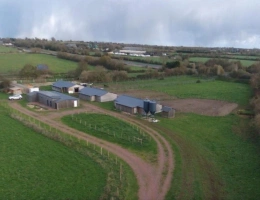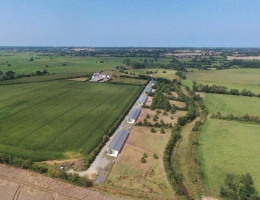
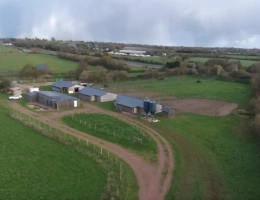
Taking over a poultry farm for sale in Normandy usually means a mid-sized unit set within a grassland or mixed farming system. The region raises broilers, turkeys and ducks and produces table eggs, with a well-established network of laying units and hatcheries. The listings on this page are placed by farmers nearing the end of their career, rural agencies and notaries, and state the building area, the rearing system, the land included and the partner organisation. They complete the wider offer of poultry farms for sale in France.
This page adds what a listing does not say: farmland prices across the region, the departments where sales cluster, how to read the condition of the buildings, and the checks specific to poultry. If you are building a setting-up project, our white paper « Créer une exploitation agricole » (in French) describes each stage, from the agricultural qualification to the funding plan.
Land remains the largest item when buying a poultry farm. According to sales recorded by the French tax administration (DVF, vineyards excluded), the median price of agricultural land in Normandie stood at €8,305/ha in 2025, with an average of €8,905/ha across 1,442 sales; 80% of transactions fall between €5,139 and €13,206/ha, against a national median of €5,307/ha.
The SAFER benchmark of land values (2025 figures) puts vacant land and pasture at €9,610/ha (+2.9% year on year, +17.2% over ten years), against a national average of €6,460/ha; land already let sells around 17% lower.
An asking price cannot be read off the land parcels alone. It reflects the built volume and its age, the ventilation and heating equipment, the silos, the biosecurity entry room, and whether there is an outdoor range and how well grassed it is. It also reflects the outlet: a live production contract, membership of a producer group, or an established customer base where the farm sells direct. To place a holding within its market, consult our land price observatory and stress-test your figures with our financial calculators.
What comes to market ranges from a single house attached to a grassland farm to a site with several broiler houses in a row, as well as laying aviaries. On a broiler farm, look at the structure and roof covering, the insulation, the ventilation method, any heat exchanger, the heating, the feed line, the lighting and the floor. Check that the entry room complies, and look at the washing area, rainwater management and heavy goods access. Where there is an outdoor range, the state of the grass cover, the rotation of the pop-holes and the drainage around the building say a great deal about how the site has been run and what work lies ahead.
Where the unit runs under an integration contract, check the remaining term, the conditions for transferring it to the buyer and the group's renewal policy. On the laying side, what matters is the production code, the agreement with the packing centre and the regularity of the batches. Farms that process on site or sell direct are valued separately, with their workshop, health approval and customer base. On a holding sold with a house and land, insist on a clear split between the dwelling, the farm buildings, the machinery and the parcels.
Orne and Manche carry a large share of regional production: the Orne bocage, the Perche and the Cotentin combine grassland with indoor units on land that is more affordable than elsewhere in the region. Seine-Maritime, from the Pays de Caux to the Pays de Bray, brings together laying units and broiler houses grafted onto arable or dairy holdings. Calvados, with the Pays d'Auge and the Caen plain, mixes small diversification units with more structured sites. The Eure, more arable in character, tends to offer buildings standing alone on large parcels.
Sales follow the age profile of the profession first of all, and it is well advanced in the bocage. They are scarcer near the coast and along the roads towards the Paris region, where demand for rural property lifts values. A buyer willing to move away from the coastline and the larger towns will find complete holdings at a markedly lower entry cost, with spreading area easier to assemble.
The classified installations regime applies according to flock size: declaration, registration or authorisation, with a duty to notify the prefecture of a change of operator. Ask for the full file, including any past inspections. The biosecurity plan, the entry rooms, the separation of clean and dirty routes and the protection of outdoor ranges are all scrutinised since avian influenza measures were tightened, a sensitive matter around the coastal wetlands and the Seine and Orne valleys.
The second strand is land. In Normandy a large share of it is rented: the rural lease continues with the new farmer subject to the landlord's agreement, and the deal goes through the structures control, the French authorisation regime for taking over farmland, and through SAFER. Check how much spreading area can genuinely be mobilised around the buildings, because it caps any extension. If you are applying for setting-up support, file before signature: the timetable has to be agreed with the seller from the first discussions.
The listings gathered here come from private sellers, rural estate agencies and notaries. Filter by department, production type or budget, set up an e-mail alert to follow new listings, then widen your search to all farms for sale in Normandy.