
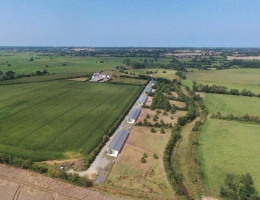
Supply of a poultry farm for sale in Manche stays modest, as befits a department where grass and milk shape the countryside. Birds are kept in enterprises grafted onto hedged livestock farms: chickens and guinea fowl housed with a range, ducks and festive poultry, and free-range laying flocks whose eggs supply markets, producer shops and coastal restaurants. Sales come from farmers handing over, rural property professionals and notarial offices, and state the covered area, how the flock is run and the marketing channel. For comparison, the directory of poultry farms for sale spans the whole country.
This page gathers what lets you judge an offer: farmland values in Manche, the districts where units are still found, the items to inspect on a building and its range, and the health and regulatory verifications that cannot be skipped. If you are building a setting-up project, our white paper « Créer une exploitation agricole » (in French) details the stages and the support available.
Land remains the largest item when buying a poultry farm. According to sales recorded by the French tax administration (DVF, vineyards excluded), the median price of agricultural land in Manche (50) stood at €7,735/ha in 2025, with an average of €7,788/ha across 411 sales; 80% of transactions fall between €4,957 and €10,831/ha, against a national median of €5,307/ha.
The SAFER benchmark of land values (2025 figures) puts vacant land and pasture at €8,150/ha (+1.0% year on year, +16.4% over ten years), against a national average of €6,460/ha; land already let sells around 17% lower.
Beyond area, value sits in the buildings and in the sales channel. Buyers look at the frame, the roof, insulation facing a very damp oceanic climate, ventilation and climate control, heating, silos, the biosecurity entry room, the bearing capacity and drainage of the range, the fencing and the shelters. On-farm slaughter and cutting rooms, cold stores, the health approval, local reputation and the regularity of the outlets all count too. To weigh it up, lean on the land price observatory and on our financial calculators.
Units here are seldom large: you mostly find mid-sized buildings, sometimes mobile houses for birds kept outdoors, and fixed houses attached to a farmstead. The damp climate calls for close attention to the roof, the insulation, the ventilation and the drainage of water around the building. Check the frame, the state of the floors and washable walls, the compliance of the entry room, the silo capacity, the water and electricity supply, and whether a back-up generator is present. A well-drained, shaded range divided into rotating paddocks is worth more than a larger area that lies waterlogged for part of the year.
Many holdings sell direct, and value then shifts towards the slaughter and cutting room, the cold stores, the preparation area, the approval and the trade built up at markets and with restaurateurs. A broiler farm of this kind changes hands with a goodwill element that has to be evidenced, by examining the accounts and the stability of the outlets. Where a farm is sold with house, buildings and pasture, ask for separate valuations: housing in Manche gains value quickly near the coast, regardless of the production tool.
The north of the department, in the Cotentin and the Val de Saire, combines vegetable growing, livestock and steady residential demand near the coast. The centre, around Saint-Lô, Torigni and the Vire valley, remains the heart of the dairy bocage: this is where convertible livestock buildings and complete holdings turn up most often. The Coutances and Mortain areas offer more isolated sites and more measured land prices. The Avranchin and the approaches to the bay of Mont-Saint-Michel pair active farming with strong tourist appeal, which lifts the price of anything built.
For a first takeover, the south-east of the department and the inner bocage give the best ratio between purchase cost and quality of the production tool. Coastal communes, from Granville to Barneville, tend to hold properties where the dwelling carries most of the price, with farm outbuildings that are hard to bring up to standard for keeping birds.
Classification under the French classified installations regime depends on the flock held: declaration, registration or authorisation, with the change of operator notified to the prefecture. On an outdoor holding, avian influenza prevention takes a central place, with housing periods, requirements on protecting feeders and drinkers and on fencing the range; a department this open to the coast and to wetlands faces added pressure from migratory birds. Ask for the biosecurity plan, the flock register and the inspection history before making an offer.
If the holding slaughters and cuts on site, check the approval or derogation in force, the rooms themselves, the cold chain and the handling of by-products. On land tenure, the rented share is substantial in the bocage: a sitting rural lease passes to the purchaser once the landlord consents, and the deal comes under the structures control, France's authorisation regime for farmland takeovers, and under SAFER. Lastly, make sure effluent storage capacity and the spreading plan fit the project you have in mind.
The files come from private sellers, estate agencies specialising in rural property and Norman notaries. Select area, budget and production type, including for a small broiler house rather than a full-scale unit, then schedule an alert so each new listing reaches you. Widening the search to the poultry farms for sale in Normandy multiplies the possibilities.