Looking for a poultry farm for sale in Calvados means prospecting a department shaped by milk and cider apples, where birds usually form a complementary enterprise: chickens and guinea fowl housed with access to a range, ducks and festive poultry in the Pays d'Auge, free-range poultry supplying producer shops and local restaurants with eggs. Farmers organising their departure, rural agencies and notaries place these properties, stating building area, husbandry system and, where one exists, the contract that secures the batches. The full picture of poultry farms for sale lets you widen the search afterwards.
A listing alone never settles a decision. Here you will find farmland values across Calvados, the districts where units are actually found, how to read a building and its range, and the checks specific to keeping birds. For a first setting-up project, our white paper « Créer une exploitation agricole » (in French) sets out the steps, from the funding plan to recognition of the agricultural qualification.
Land remains the largest item when buying a poultry farm. According to sales recorded by the French tax administration (DVF, vineyards excluded), the median price of agricultural land in Calvados (14) stood at €8,917/ha in 2025, with an average of €9,368/ha across 301 sales; 80% of transactions fall between €5,785 and €13,759/ha, against a national median of €5,307/ha.
The SAFER benchmark of land values (2025 figures) puts vacant land and pasture at €10,390/ha (+2.8% year on year, +30.0% over ten years), against a national average of €6,460/ha; land already let sells around 17% lower.
Outside the land, value here is built on tangible things: the condition of frame and roof, insulation suited to a damp climate, ventilation and climate control, heating, silos, biosecurity entry room, and the bearing capacity, drainage, shade and fencing of the range. Add membership of a quality scheme where it applies, the strength of the outlet, any processing equipment, and the goodwill attached to selling at the farm gate. To frame a budget, lean on the land price observatory and on our financial calculators.
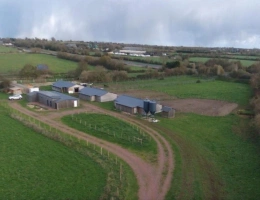
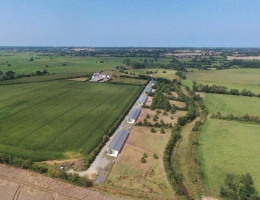
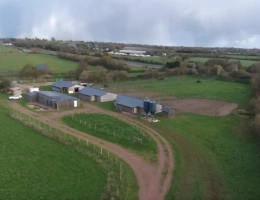
The department holds few very large sites and many mid-sized units, often grafted onto a grassland holding. A property here commonly combines one or two buildings, a wooded range and adjoining pasture. Look at the span and condition of the frame, the roof covering, the insulation, whether ventilation is natural or fan-driven, the heating, the capacity and access of the silos, the compliance of the entry room and the nature of the floors. The range deserves the same care: its bearing capacity, drainage, shade and the rotation possible between batches govern flock health as much as day-to-day working comfort.
How the flock is run drives the valuation. A unit under an integration contract is judged on the remaining term, the takeover conditions and the producer group's policy. A free-range poultry holding selling oven-ready birds counts instead on its health approval, its on-farm slaughter room, its cold stores and its trade. Where the sale includes a longère or an Auge-style farmstead, the dwelling often makes up a large share of the price: separate it from the production tool before you negotiate.
The Pays d'Auge, from Lisieux to Livarot and Pont-l'Évêque, remains grass, milk and orchard country; poultry units are scattered and farmsteads sell dearly, carried by residential and tourist demand. The Bessin around Bayeux, and the south of the department in the Bocage virois and the Pré-Bocage, offer more affordable sites and more functional farm buildings. The Caen plain and the Falaise country, given over to cereals, combine expensive land with very little livestock. The Vire and Orne valleys, by contrast, open onto a less pressured market.
For a new entrant, the south and west of the department are worth exploring first: land is more accessible, livestock buildings more numerous and complete holdings with a house more frequent. On the coast and in the northern Pays d'Auge, competition from second homes raises the price of the built element without improving the quality of the production tool, which quickly unbalances a takeover plan.
How the unit is classified under the French classified installations regime depends on flock size: declaration, registration or authorisation, with an obligation to notify the prefecture of a change of operator. Ask for the order, the latest inspection report and the biosecurity plan, and verify on site the separation of clean and dirty routes, the state of the range fencing and the measures keeping wild birds away, on which avian influenza prevention rests. In a department marked by wetlands and rivers, the position of the site relative to water catchment perimeters and flood-prone zones should also be established before any offer.
Next, question the status of the fields: many are rented, and a sitting lease carries over to the new farmer once the owner consents. The transaction falls under the structures control, the French authorisation regime for taking over farmland, and may give rise to SAFER pre-emption. Finally, make sure manure storage capacity and the spreading plan match the flock actually kept, otherwise any later increase will be refused.
This selection brings together private sales, mandates held by agencies specialising in rural property, and files from notaries. Set the filters on area, price and the production you want, save an alert to follow new sales, and when the department yields too few results, browse the poultry farms for sale in Normandy.