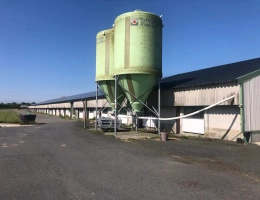
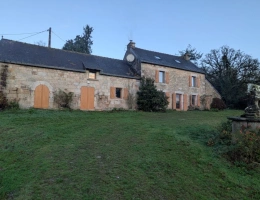
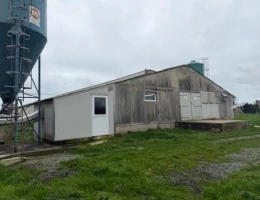
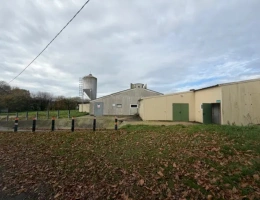
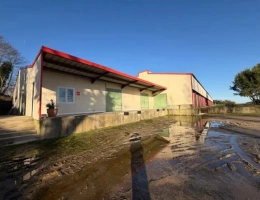
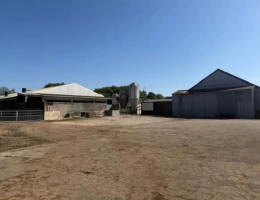
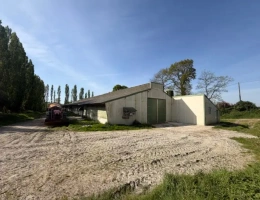
Buying a farm for sale in Brittany usually means taking over a business already running: an equipped milking parlour, a pig unit brought up to standard, contract poultry houses, a vegetable packing shed near the Channel coast. Buildings, livestock and supply contracts weigh more heavily in the price here than the hectares themselves, and the real question facing a buyer is whether the whole thing can be kept turning from the first season. Livestock farmers approaching retirement, notarial offices and advisers specialising in herd handovers describe each site piece by piece — area farmed, buildings, permits, machinery included — before bringing it to market. Their listings are then added to the nationwide inventory that makes up farms for sale in France.
Each Breton district is situated in the sections that follow: what land is worth from one department to the next, which sectors dominate, where retirements regularly free up sites, and what to inspect in a livestock building before committing — authorised capacity, slurry spreading plan, condition of the equipment, contracts that may transfer. Anyone setting up for the first time will find the legal and financial groundwork in our white paper « Créer une exploitation agricole » (in French).
Land forms the base of a farm's value. DVF, the property sales database published by the French tax administration (vineyards excluded), records a 2025 median of €5,500 per hectare in Bretagne, an average of €5,803 and 1,297 sales; four transactions in five fall between €3,510 and €8,658, against a national median of €5,307.
The SAFER land value benchmark sets €6,540 per hectare for vacant land and pasture offered for sale in the same year, +0.3% over one year and +16.8% over ten, against €6,460 nationally. Land sold with a tenancy in place is valued at €5,180, a discount of about 21%.
These figures place regional land values; they do not price a farm, which depends first on its buildings, its herd and its outlets. For department-level detail, see our land price observatory, then cost your purchase with our financial calculators.
| Department | DVF sales 2025 | Median price/ha | SAFER vacant land |
|---|---|---|---|
| Côtes-d'Armor (22) | 371 | €5,584 | €5,890 |
| Finistère (29) | 276 | €5,751 | €5,560 |
| Ille-et-Vilaine (35) | 357 | €5,100 | €5,280 |
| Morbihan (56) | 293 | €5,507 | €5,360 |
Dairying dominates the farmed area: dairy holdings occupy the bocage right across the region, with grass-based systems in the west and more maize in the lowland districts. Pig units and poultry enterprises form the second foundation, concentrated in the centre and south of the peninsula and tied to organised processing chains. On the northern coast, market gardening and field vegetables — artichoke, cauliflower, shallot, onion — occupy a belt of exceptional silty soils. Arable crops are grown mainly to feed the herds. Suckler herds are a minority here, found mainly on the least workable ground inland and in the Monts d'Arrée.
That structure changes how a property is assessed. A working farm is judged here on the condition and compliance of its buildings, its effluent storage capacity, its spreading plan and its supply contracts far more than on area alone. A sound takeover means gauging the age of the equipment, the cost of upgrades still to come and the strength of the outlets attached to the enterprise.
Finistère (29) holds the Breton extremes: the vegetable belt of the Léon, with deep soils and fiercely contested land, dairy and pig farms in the centre, the heath and grassland of the Monts d'Arrée, and a coastal strip under constant non-farming pressure. Côtes-d'Armor (22) adds dairy, pig and poultry enterprises on the inland plateau to vegetable growing around the Trégor and Paimpol, with some of the best-equipped structures in the region.
Ille-et-Vilaine (35) is the most dairy-oriented department, with extensive forage areas, cash crops in the south and east, and land values driven hard by the growth of Rennes and its road corridors. The Fougères and Vitré districts and the Bretagne romantique concentrate the most sought-after holdings. Morbihan (56) combines poultry and pig farming in the centre, around Pontivy, dairy systems in the Vannetais and inland, and a coastal fringe where farmland keeps retreating.
The widest supply comes from the interior of the peninsula — central Brittany, the Argoat, the Pontivy district, the Monts d'Arrée — where handovers are numerous and entry prices most contained. The Léon vegetable belt, the Rennes ring and the coast as a whole concentrate the highest values: land is scarce, parcels are fragmented and every hectare released draws several neighbouring applicants.
The whole region is designated a nitrate vulnerable zone under a reinforced action programme. That frames spreading periods and rates, requires cover crops between harvests, sets minimum storage capacity and caps the nitrogen applied per holding. On the coastal catchments affected by algal blooms, the requirements go further still, with reduction commitments and close monitoring of practice.
Most pig and poultry units fall under the classified-installation regime: declaration, registration or authorisation according to size. A change of operator must be declared, the orders in force should be read before an offer, and any future extension depends on the capacity available. Check also the setback distances, the spreading area genuinely available and the land made over by third parties, which does not always follow the sale.
Faced with a block of parcels, the first question is who occupies them. Where a tenant works the land, he is first in line to purchase it and, should he decline, may remain in occupation until his lease expires: real availability is read in the tenancy agreements rather than on the cadastral map, and a site sold vacant is not financed like one largely let.
The notary then informs SAFER Bretagne of every intended sale. That agency can substitute itself for the intended purchaser and redistribute the holding once candidates have been invited to apply, favouring young entrants quite openly. The regional structure plan adds a second filter, setting the thresholds above which a farming authorisation is required and watching closely any purchase of shares in farming companies. An agricultural property is judged partly on how solidly it clears that process.
The flow of listings follows the handover calendar, thickening as seasons end and retiring farmers, rural agencies and notaries across the four departments hand over their instructions. Sort the results by sector, department, area or price, then ask to be told by e-mail as soon as a matching site appears. Posting a listing takes a seller a few minutes. The national market stays within reach through farms for sale in France.