

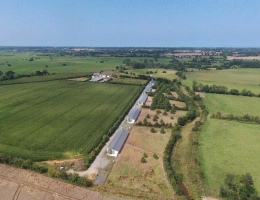
In few departments does a mild maritime climate shape growing so directly. A market garden for sale in Manche may be a sand-land vegetable farm on the west coast, an early-crop unit in the Val de Saire, a holding under cover supplying coastal markets, an ornamental horticulture business or a nursery serving garden centres and local authorities. The properties we publish are entrusted to us by growers preparing to stop, by rural estate agencies and by notaries of the Cotentin and the Avranchin; each listing sets out the growing structures, the irrigation and the sales channels. The department accordingly carries real weight in the national supply of market gardens and nurseries for sale.
This page goes further than a particulars sheet: land values across the department, the districts where holdings turn over most, how to read a set of tunnels exposed to sea winds, and the obligations that travel with a takeover, whether the ground is owned or rented. Before committing, read our white paper « Créer une exploitation agricole » (in French), which covers legal form, support schemes and start-up working capital.
Land value drives much of the asking price for a market garden or nursery. French tax transfer statistics (DVF, vineyards excluded) show, for 2025, a median of €7,735/ha in Manche (50), an average of €7,788/ha and 411 sales; 80% of transactions settle between €4,957 and €10,831/ha, against a national median of €5,307/ha.
On the SAFER side, the value of vacant land and pasture is set at €8,150/ha for 2025, moving +1.0% over a year and +16.4% over ten, against €6,460/ha nationally; expect an average discount of 17% where a lease is running.
Value here rests first on soil, on aspect and on equipment. Into the balance go the sandy or loamy texture of the plots, how early they crop, shelter from the wind, the covered area and the age of the tunnels, a secured water supply, washing and grading capacity, the cold store and the dispatch bay, and the goodwill too: a pitch on a market, a summer clientele, commitments to packers or to garden centres. Cross-check those pointers with our land price observatory before costing your plan in our financial calculators.
On the sands of the western shore, growing is mainly in the open field, with cold tunnels for early vegetables and a few multi-span houses. Wind sets the rules: check how the structures are anchored, the state of the hoops, how the films are holding, and the shelter belts and their upkeep. Sand calls for very responsive irrigation, so a licensed borehole, a verified yield and sprinkler or drip lines in working order. On the loamier ground inland, attention shifts to drainage and to whether the land carries machinery at harvest. In both cases, ask for soil analyses and the rotation history.
The packhouse often separates two otherwise similar holdings: grading and washing lines, a trimming bench, cold storage, a room approved for supplying customers direct, pallet handling. A greenhouse business in ornamentals is judged on other things, its benching, sub-irrigation, shading, container beds and, where there is one, its public retail area. When house, buildings and land are sold as one, ask for a written breakdown of the price, since funding terms differ with the nature of each component.
The sandy strip of the west coast, from Lessay through Créances, Pirou and Saint-Germain-sur-Ay, is the department's vegetable heartland, known for its sand-grown leeks and carrots; land there is sought after and rarely comes free. At the northern tip, the Val de Saire, around Quettehou, Réville and Saint-Vaast-la-Hougue, owes its name to how early its crops come in. The Coutançais and the country around Granville live partly off seaside trade. To the south, the Avranchin and the Mortainais, hedged and pastoral, run to small mixed holdings.
Pressure on land does not come from vegetable growing alone: dairy farming is strong here and coastal housing demand keeps prices up. Anyone setting up will more readily find acreage inland or in the south of the department, provided they accept later cropping ground and a longer run to the summer outlets.
On free-draining ground everything turns on water: have the source of the abstraction spelled out, along with the current licence, the volume allowed, the meter and the restrictions imposed in dry summers. Then look at where the parcels stand in relation to coastal planning rules and protected areas, which limit new building and the siting of permanent structures. Zoning in the local planning document deserves the same scrutiny near Cherbourg, Granville and Avranches, where housing demand puts some ground beyond reach for lasting agricultural use.
Legally, the sale goes through the structures control, the French authorisation regime for taking over farmland, and SAFER may pre-empt it; rented parcels stay covered by their rural lease. Verify the organic certification, how long it has run and whether it passes on, then the commitments made to buyers, which are sometimes personal to the seller. Finally, ask how seasonal workers are recruited and housed, a central question where harvesting on the coast is done by hand.
What you see here has been placed with us by owners selling up, by rural property professionals and by Norman notaries. Set your criteria for area, budget and district, create an alert to follow new listings, then open the search out to market gardens for sale in Normandy.


