

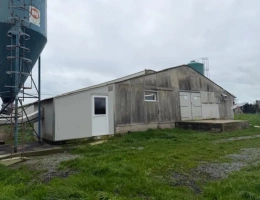
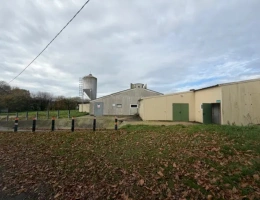
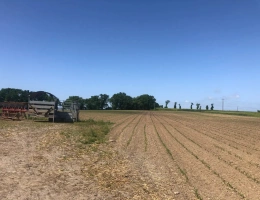
Looking for a market garden for sale in Côtes-d'Armor means turning to the northern shore of Brittany, where field vegetables have been grown for generations on the loamy coastal strip of the Trégor and around the bay of Saint-Brieuc. Cauliflower, artichokes, early potatoes and the Paimpol coco bean sit alongside tunnels of seasonal crops, ornamental growing sites and a handful of nurseries. The files reaching us come from growers organising their handover, from rural property firms and from notarial offices in the department; they set out the area worked, how much of it is covered, where the water comes from and which outlets take the crop. Each of them can be set against the wider list of market gardens and nurseries for sale.
Beyond the listings, this page gathers the bearings that are usually missing before a visit: what land is worth locally, the districts where holdings do come up, how to judge a set of structures exposed to the wind, and the checks a takeover calls for. For the project itself, our white paper « Créer une exploitation agricole » (in French) covers legal status, support schemes and start-up working capital.
Land value drives much of the asking price for a market garden or nursery. French tax transfer statistics (DVF, vineyards excluded) show, for 2025, a median of €5,584/ha in Côtes-d'Armor (22), an average of €5,872/ha and 371 sales; 80% of transactions settle between €3,914 and €8,226/ha, against a national median of €5,307/ha.
On the SAFER side, the value of vacant land and pasture is set at €5,890/ha for 2025, moving +1.9% over a year and +23.2% over ten, against €6,460/ha nationally; expect an average discount of 17% where a lease is running.
Beyond the hectares, what you pay for here is the cover and the post-harvest chain: tunnels anchored firmly against the gales, any multi-span houses, the drip network, a properly declared borehole, the grading shed, the cold store and the loading bay. Add to that the cooperative shares, the supply commitments, the customer base built up through direct selling and, for a plant nursery for sale, the value of the young stock still growing on. To place the land element, lean on our land price observatory and on our financial calculators.
Open-field growing dominates the local vegetable landscape, yet the operation is judged first on what surrounds the plot. Examine how the tunnels are anchored and how their end walls hold, since north-westerly winds test them hard, then the condition of the films and the venting, and, where the holding includes glass or multi-span houses, the boiler, the thermal screens and the climate control. Move on to washing and grading: washer, grader, netting or bin line, cold store, dispatch bay. An ornamental greenhouse business reads differently, through its benching, its shading, its sub-irrigation and its container beds.
The route to market then steers the valuation. A regular supplier to a dispatch cooperative draws its worth from volume, from consistency and from the shares attached to the holding; a farm delivering boxes, producer shops and school canteens is worth mainly the order book it passes on. Where house, buildings and land form a single lot, ask for the price to be split item by item: lending terms and the security demanded differ sharply from one element to the next.
The north of the department holds most of the production. Around Paimpol, Plouha and the Lézardrieux peninsula, ground worked close to the shore carries field vegetables and the coco bean, with dispatch cooperatives long established at Paimpol and Tréguier. The Trégor, towards Lannion and Plestin-les-Grèves, continues that coastal band under the same mild, damp climate. Further east, the rim of the bay of Saint-Brieuc, from Pléneuf-Val-André to Hillion and Lamballe, combines vegetables, protected cropping and direct selling into the Saint-Brieuc conurbation. Inland, from the Mené hills down to Loudéac, livestock and combinable crops take over and covered growing becomes scarce.
Along that coastal fringe, holdings change hands slowly and residential demand bears on values: well-exposed, irrigable ground does not trade at the level of land further inland, and newcomers rarely find a vacant unit waiting. Back from the coast, towards Guingamp, Quintin or Corlay, takeovers become more affordable, provided you look hard at the water supply, at the distance to the packing station and at the travelling time each harvest will carry.
The whole department is classed as a nitrate vulnerable zone: fertiliser planning, winter soil cover and spreading periods are regulated, and several bays fall under reinforced programmes tied to green algae strandings, with extra requirements on the catchments concerned. Check where the irrigation water comes from, whether the borehole is declared or licensed, the volumes genuinely available in late summer and how often restriction orders are issued. Near the shore, the coastal planning act sharply limits new building: extending a grading shed or putting up further structures is never a given.
The sale remains subject to the structures control, the French authorisation regime for taking over farmland, and SAFER may exercise its pre-emption right; rented parcels pass to you under their existing lease. Ask for soil analyses, for how long each parcel has held organic certification, and for the supply contracts together with proof that they can be transferred. Finally, weigh up seasonal recruitment and where the workers will sleep, a sensitive matter in the coastal tourist communes.
The holdings shown here are entrusted to us by sellers acting directly, by agencies specialising in rural property and by notaries based in the department. Match the search to the area you want, to your budget and to the district you have in mind, set up an alert so each new publication reaches you, then widen the view to the market gardens for sale in Brittany.


