

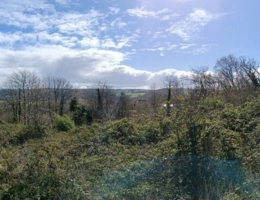
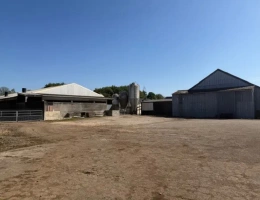
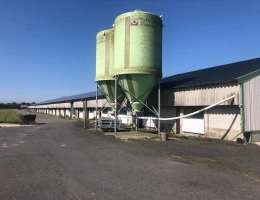
Looking at an arable farm for sale in Finistère means reading a department where grain mostly feeds livestock: wheat, barley, maize and triticale supply pig units, poultry houses and dairy herds, while the Léon plateau combines cereals with field vegetables. The files gathered here come from working farmers organising their handover, firms specialising in rural property and notaries in Quimper, Morlaix or Châteaulin; they set out the cropping plan, how much of the ground is owned outright, the storage capacity and the machinery included in the deal. You will also find them among the arable farms for sale listed across France.
This page adds what the particulars leave out: local land values, the districts where holdings change hands most often, how to judge a store exposed to a maritime climate, and the checks that apply to a crop farm in Brittany. If you are preparing a first entry into farming, our white paper « Créer une exploitation agricole » (in French) walks through the administrative and financial steps.
Pricing the land comes first in any plan to buy an arable farm. On the basis of 2025 DVF sales (vineyards excluded), the median in Finistère (29) works out at €5,751/ha and the average at €6,059/ha, across 276 transactions. The central range covering 80% of sales runs from €3,909 to €9,022/ha; nationally the median is €5,307/ha.
The SAFER benchmark, the market's second yardstick, gives €5,560/ha in 2025 for vacant land and pasture (+2.6% over twelve months, +16.3% over ten years), beside a national €6,460/ha; tenanted land is worth about 17% less.
Beyond area, equipment opens the gap: bins and a drier sized to swallow the harvest, a weathertight shed, drills and combines with life left in them, a maintained drainage network, blocks gathered around the yard, transferable basic payment entitlements and a delivery contract with a cooperative or a grain merchant. Nearby livestock units matter too, since they secure an outlet for the crop. An offer stands on firmer ground when our land price observatory and our financial calculators back it.
Silty soils formed over schist and granite carry decent potential, but depth changes quickly from one field to the next and waterlogging calls for drainage that has been kept up, especially in the valley bottoms. The standard rotation runs wheat, maize and barley, with oilseed rape less common and temporary leys where livestock still occupies part of the acreage. Steady rainfall usually removes the need to irrigate, so boreholes rarely come into the conversation, but it shortens harvest windows: a working drier then becomes a real selling point. Ask for soil analyses, a drainage plan and the yield records of recent seasons.
Buildings mix stone longères, converted cattle housing and steel-framed sheds. Check the roof structure, the covering, bin ventilation and the concrete apron, because salt air speeds up corrosion. A crop farm able to store its own harvest lets you pick your selling moment rather than delivering straight off the combine. Where the dwelling forms part of the lot, have it valued on its own: the residential market along the Finistère coast follows its own logic and would distort any comparison with farmland.
The Léon plateau, between Saint-Pol-de-Léon, Landivisiau and Plouescat, pairs vegetable growing with cereals on deep ground; demand is strong there and available acreage scarce. The Châteaulin basin, open and more even, holds a good share of the department's mixed crop and livestock systems, with collection silos close at hand. Towards Carhaix-Plouguer and the Poher, cropping supports the intensive livestock units of central Brittany. Inland Cornouaille, around Quimper, Rosporden and the pays bigouden, offers smaller holdings, while the Monts d'Arrée remain grassland country.
Pressure from neighbouring livestock farmers wanting to expand keeps values high, particularly where fields are grouped and easy to reach. Arable land in one block, served by a road lorries can use, finds a buyer quickly. Further inland, the fragmentation inherited from the hedged landscape leaves more room to negotiate, though you should cost out the travel between blocks before committing.
Every takeover goes through the structures control, the French authorisation regime governing entries into farming and expansion, and SAFER, the rural land agency, may pre-empt as soon as the notary notifies the sale. Work through each rural lease: remaining term, rent, environmental clauses, the sitting tenant's right of pre-emption. The whole of Finistère lies in a nitrate vulnerable zone, so the regional action programme sets spreading periods, cover crop obligations and effluent storage requirements, even where the grain is sold rather than fed on site. Confirm that manure plans exist and match the acreage.
Then make sure basic payment entitlements are transferred and declared within CAP deadlines, read the graphical field register to compare declared areas with advertised ones, and ask about commitments taken on under the water quality programmes that apply to the affected bays. Where the business is held in a company, the deal may cover shares instead of land, with tax treatment and warranties quite unlike a land purchase.
Long-established sellers, rural estate agencies and Breton notaries keep this selection moving. Adjust the area, budget or commune filters, switch on an alert so each new listing reaches you as it appears, and widen the search towards arable farms for sale in Brittany.


