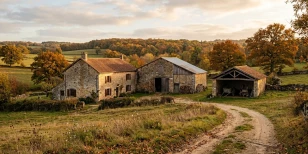

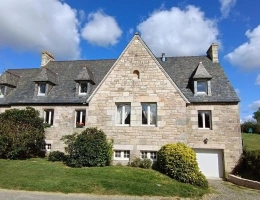

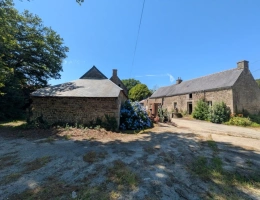
Brittany once had more than 6,000 mills, powered by water, wind and tide: it is now one of the French regions with the most mills for sale. This page brings together the mills for sale in Brittany published on ma-propriete.fr across the four departments: watermills to renovate inland, restored former mills with millrace and water wheel, flour mills converted into gîtes, tide mills on the Rance and windmills on the coast.
Below you will find the reference prices of the Breton rural market, an overview of the valleys and areas where mills are concentrated, and the criteria to check before buying. If your project includes tourist accommodation, our white paper on setting up a rural gîte explains the formalities, taxation and expected returns.
There are no official statistics dedicated to mills: sales are too rare and too varied (a ruin to restore, a habitable mill, a flour mill with a turbine). The most reliable market benchmark remains the price of country houses, which a habitable mill resembles, with a premium for the water, the character and the water rights, and a discount for the work required.
How much does a country house cost in Brittany? According to DVF data (notarised sales) analysed by the ma-propriete.fr observatory, the median price of a country house in Brittany stood at €210,000 in 2025, with an average price of €223,474 and a median price of €2,027/m² of living space (13,579 house sales in rural municipalities over the year). 10% of houses sold for less than €110,000 (floor price, 1st decile) and 10% for more than €355,291 (ceiling price, 9th decile). The typical country house offers 107 m² of living space on an average plot of 3,041 m², i.e. around 0.3 ha.
The region is above the national median (€189,200). Since the second half of 2020, the regional median price has risen from €166,465 to €210,000, i.e. +26.2%; over one year (2024-2025) the change is +3.4%.
| 2025 indicator | Brittany | France |
|---|---|---|
| Median price | €210,000 | €189,200 |
| Average price | €223,474 | €207,100 |
| Floor price (1st decile) | €110,000 | €90,000 |
| Ceiling price (9th decile) | €355,291 | €340,000 |
| Median price per m² of living space | €2,027/m² | €1,830/m² |
| Average living space | 107 m² | 108 m² |
| Average plot size | 3,041 m² | 3,181 m² |
| Number of sales in 2025 | 13,579 | 150,313 |
Differences between departments are significant: the median ranges from €185,000 in Côtes-d'Armor (22) to €220,000 in Morbihan (56). The table below compares 2025 prices and their change since 2020.
| Department | Median price 2025 | Average price 2025 | Median price per m² | Change 2020-2025 | Sales 2025 |
|---|---|---|---|---|---|
| Côtes-d'Armor (22) | €185,000 | €196,843 | €1,865/m² | +23.3% | 3,477 |
| Finistère (29) | €215,000 | €225,485 | €2,072/m² | +28.7% | 3,530 |
| Ille-et-Vilaine (35) | €215,000 | €221,534 | €2,054/m² | +21.5% | 2,996 |
| Morbihan (56) | €220,000 | €249,006 | €2,141/m² | +22.2% | 3,576 |
A regional average also hides large gaps between municipalities. A smallholding to renovate, a restored longère with its outbuildings, a farmhouse on several hectares of land or a manor house with parkland do not sell at the same price, and the location matters as much as the building: coastline, tourist area, peri-urban countryside close to a job market or deep countryside. The table below shows the median price of country houses in Brittany by type of municipality (cumulative sales from mid-2020 to 2025) and its change between 2021 and 2025.
| Type of municipality | Median price 2020-2025 | Median price per m² | Change 2021-2025 | Sales 2020-2025 |
|---|---|---|---|---|
| Tourist coastline | €280,000 | €2,738/m² | +12.1% | 9,739 |
| Residential coastline | €235,000 | €2,270/m² | +12.2% | 14,949 |
| Inland tourist areas (hinterland, mountains) | €120,000 | €1,270/m² | +8.8% | 406 |
| Peri-urban countryside (city catchment area) | €207,721 | €1,963/m² | +12.8% | 29,568 |
| Deep countryside (outside urban influence) | €155,465 | €1,565/m² | +16.9% | 34,594 |
These benchmarks help you assess a listing, estimate a property before putting it up for sale, or set your budget, whether you are looking for a holiday home, a permanent move to the French countryside or a property to turn into a rural gîte. To go further, see our observatory of country house prices in France (national, regional and departmental analysis, downloadable annual report) and work out the full cost of your purchase, including French notary fees, with our notary fees calculator.
Watermills make up most of the supply. They line the rivers of inland Brittany: the Aulne and Élorn in Finistère, the Blavet, Scorff and Oust in Morbihan, the Trieux, Léguer and Gouët in Côtes-d'Armor, the Vilaine, Couesnon and Ille in Ille-et-Vilaine. The Monts d'Arrée (the Kerouat mills at Commana) and the Nantes-Brest canal have remarkable groups of them.
Tide mills, a Breton coastal speciality, survive on the Rance, in the Gulf of Morbihan and on the abers of the Léon coast; they very rarely come up for sale. Windmills are concentrated on the coast and islands (Bréhat, Ouessant, Cap Sizun, the Rhuys peninsula) and around Fougères; most are sold as characterful outbuildings or small homes.
Finistère has the most secluded mills, between Carhaix, Huelgoat and Châteaulin, at contained prices. Côtes-d'Armor offers a good choice in the Trégor and around Guingamp, Rostrenen and Loudéac. In Ille-et-Vilaine, the Couesnon, Rance and Vilaine valleys between Fougères, Combourg and Redon appeal to buyers working in Rennes or Saint-Malo. In Morbihan, the Blavet and Oust valleys around Pontivy, Josselin and Malestroit remain the heart of the market.
Prices follow proximity to the coast and the main cities: a restored mill less than 30 minutes from Vannes, Rennes or Saint-Brieuc sells well above an equivalent property in central Brittany, where the best renovation opportunities are found.
The water rights (a mill fondé en titre or authorised), the condition of the millrace, sluices and weir, and ecological-continuity obligations on classified rivers determine both the value of the property and your plans, in particular any hydroelectric project. Water wheels, millstones and machinery are a heritage asset but also a renovation cost. At the bottom of a valley, damp, flood zoning, drainage and access must be checked before any offer.
The annexes (miller's house, barn, shed) and the land, often crossed by water, open the way to a gîte, guest rooms or an equestrian project: Brittany, France's leading region for rural gîte stays, offers a real outlet for this kind of conversion.
All the Breton mill listings published on ma-propriete.fr (private sellers, agencies, notaries) are accessible from this page and broken down by department. You can also widen your search to all rural properties for sale in Brittany: longères, farmhouses and riverside country houses often share the assets of a mill.